

OTTAWA — In several days, I will stand on Kinmen Island, a small Taiwanese outpost off the coast of mainland China, to assess the growing danger of a military attack ordered by Xi Jinping.
From Kinmen, the threat is visible.
The island lies just kilometres from the beaches of Fujian province, where Xi once served as governor. It sits on the front line of an unresolved struggle between the Chinese Communist Party and democratic Taiwan — one that has already produced artillery bombardments, military confrontations and generations of uncertainty.
The question today is whether Xi, having made Taiwan’s absorption into the People’s Republic of China central to his historical ambitions, is prepared to risk a war that could draw in the United States and destabilize the global economy.
It is a more complicated question than the familiar warnings about a Chinese invasion in 2027 suggest.
Xi has ordered the People’s Liberation Army to develop the capability to seize Taiwan by that year. But there is growing evidence that China’s military may be further from achieving Xi’s objectives than Beijing would like the world to believe.
Before I leave Canada to travel to Taiwan with a group of independent journalists, however, I find myself confronting another geopolitical question.
What exactly does Prime Minister Mark Carney believe Canada’s place in the world should be? And is he being transparent with Canadians about the real threats the nation faces, rather than the threats he wishes to see?
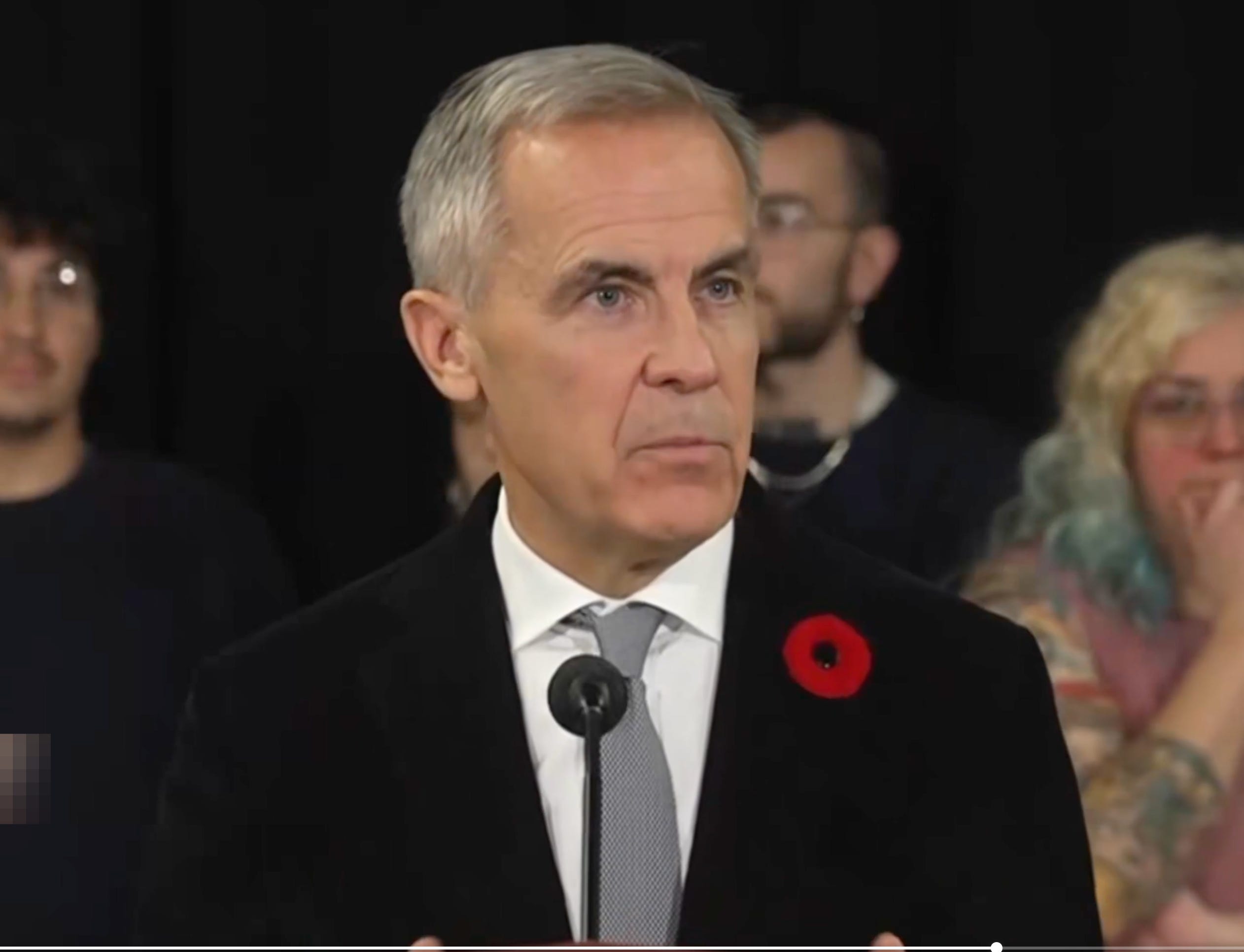
On November 10, ahead of his next meeting with Xi, Carney was asked about Safeguard Defenders’ findings on Beijing’s overseas repression network, reported by The Bureau days earlier. The findings identify at least 18 liaison points in Canada, operating through community associations linked to Chinese authorities.
The short English clip did not convey his full answer.
In English, Carney described the security risks of Canada’s partnership with China as “much, much, much, much less” than those of the United States.
His wording was careless. But his French remarks clarified the comparison. According to Carney, Canada faces much less risk in its relationship with China than the Americans face in theirs.
Whether Carney’s shifts between French and English reflected mere carelessness or a strategic effort to soften public criticism of China cannot be known.
Carney was asked about allegations that China’s clandestine machinery of policing and repression has continued to expand in Canada under his watch. At issue was whether his controversial strategic engagement with Beijing was imprudent and risked exposing Canada to greater danger.
The Bureau has repeatedly argued that this engagement does expose Canada to direct threats, beginning with the RCMP’s murky partnership with China’s Ministry of Public Security — the same Chinese policing apparatus implicated in Laura Harth’s reports on Beijing’s growing system of repression in Canada.
And Carney’s answer was demonstrably wrong.
Canada’s smaller role in world affairs and the Washington-Beijing rivalry does not protect it from the operations described in the report he was being asked about.
In fact, Canada has a disproportionate concentration of Chinese interference networks embedded in its institutions and communities, alongside a shamefully inadequate capacity to counter them compared with the United States.
Safeguard Defenders’ A Formula for Repression describes a system in which United Front-linked associations become overseas liaison points for Chinese police, prosecutors, courts and other authorities. These are not necessarily buildings with police signs. They are official relationships fostered by the Chinese Communist Party, through which Beijing can collect information, monitor dissidents, apply pressure and reach people through relatives in China.
As Laura Harth’s research explains, Beijing has been exporting its domestic “grid” system of community surveillance since 2014. The Party’s rapidly growing pool of affiliated associations provides potential liaison points beyond those exposed in Safeguard Defenders’ explosive 2022 reports. Those revelations prompted RCMP investigations in Canada, which have produced no charges.
In the United States, Harth’s work helped lead the FBI to a clandestine police station in Manhattan, whose operator was convicted in May. Evidence in the case revealed connections to Fuzhou police in Fujian province and a network that also reached Toronto.
Among the Western democracies studied, Canada is an outlier in its exposure to these Chinese Communist Party-linked groups.
The Jamestown Foundation study cited by The Bureau and in Harth’s new report identified at least 575 United Front-linked organizations in Canada and 967 in the United States — roughly five times the American presence per capita. The density directly challenges Carney’s reassurance.
The Bureau’s reporting has traced parts of this infrastructure through Fujian-linked business associations and an umbrella body whose leaders have attended United Front events in Beijing. Our reporting on election interference has examined overlapping organizational circles.
The Bureau assesses that some entities identified in Safeguard Defenders’ new research are likely connected to networks involved in election interference, including entities that may have participated in the intimidation of Conservative candidate Joe Tay. Those particular connections remain an assessment requiring investigation.
What happened to Tay is documented.
During the 2025 federal election — the election Carney won — Tay faced a transnational-repression operation identified by Canada’s election-security task force. He later told Parliament that the RCMP warned him of a credible threat and subsequently advised that it was unsafe to canvass.
There is another problem with Carney’s reassurance.
The United States has a vastly larger and better-resourced domestic counterintelligence and federal law-enforcement system, led by the FBI, and a record of bringing these operations into court.
In May, a federal jury convicted Lu Jianwang of acting as an illegal Chinese agent in operating a Manhattan police station, and of obstructing justice. His co-defendant, Chen Jinping, had pleaded guilty. These are judicial outcomes involving the overseas-policing system Safeguard Defenders exposed.
Former New York gubernatorial aide Linda Sun is accused of advancing Beijing’s interests, including obstructing contact with Taiwanese representatives, in exchange for benefits. The government’s case also identified unindicted co-conspirators who led community groups linked to the United Front Work Department.
Government exhibits also highlighted a convicted drug trafficker and human smuggler who, according to The New York Times, has been involved in significant election-interference operations in New York since his release. As The Bureau reported, he also hosted an event at which a covert Chinese intelligence officer operating from China’s New York consulate presided over the swearing of oaths by leaders of Fujianese United Front-linked community groups.
In The Bureau’s assessment, these groups form part of the same network at the centre of Laura Harth’s reporting on Beijing’s overseas police stations.
Last month, FBI agents arrested Wanying “Heather” Zhang, an Irvine realtor accused of surveilling the Seattle-area home of President Lai Ching-te’s son at Chinese officials’ direction.
Zhang also reportedly appeared at a San Francisco rally during Xi Jinping’s visit alongside a California group whose leader belongs to a community organization linked to the United Front Work Department. Human rights advocates reported that pro-Beijing groups gathered for the visit while pro-democracy protesters faced repression.
The Bureau’s examination of FBI filings also described alleged underground money transfers and an Arcadia property connection through her alleged surveillance partner. The charge remains unproven.
These distinct cases illustrate both the methods Canada faces and the American capacity to investigate and prosecute such activity.
But Canada has yet to bring comparable charges over the overseas police network described in The Bureau’s reporting. Mark Carney should explain why, even as his government pursues deeper engagement with the same Chinese Communist Party entities behind expanding transnational repression operations.
A More Dangerous World: Chinese Threats to Taiwan and Canada’s Stalled Trade Deal
The United States is Canada’s principal defence partner, its indispensable NORAD counterpart and its closest intelligence ally. Canada and the United States have spent generations building an integrated continental security architecture that cannot be replaced by a series of commercial agreements in Beijing.
China, meanwhile, is the authoritarian state whose intelligence services and political influence networks have been implicated in espionage, foreign interference and transnational repression directed at Canadians.
Canadian security agencies, parliamentary inquiries and the foreign-interference commission have documented these threats.
Carney’s search for more diverse markets has won wide support among Canadian voters. His standing in the polls also appears to benefit from his continued portrayal of the United States as an unreliable ally and even a growing threat.
His remarks to The New York Times about the “extreme tail risk” of U.S. military action against Canada raise questions about their logic and potential consequences.
Former NORAD commander Gen. Glen VanHerck questioned the premise, saying he saw no indicators beyond political rhetoric that such an attack was being considered.
