

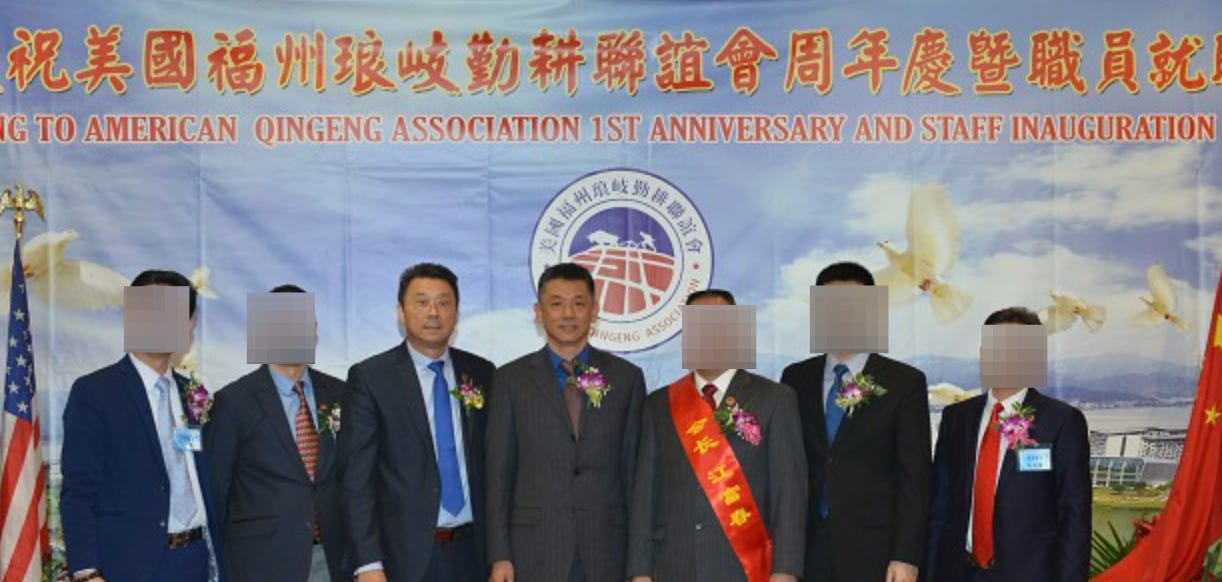
NEW YORK — In the final days of winter, in March 2019, Golden Imperial Court in Brooklyn staged a scene that carried extraordinary significance. At the head banquet table, raising a glass of red wine, was John Chan, the restaurant's owner. Seated beside him was Li Qing, a younger man from China's consulate in New York whose title was Overseas Chinese Affairs Officer. To Li's right was the president of the Fuzhou Langqi Friendship Association, marked by a red sash across his chest.
By then, Chan had completed a transformation unheard of in America’s Chinese diaspora. In 2008, after serving nearly six years in federal custody for his role in a major human-smuggling operation that ran through Vancouver and Belize into the United States — a case that also included allegations he threatened to have a witness killed, and admissions involving heroin trafficking and underground casinos in Manhattan — Chan had secured a remarkable plea deal.
After cooperating against another Asian organized crime figure, he regained his freedom and eventually emerged as a political kingmaker in New York, leading a network of Chinese community groups like the Fuzhou Friendship association.
At a certain point, the banquet gave way to ritual. The association’s incoming officers stood in a line, each holding a printed sheet, and read aloud in unison as Li Qing, microphone in hand, led them through a sworn oath. On its face, his consular role was to liaise with Chinese community organizations. But the ceremony’s true significance only comes into focus when court records are pieced together with Chinese community reports.
More than five years later, in the landmark prosecution of Governor Kathy Hochul’s former aide Linda Sun, Li Qing surfaced in an ominous light. Prosecutors alleged that he had been operating as an undercover officer for Beijing’s Ministry of State Security, the feared secret police service at the heart of the Chinese Communist Party’s global influence apparatus. FBI Special Agent Garrett Igo testified that Li was tasked with monitoring diaspora communities associated with what Beijing calls the five poisons, suppressing pro-Taiwan views, and cultivating access through appearances at public events attended by American political figures, including Linda Sun.
Igo also testified that he warned Sun directly of Li’s covert role during a 2020 interview. The government’s theory suggested a broader pattern. Under diplomatic cover, Li’s presence at diaspora banquets, ceremonies, and political gatherings was the extension of Beijing’s government into American communities — from voters right up to senior elected officials.
A final photograph from that evening at Golden Imperial Court captures the scene with unusual clarity. The room is mid-toast. John Chan — who told Judge Denny Chin in 2008, "I will never again break the law" — sits beside Li Qing at the head table, before hundreds of Fujian migrants in the United States. Bouquets, ceremonial Chinese dragons, and the flags of the United States and China frame the room. The association's new leadership has just been installed by a man prosecutors call an operative of Xi Jinping's secret police.
Congress Probes Tax-Exempt Status of Diaspora Groups
John Chan has been the subject of consequential reporting by the New York Times, which in December 2024 exposed his overt ties to Xi Jinping’s government and his alleged use of tax-exempt community organizations — groups that two powerful congressional bodies, the House Ways and Means Committee and the House Select Committee on the Chinese Communist Party, have since demanded that Treasury and the Internal Revenue Service investigate for potentially illegal political and election interference activity. Chan was reportedly interviewed by the FBI in 2024 but has not been charged with any offense.
The Times reported that Chan “has stood out nonetheless, both for his overt connections to the Chinese government and for his ability to influence American elections up and down the ballot. He has done it in part through a network of nonprofits that he and his allies control, directing money, staffing and votes to his favored candidates and organizing demonstrations against anyone opposed to Mr. Xi or his policies.”
It was in the context of that broader federal scrutiny that FBI Special Agent Garrett Igo, testifying in the landmark Linda Sun foreign influence trial, identified Chan by name as the prominent community leader standing beside Sun in a government evidence photograph — first reported by The Bureau — taken at a 2022 Brooklyn community event. A letter signed by Select Committee chair Representative John Moolenaar notes that United Front community groups conceal Ministry of State Security operations, and demands a briefing on New York’s network of these nonprofits from the executive branch by April 22, 2026.
The Bureau’s investigation reveals new cross-border details from Chan’s criminal past and his political present that are likely to be of direct interest to those investigators. They include significant connections to a Toronto Chinese-language media platform cited in the most prominent allegation of federal election interference in Canada’s 2021 federal election — a coordinated reputational attack against Conservative Member of Parliament Kenny Chiu.
They include detailed evidence of Chan’s central role in human-smuggling operations routed through the port of Vancouver, documented in part through Canadian police wiretaps entered as evidence in American federal proceedings — records obtained by The Bureau that are no longer publicly accessible.
And they include an extensive body of Chinese-language community records, cross-referenced against federal court exhibits and trial testimony from the Sun prosecution, that place a covert Ministry of State Security officer at the operational center of New York’s most politically influential Chinese diaspora network — performing institutional acts on behalf of the Chinese state, on American soil, across a documented period of more than two years.
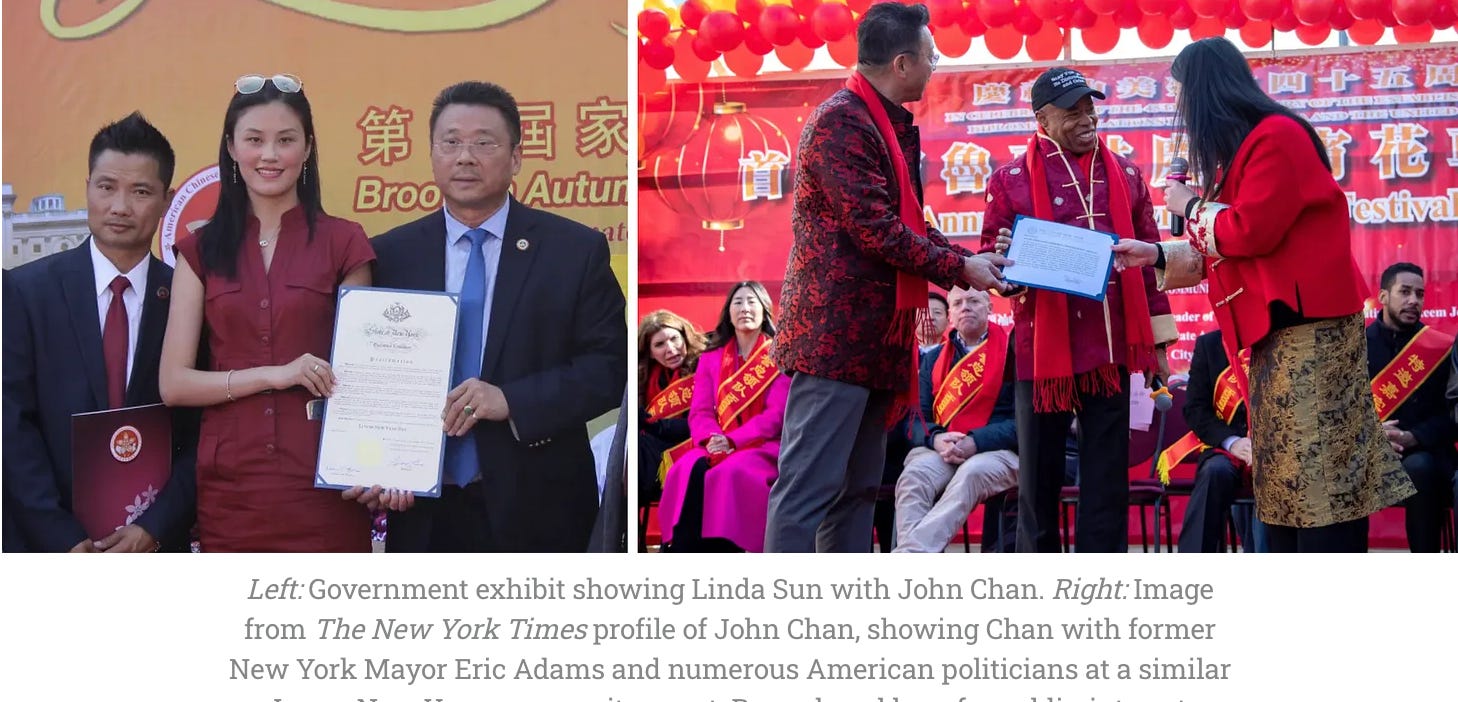
Among the American political figures documented sharing a public platform with that intelligence officer is Congresswoman Grace Meng — whose aide was separately identified by the FBI in the Linda Sun trial as a conduit in the United Front organizational chains connecting Chinese consulate officials to the governor’s office.
More broadly, what The Bureau has found documents a line from a Fujian organized crime network — tied to senior CCP officials and security arms in China, which controlled the arrival and indebtedness of thousands of migrants who would become the core population of New York’s most politically mobilized Chinese diaspora communities — through to the present-day election and institutional influence apparatus those same communities now anchor.
The man who appears at both ends of that Chinese-state-affiliated line — from the 1990s to the 2020s — is John Chan.
The people who climbed rope ladders onto his ships in international waters off the coast of South America in the late 1980s, who arrived in the United States indebted to his organization, who settled in the Brooklyn and Flushing neighborhoods his community groups now claim to represent — are the constituents through which the influence apparatus documented in this investigation operates. Their arrival was controlled by Chan’s criminal network. Their political identity, decades later, is organized by the groups he leads.
This is not an academic abstraction.
The specific nexus The Bureau has surfaced — sworn oaths administered by an alleged Ministry of State Security officer to leaders of tax-exempt United Front-linked community organizations now under congressional scrutiny, rooted in a legacy Fujian organized crime network whose human-smuggling operations shaped the very same demographic base of New York’s Chinese diaspora — has rarely been documented with this degree of primary source granularity. The evidence and intelligence drawn from American courts and a confidential Canadian government document illuminates how influence networks of this kind are constructed.
From the coastline of Fujian in the late 1980s, through the Triad-influenced transit state of Belize and the shipping yards of Vancouver, to the diaspora communities of New York and Toronto — where, decades later, leaders are sworn into office by alleged agents of the Ministry of State Security, among them Li Qing, operating under cover as an Overseas Chinese Affairs Officer, inside a Brooklyn restaurant owned by a man who once stood before a federal judge and admitted to smuggling thousands of Chinese migrants into America.
Chan, through his lawyer, has declined to discuss his criminal past with journalists from the New York Times. He did not respond to questions submitted by The Bureau to his lawyer of record in the federal proceedings cited in this story. That lawyer could not be reached after multiple phone calls from The Bureau.
The Network Intelligence Warned About
The scene at Golden Imperial Court in March 2019 did not emerge randomly.
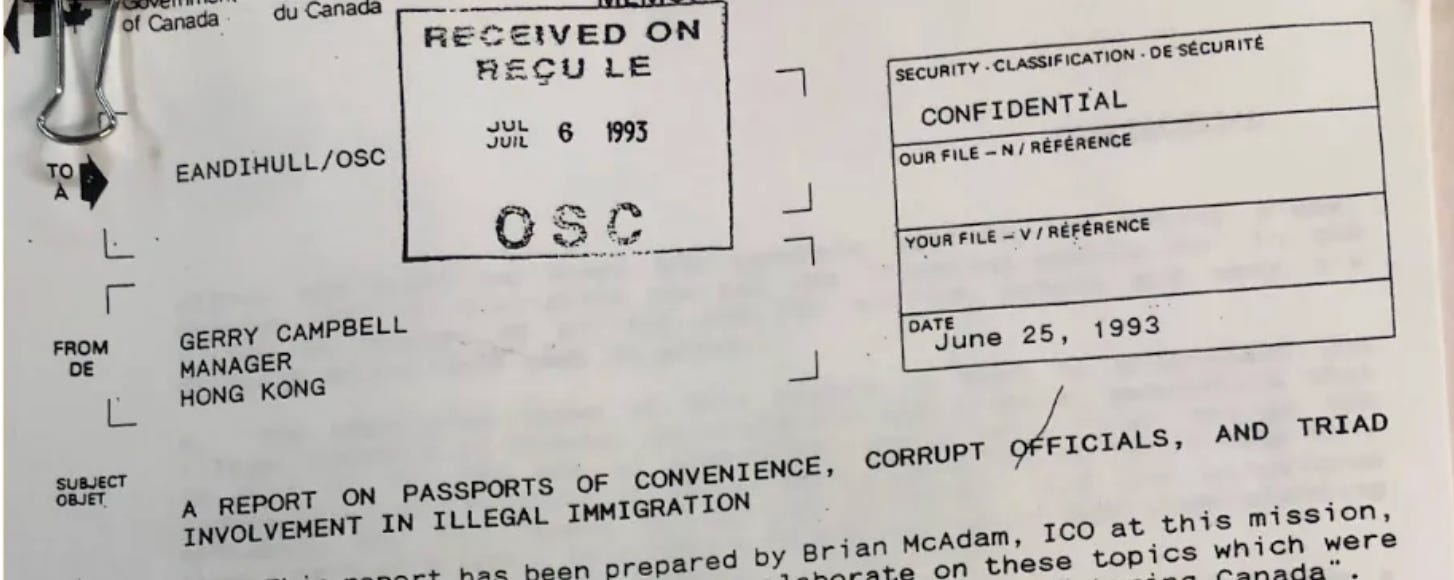
Its roots reach back more than three decades, to a confidential intelligence assessment that Canada’s consul in Hong Kong, Brian McAdam, filed with Ottawa in 1993. The 65-page report, titled “Passports of Convenience” and drawn heavily from American intelligence sources, described a criminal architecture that reached from Fujian Province through Hong Kong, across Latin America, and into the ports of the United States and Canada — one in which the Chinese Communist Party’s leadership in Fujian, Beijing’s security services, and Hong Kong’s Sun Yee On Triad operated in deliberate partnership.
The report cited American immigration authorities warning that “an underground community of smuggled aliens has been created in the United States which in many ways is subject to the control of Chinese criminal groups.”
More than 20 Triads and criminal gangs were involved in moving Chinese nationals illegally into the United States, American officials told their Canadian counterparts, and organized crime was using those migrants as soldiers in criminal activities once they arrived.
The Latin American corridor was central to the operation. Canadian files showed cabinet ministers of Belize involved in the sale of travel documents to Chinese nationals, while Triad leaders controlled chartered aircraft out of Belize to move those nationals into the United States and Canada. A 1995 State Department report, citing testimony from an American immigration lawyer who consulted for the Immigration and Naturalization Service, described the arrangement with still greater specificity: Taiwanese Triad members had effectively purchased the government of Belize and its minister for immigration, turning the country into an air gateway for illegal entry into the United States.
The financial mechanism that sustained the network was coercive by design. Smuggling fees ran as high as $50,000 per person, paid on credit — meaning migrants arrived in America already indebted to the criminal organization that moved them, at amounts the Canadian report said could equal 100 times a person’s annual salary in China. Those who could not pay faced torture, prosecutors would later allege in American courtrooms.
Bruce Nicholl, the former head of United States immigration operations in Hong Kong, cited in McAdam’s report, wrote that Chinese organized crime groups “simply do not recognize international borders or the legitimacy of governments which they merely see as targets for corruption.” They were based, he noted, just as much in New York, San Francisco, Los Angeles, Toronto, and Vancouver as in Hong Kong, China, Thailand, and Singapore.
That assessment, filed in Ottawa in 1993, reads today as a precise description of the network a federal grand jury would indict eight years later in lower Manhattan.
The Chan Organization
From 1989 through July 2001, according to a sealed complaint arising from an Immigration and Naturalization Service probe, John Chan, also known as “Ah Jong” and Chan Sin Chung, led a conspiracy to smuggle Chinese nationals illegally into the United States, operating across three continents and using Canadian ports as a transit corridor. Chan’s New York organization was embedded within the broader criminal structure of the Wu Li Kwan Triad.
The complaint, filed in the Southern District of New York, drew on four cooperating witnesses and a body of evidence that included Canadian wiretap intercepts, cargo container manifests, hotel records, airline tickets issued under false names, cellular phone records, and the business card of a Chan-owned restaurant recovered from a co-conspirator arrested at a Seattle shipping yard.
The Belize corridor that McAdam’s 1993 report had described — based on American intelligence and immigration files — was Chan’s actual operational route. One cooperating witness told investigators that in 1989, he and several relatives were smuggled out of China by Chan, routed first into Belize and then transported onward to the United States. While in Belize, according to records in the complaint, the witness encountered approximately 100 other Chinese nationals who, he learned, had also been moved there by Chan.
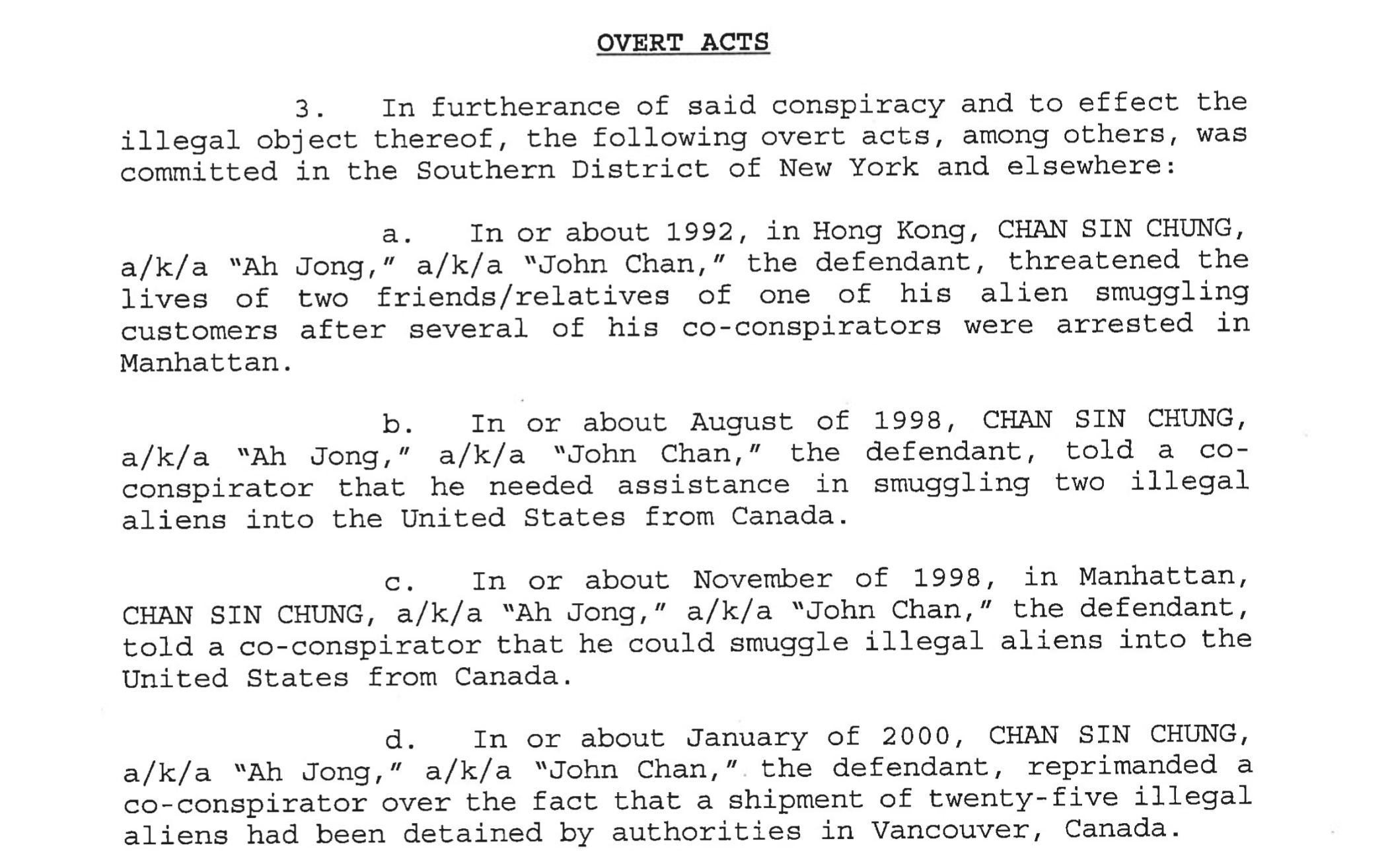
The Canadian dimension surfaced independently in both intercept evidence and witness accounts. In August 1998, Chan was intercepted on a wiretap conducted by Canadian authorities discussing smuggling activity with a co-conspirator. According to transcripts of that intercept entered into American federal proceedings, a conspirator said Chan needed help bringing two customers into the United States from Canada; calls were placed to a cellular number associated with Chan, after which Chan replied he had already taken care of it. In November 1998, in Manhattan, he told another individual that if he had people in Canada who needed to reach the United States, he could easily get them across the border.
The operation’s scale came into sharper focus in late 1999 and early 2000. On January 2, 2000, twelve Chinese nationals were found inside a cargo container at a shipping yard near Seattle aboard an Orient Overseas Container Line vessel, the OOCL Faith. The following day, approximately 25 more were detained by Canadian authorities in Vancouver after arriving aboard a second OOCL ship, the California Jupiter.
Chan was subsequently observed reprimanding a co-conspirator directly over the Vancouver detentions — placing him not merely as a participant in the network but as its supervising authority. Orient Overseas Container Line, known as OOCL, was a Hong Kong-based carrier founded in 1969 and acquired by the Chinese state-owned enterprise COSCO in 2018.
Canada’s Operation Sidewinder — a joint CSIS-RCMP intelligence report formally titled “Chinese Intelligence Services and Triads Financial Links in Canada” — had previously identified COSCO’s connections to Chinese Triad networks operating through Canadian ports. In January 2025, the United States Department of Defense designated COSCO a Chinese military company, noting that OOCL, as a COSCO subsidiary, fell under the same designation.
A business card for a restaurant owned by Chan was recovered in a search connected to the Faith episode — a detail that placed him at the operational center of a pipeline running simultaneously through Seattle, Vancouver, and Los Angeles. Prosecutors alleged that migrants smuggled into the Seattle area in containers in mid-1999 had died in transit, a fact the confidential witness at a Manhattan law firm had been warned about when assessing the risks of different ports.
A co-conspirator repeatedly visited the Manhattan law firm seeking representation for detained migrants, paying legal fees always in cash, sometimes sending associates to deliver payments while family members of other detained migrants came to the firm separately, also paying in cash. The co-conspirator complained on multiple occasions that the arrests were costing him a fortune, and told the firm’s witness that it was expensive to move people through China’s borders, and expensive to pay officials in China.
Among the most serious allegations in the complaint was one that predated the container arrests by nearly a decade.
In 1992, in Hong Kong, prosecutors alleged, Chan threatened the lives of two friends or relatives of one of his alien smuggling customers after several of his co-conspirators were arrested in Manhattan. Chan allegedly approached the individual in Hong Kong, told them the arrested men were his underlings, and stated that unless the charges in New York were dropped, he would have them and a family member killed.
Taken as a whole, the government’s narrative cast Chan as the network’s central node — coordinating routes through Hong Kong and Belize, running a Canada corridor, directing subordinates across multiple West Coast ports, and using cash payments, legal maneuvering, official corruption abroad, and explicit threats of lethal violence to protect a container-based smuggling pipeline in which people had already died.
It was, as McAdam’s 1993 report had characterized such networks, an operation that recognized no international borders, viewed governments merely as targets for corruption, and sustained itself through the coercive indebtedness of the very migrants it moved.
What Chan Said in Court
Prior to his January 2008 sentencing, Chan Sin Chung stood before a federal judge in the Southern District of New York and entered a guilty plea. The plea transcript, reviewed by The Bureau, records what he admitted in his own words, through an interpreter, in open court.
“In the government’s indictment against me, I was accused of the criminal activities of the Wu Li Kwan Triad,” he said.
“Since I’ve come to the U.S. together with a group of people, I have engaged in illegal but lucrative things. I am the head of this group. Then I engaged in smuggling people to the United States while knowing that they have no right of entry and I did that for financial gain. And with these few people, I engaged in heroin transactions of over three kilograms. And I’m also operating some gambling businesses. Some were in Manhattan, some were in Flushing.”
The judge confirmed each element. The sentencing hearing took place on January 15, 2008, before Judge Denny Chin. The government moved for a downward departure under Section 5K1.1 of the federal sentencing guidelines — the substantial assistance provision — in recognition of Chan's cooperation against others. The guideline range for his offenses was 262 to 327 months — between approximately 22 and 27 years in federal prison.
Judge Chin granted the motion. “I find that the defendant has provided substantial assistance to the government,” he said from the bench. “The results were quite good. The Ma organization was dismantled.”
Defense counsel Joel Cohen told the court that Frank Ma, the Chinatown organized crime figure against whom Chan had cooperated, was believed responsible for between 10 and 15 murders. Chan’s information had been the foundation for dismantling that organization.
Before sentence was pronounced, Chan addressed the court. “I want your Honor to know how much I regret the crimes that I have committed,” he said. “This is especially true about the crimes involving drugs. My only desire before I came here was to make money, and I didn’t really think about the people who were harmed by what I did.” He told the judge: “I will never again break the law.”
Judge Chin sentenced Chan to time already served.
Defense counsel Cohen informed the court that the government either had, or was about to, make an application for an S-visa for Chan, which would enable him to remain in the United States. Chan’s legal presence in the United States after his release, and the political career that was built on it, rested on that foundation.
Judge Chin closed the 2008 hearing simply. “Mr. Chan, good luck to you and your family,” he said.
The Rehabilitation
In 2022, a Toronto-based website called 51.ca published a lengthy Chinese-language profile of John Chan — a work of hagiography running to thousands of words across five chapters, portraying Chan as a neighborhood patriarch, a civil rights activist, a mediator of community disputes, and a man whose criminal case was, in essence, an act of retaliation from Washington for Chan’s temerity in organizing a protest against United States military action.
Notably, 51.ca is neither an obscure platform nor an American one.
Based in the Toronto suburb of Markham, it targets the large Chinese diaspora communities of Markham and Scarborough with significant reach. It is also a platform that Canada’s foreign interference commission — the Hogue Commission, which examined Beijing’s efforts to manipulate Canadian federal elections — placed under scrutiny in connection with influence operations targeting Chinese-Canadian voters.
Reporting around the 2021 Canadian federal election tied disinformation campaigns targeting Conservative Member of Parliament Kenny Chiu — a Hong Kong-born legislator who unsuccessfully tabled a bill prior to the 2021 vote calling for a foreign agent registry — to Toronto-area Chinese-language channels and accounts connected to the 51.ca network. Documents referenced in the commission’s proceedings linked those accounts to narratives attributed to Beijing’s United Front Work Department, the same apparatus cited in the American case against Linda Sun and her alleged New York community co-conspirators.
The 51.ca profile describes Chan’s early life in Fuzhou’s Langqi Island — the area that accords with the March 2019 event at Chan’s Brooklyn restaurant attended by alleged MSS officer Li Qing — his departure for Hong Kong at around 14 or 15, and his years running with street gangs. In a passage of heroification that registers like propaganda, the profile compares him approvingly to characters in the Hong Kong gangster drama “Young and Dangerous.”
Chan is portrayed as an entrepreneurial visionary who, in the late 1980s, joined several partners to spend $2.8 million purchasing a decommissioned 3,000-ton cargo ship in South America, then another $1.3 million refitting it. The profile claims Chan’s concept was to sail the vessel into international waters and operate a floating casino drawing passengers from around the world — but says the ship instead became an offshore staging point for migrants from Fujian, who took small fishing boats into open water and climbed rope ladders onto the larger vessel, seeking what the profile calls the American Dream. It does not use the word smuggling.
The profile’s account of Chan’s legal case is where the published narrative and the court record diverge most starkly. The piece claims that after Chan organized a protest following the 1999 NATO bombing of China’s embassy in Yugoslavia, authorities found a tainted witness and charged him with organized crime in what Chan viewed as retaliation. None of that language was apparent in Chan’s own words when he stood before Judge Denny Chin in 2008. The 51.ca report claims Chan was pressed to plead guilty and describes the resolution of his case as a mutual agreement in which both sides withdrew their claims.
The profile’s language is equally revealing in its depiction of Chan’s domain. His second-floor office at Golden Imperial Court, it explains, had become a de facto petition reception room for Brooklyn’s Chinese community — using the precise Chinese term for the formal petition system of the Chinese state. People arrived with problems that American judicial departments, law enforcement agencies, and government offices could not resolve. Chan listened. Chan advised. Chan picked up the phone and acted.
The profile also presents Chan as a godfather-style figure who mediates community disputes and lobbies American authorities when he believes Chinese interests are at stake.
As evidence of his reach, it points to an October 2021 march on Eighth Avenue in Brooklyn that it says Chan led to press for affordable housing, recounting how he framed the rally in civil-rights terms. “We are not the virus, and we can no longer remain silent. We must unite and make our voices heard,” Chan told reporters, according to the profile. The same demonstration, the piece claims, drew approximately 15,000 people, effectively shutting down a section of the city, drew backing from at least 200 affiliated community groups, and brought supporters in from Boston and Philadelphia as well as participation from non-Asian citizens and politicians.
Read alongside the federal court record — and alongside the photographs from the Golden Imperial Court, where a covert Chinese intelligence officer allegedly led community figures through their oaths of office — the profile describes something that resembles a parallel structure of authority, planted inside a Brooklyn restaurant, operating with a convicted Triad boss at its center. The rehabilitation did not stop with a Toronto diaspora website.
On January 9, 2023, the People’s Daily — the official newspaper of the Chinese Communist Party’s Central Committee — carried a profile of Chen Shanzhuang under the headline “Advocating for the Rights of Overseas Chinese,” sourced to China News Service, the Chinese government’s official overseas Chinese news agency.
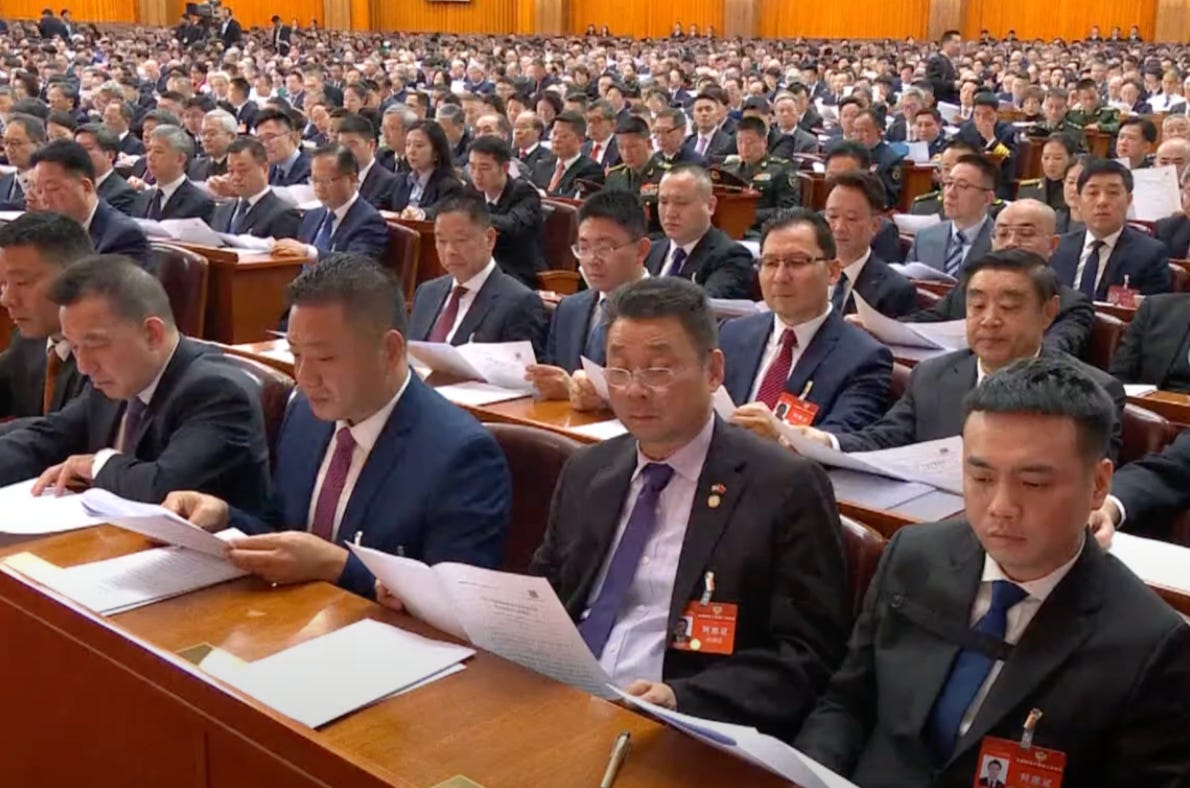
With that arc complete, Chan was not merely rehabilitated. He was righteous — and ready. In March 2024, he took his seat as the sole American diaspora delegate at a session of the body the Central Intelligence Agency identifies as the institutional heart of Beijing's global influence apparatus.
The New York Consulate Network
Beginning in 2018, a review of Chinese-language media records, official Chinese government publications, and diaspora archives documents a sustained and widening pattern of contact between John Chan and senior Chinese government officials — including figures later identified in American federal proceedings.