


OTTAWA — Four years ago, Laura Harth exposed more than 100 secret Chinese police stations operating across the democratic world, three of them in the Greater Toronto Area. Working independently, The Bureau later tied one of those Toronto-area sites, a Markham address under RCMP investigation, to a man linked to methamphetamine investigations in Japan, whom Tokyo police had also sought to question in an unsolved triple murder.
Harth’s research also led the FBI to a Manhattan storefront.
According to the United States government, Fujianese community leaders there were running a station for China’s Ministry of Public Security, and a Chinese police handler tasked the station’s operator with locating a pro-democracy critic who had fled China. This May, a Brooklyn jury delivered the first American conviction of its kind, of the Fujian-born man who ran the operation.
Governments, Ottawa among them, said they had responded to Harth’s work by shutting the stations down.
Her new report says the diaspora spying system behind them, aimed at the more than 60 million people Beijing counts as “overseas Chinese,” never closed.
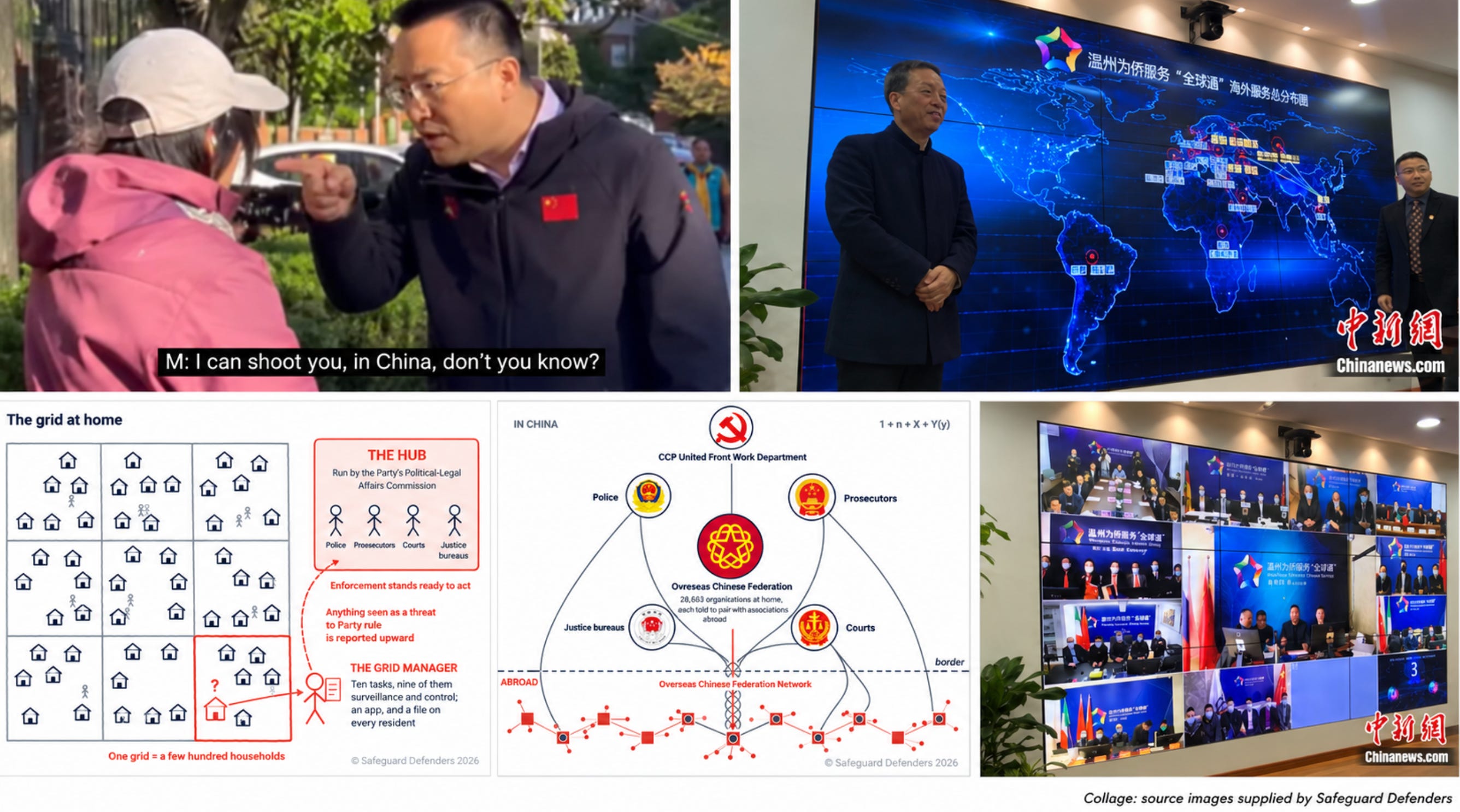
It runs through community associations designated as Party liaison nodes on Western soil, with Chinese police, prosecutors and courts plugged in from home, and online platforms and video links that put diaspora members face to face with authorities in China.
A Formula for Repression, released Friday by the Madrid-based human rights group Safeguard Defenders at the Inter-Parliamentary Alliance on China summit in The Hague, identifies 1,247 formally designated Chinese Communist Party liaison points in at least 91 countries.
A liaison point is a community association, or a person within one, that a Chinese authority has formally appointed as its contact abroad, often by presenting a nameplate to hang on the wall.
They include points in Toronto, Vancouver, Montreal, the Montreal suburb of Brossard, and Ottawa. In the United States, they include New York, Los Angeles, San Francisco, Chicago, Houston, Seattle and Washington.
More than ten police forces from five Chinese provinces now work through the network, the report says, alongside Chinese prosecutors, courts and justice bureaus.
Harth’s report places the police stations within a broader Party system for controlling Chinese communities abroad. The overseas operations “are part of a determined Chinese Communist Party policy to export its domestic system of surveillance and control to Chinese diaspora communities across the world.”
“The Party controls China’s population through a grid,” the report states. “Every city, town and village is cut into grids of a few hundred households, each with a manager who collects information and reports to an enforcement hub. Since 2014 it has been building the same grid abroad.”
Abroad, the managers are community associations.
Hometown societies, chambers of commerce and cultural groups that are already close to the Party receive a formal designation as liaison points.
Chinese police, prosecutors and courts then “simply plug into” them, the report says. The work the report documents through these points includes collecting information on diaspora members, ideological guidance, settling “disputes,” recruiting “overseas informants,” persuading people to return to China, and disrupting protests against the Party.
Leverage runs through blood ties in China.
The grid, the report says, is built to reach “the dissident it watches and the neighbor who stays silent for fear of what may happen to family back home.”
“Staying in power comes before everything else for the Party,” the report says. “Abroad it counts more than 60 million people as ‘overseas Chinese’, regardless of the passport they hold, and sees in them both a resource and a threat. Controlling them is the answer to both.”
The report cites a September 22 attack on Falun Gong practitioners outside China’s consulate in Toronto.
A man wearing a People’s Republic insignia on his jacket tore down the banners of Falun Gong practitioners, a group the Party ranks among its “five poisons,” and told the woman defending them, “This is Chinese territory, you know?” He cited China’s “Anti-Secession Law.” Then, according to video of the encounter reported by The Bureau, he said, “I’ll slam you to death, believe it or not? I’ll have you shot, believe it or not?” She was left bleeding. He left in a car that came to collect him.
Foreign Affairs Minister Anita Anand has said Toronto police and the RCMP are investigating. But her reply to a Conservative MP who demanded a probe did not say whether the man had any connection to the Chinese government or its Toronto consulate, The Bureau reported last month. The consulate has denied any link to him.
Over the following days, the report says, “similar events unfolded” during Xi Jinping’s state visit to Washington. Human Rights in China counted some hundred overseas Chinese associations bused in to line Xi’s hotel and motorcade, among them two groups named for Fuzhou and one of its counties. Men in matching dark clothing, caps, masks and earpieces filmed anti-Party protesters and “rapidly converged whenever a confrontation broke out.” Protesters were pepper-sprayed and struck with umbrellas and flagpoles, and one was “surrounded, choked, beaten, and dragged.”
Police told Tibetan activists that at least one assailant had not been detained “because he has diplomatic immunity.”
The report sets the Toronto and Washington incidents beside earlier assaults on protesters, in Manchester in 2022 and in San Francisco during Xi’s 2023 visit.
“Keep these cases and patterns in mind,” it states. “The rest of this report is about the machinery that produces them.”
The report counts 73 liaison points designated by the end of 2015 and 1,178 by the end of 2025. More than a hundred are now added each year. Five national policies issued since late 2024 instruct authorities across China to widen the work abroad. In January 2026, the Supreme People’s Court, the Party’s Political and Legal Affairs Commission and eighteen other central bodies ordered diaspora disputes routed into the county command centers that run the grid at home. “The Party numbers its affiliated associations abroad in the tens of thousands, every one of them a potential grid liaison in the waiting,” the report states.
The report draws on a mapping study by the Washington-based Jamestown Foundation, which counted more than 2,000 groups tied to the Party’s united front in four democracies.
Jamestown’s breakdown shows Canada carrying the densest network of the four. It found at least 575 such groups in Canada, against at least 967 in the United States, a country with more than eight times Canada’s population. Per capita, that’s roughly five times the American rate. Jamestown counted at least 405 in the United Kingdom and 347 in Germany.
Harth’s report says every one of those affiliates is a potential liaison point in waiting.
“The points we could place are a fraction of the affiliates available to carry them,” it states.
If that holds, Canada’s exposure to the repression grid is vastly disproportionate to its size. Safeguard Defenders is now working with Jamestown on the next phase of that mapping, which has counted at least 1,000 more united front affiliated groups in 15 other European countries.
Among the report’s evidence that the stations survived are photographs the Party published itself.
On February 12, 2025, in a conference room in Fuzhou, uniformed officers of the city police’s exit-entry administration division sat at the head table beneath a red banner, on either side of the chair of the Fuzhou Overseas Chinese Federation. Facing them sat some 30 leaders of overseas Chinese associations from 19 countries. According to the Federation’s own caption, they included the chair of the Canada Fujian General Chamber of Commerce. The Federation billed the forum as a “special session” of the police division. Fuzhou’s United Front Work Department posted the photographs online the next day.
Fuzhou’s police ran the “Overseas 110” network exposed in 2022, which included the station in Manhattan and another in Toronto. According to a United States court record cited in the report, a deputy chair of the Fuzhou Federation stood in the photograph taken at the network’s January 2022 launch, beside overseas association presidents from Spain, France, Canada and the Netherlands.
Ottawa had told Canadians the matter was dealt with. On April 27, 2023, then-public safety minister Marco Mendicino told a House of Commons committee that the RCMP had “taken decisive action to shut down the so-called police stations.” Less than two years later, Fuzhou police sat across a table from a Canadian association chair.
“The 2022 police station reports were never about physical police buildings,” the report states. “They were about the united front and its Overseas Chinese Federation networks that act as the vehicle for the enforcement machine’s reach abroad.” After the exposure, Beijing called the reports a hoax and claimed the stations had closed. “The only thing that changed following the 2022 exposure was the names used for the designated liaisons,” the report states. “The police logos were removed, but the functions of control stayed and their reach expanded.”
In January 2022, Fuzhou police hung their nameplate on 30 associations abroad, chosen “on the recommendation of the municipal Overseas Chinese Federation.” By April 2026, a senior Fuzhou official was telling the Party’s central United Front Work Department that the city’s Federation “has established prosecutor-overseas-Chinese, tax-overseas-Chinese and police-overseas-Chinese cooperation mechanisms.” “Little, if anything, was ever closed in between,” the report concludes.
According to the report, the Canada Fujian General Chamber of Commerce has kept a “liaison headquarters” of its own in Fuzhou.
In August 2024, the Hangzhou Overseas Chinese Federation briefed overseas association heads alongside the city’s police exit-entry bureau, then signed “linkage association” agreements with associations in Canada, Greece and Iceland.
The report’s maps add a Vancouver liaison person appointed by a Fujian district procuratorate, a Vancouver sub-center of the Nantong police, a Wenzhou police liaison point in Vancouver, a Yiwu liaison station in Toronto whose head’s first duty is to “assist the Yiwu Federation in collecting the basic situation of Yiwu people,” and Jinan stations in Toronto, Ottawa and Vancouver.
The Federation in Wuxi runs “hometown stations” in more than 150 cities, including Toronto and Vancouver, together with the city’s public security and state security bureaus, according to the report. In its own 2022 account, the Federation described a student in Vancouver who had fallen out with his parents and stopped answering their calls for a week. The local liaison officer, it said, “reached the child and did ideological work.”