

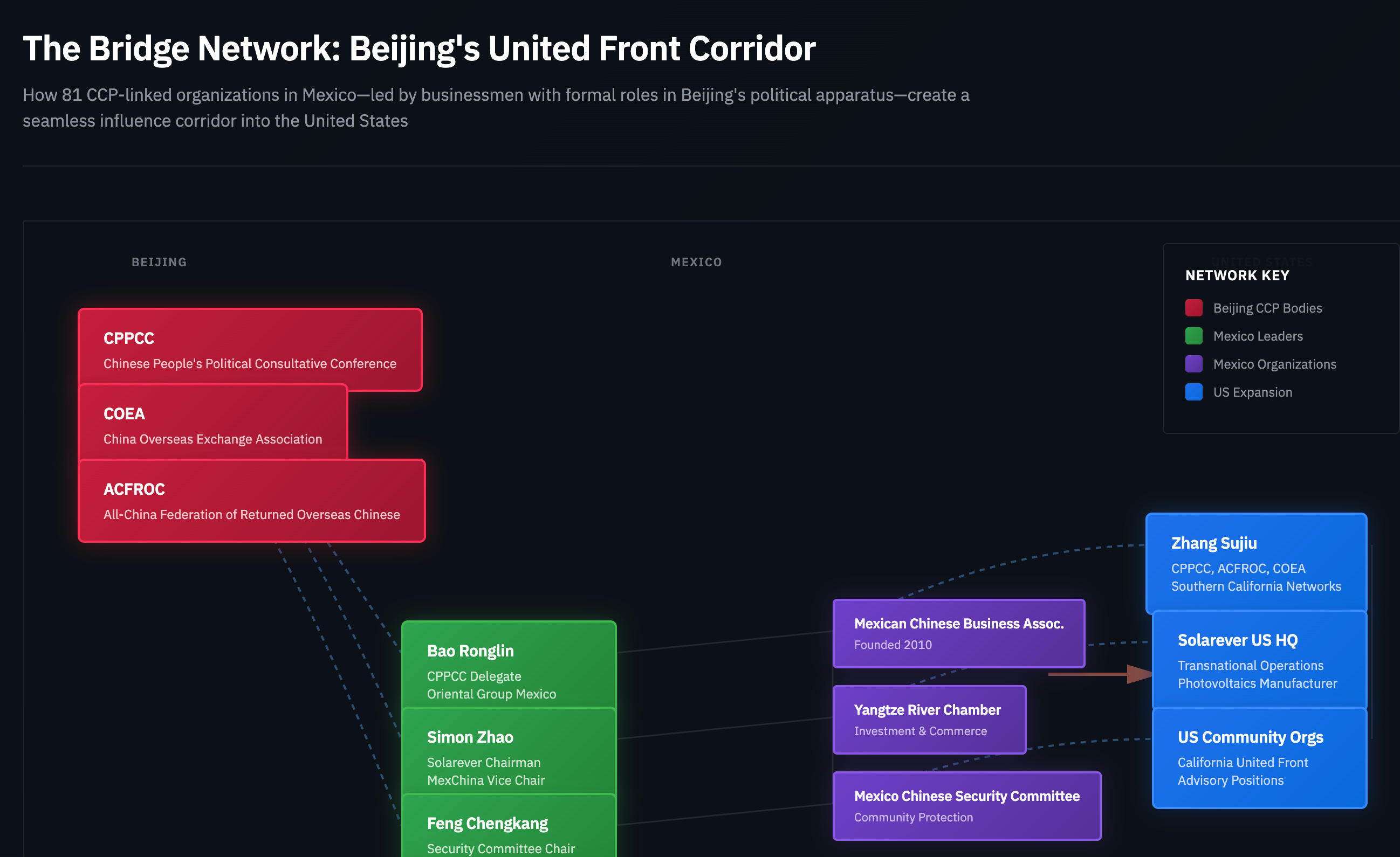
WASHINGTON — When three Chinese community organizations in Mexico condemned U.S. legislation on Taiwan last December, they revealed something far more significant than a diplomatic grievance amplified through Beijing proxies. Rather, these organizations are allegedly part of a sophisticated network of 81 influence groups that Beijing has constructed across Mexico, led by wealthy diaspora businessmen, and designed explicitly to expand into the United States.
A new analysis by the Jamestown Foundation has documented ties between the organizations in Mexico and the CCP’s United Front Work Department, and detailed how some of the key leaders have reportedly met with a number of American presidents and senior leaders, from Bill and Hillary Clinton to Barack Obama. What makes these networks significant, according to author Cheryl Yu, is their concrete function as deliberate bridges into American territory, business markets, and political spaces.
The pattern is methodical: businessmen with formal roles in core CCP political bodies establish commercial operations in critical Mexican sectors, including green energy, solar manufacturing, mineral exports, and electric bicycle production.
In the classic United Front tradecraft already documented by The Bureau’s investigative reporting in Canada and the United States, these community leaders cultivate relationships with Mexican officials, then expand northward to set up U.S. headquarters, according to Yu.
“The statements criticizing U.S. policy are the visible products of the Party’s mobilization of this network in Mexico, with the aim of shaping local discourse and influencing Mexican society and politics,” Yu writes. “Today, Party leaders have repeatedly framed Mexico as an asset in advancing their preferred international order and in counterbalancing U.S. influence.”
In New York, The Bureau’s reporting on the explosive Linda Sun case revealed alleged links between Sun and her husband’s multi-million-dollar China business deals facilitated by United Front community leaders in New York City. The case—accusing Sun of using her Asian community liaison position as a bridge to influence governors Cuomo and Hochul in exchange for bribes allegedly laundered from China—ended in a hung jury and resumes in January 2027.
The Bureau reported that Brooklyn community leader John Chan—identified with Linda Sun in evidence photos and previously convicted on human trafficking, illegal casino and heroin racketeering charges—now holds roles in some of the same Beijing-based United Front entities Yu documents in Mexico.
The New York Times has reported on John Chan's deep influence in American politics, including promoting pro-Beijing candidates and campaigning against candidates that are favorable to Taiwan.
What makes Yu’s report groundbreaking is the establishment of concrete directorial ties between the Mexican and U.S.-based groups. Once established in Mexico, these United Front organizations appoint U.S. community leaders to advisory positions, creating what the report describes as a seamless influence corridor.
