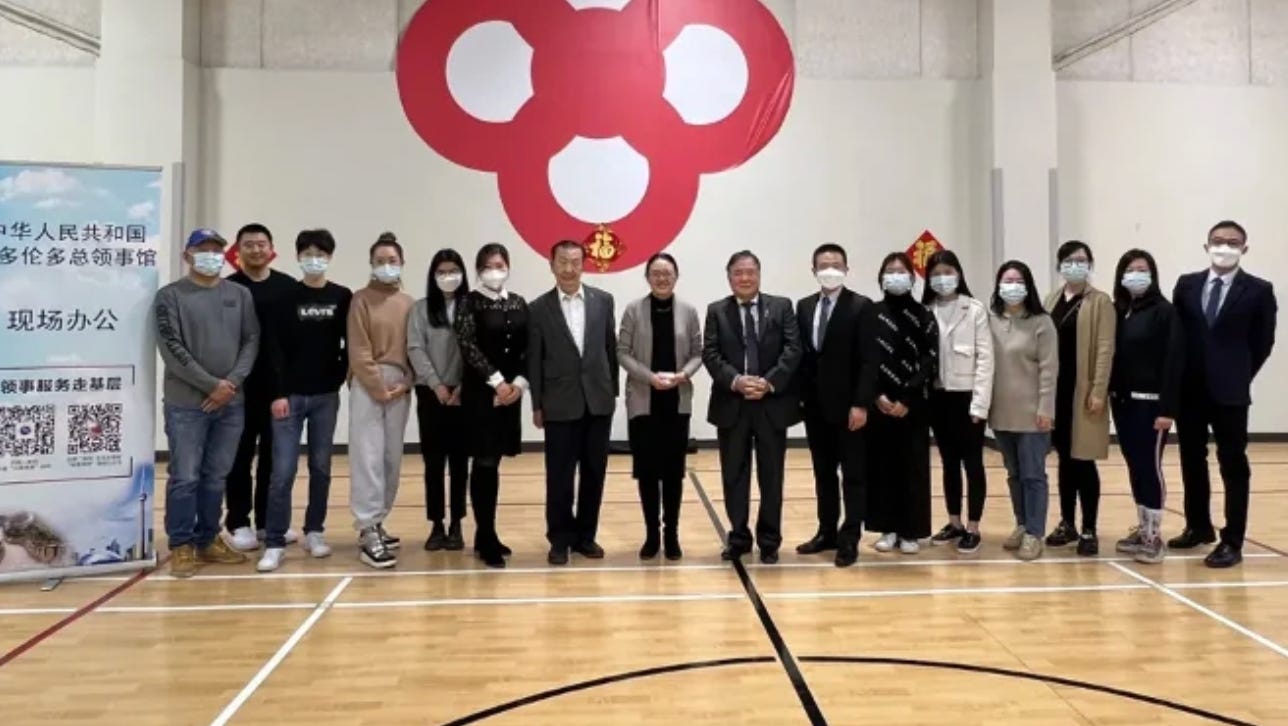
From Illegal ‘Police Stations’ to Rolling Consulates: Beijing’s New Interference Tactic Expands Beyond Major Cities on Canadian Soil
Researcher Sze-Fung Lee maps over a decade of PRC door-to-door missions in 11 provinces, calling Canada an extreme outlier in Beijing’s global consular campaign.

OTTAWA — While North Americans have only begun to recognize that China has been implanting illegal “police stations” in several major cities in recent years, a sweeping new investigation has revealed that Chinese diplomats in Canada have intensified and extended these missions — quietly staging more than 100 quickly mounted and dismantled “pop-up” consular events in 22 cities across 11 provinces since 2015, operating out of small, unofficial sites rather than accredited consulates.
The new open-source probe for the Jamestown Foundation by Canadian researcher Sze-Fung Lee finds these diaspora-outreach missions likely violate international law, and appear to be a strategic effort of the Chinese Communist Party to extend its influence into rural and regional parts of Canada — beyond major centres such as Toronto and Vancouver, where Chinese intelligence and United Front networks have already established deep influence in diaspora monitoring and federal election-interference operations.
Strikingly, what is now occurring on Canadian soil echoes the Chinese Communist Party’s regional strategy nearly a century ago to spread across China by leveraging smaller capitals and rural power bases against contested state power centres, according to Lee’s paper.
And while these illegal “pop-up” operations appear to be part of a global campaign targeting multiple sovereign states, Lee finds that Canada has become a stark outlier — more heavily saturated than its democratic allies by the spread of Beijing’s covert diplomatic networks.
As Ottawa under Prime Minister Mark Carney seeks a strategic “re-engagement” with Beijing, the consular “pop-up” campaign is advancing in the shadows. There is no public evidence, Lee notes, that the federal government has acknowledged the breadth of these operations, let alone moved to regulate or halt them.
“This sets a potentially alarming precedent for the PRC’s growing and pervasive efforts to extend its outreach and exert control over diaspora communities,” the report says. “In the name of providing consular services, PRC officials are knocking on doors on Canadian soil — likely with diplomatic immunity.”
The events are organized by the Embassy of the People’s Republic of China in Ottawa, along with PRC consulates in Toronto, Montreal, Vancouver and Calgary, with online evidence showing diplomats from these city missions travelling to rural areas, even sometimes entering the homes of Canadian citizens.
While they are advertised as offering routine consular services to Canadian citizens or visitors from China — passport renewals, travel documents — Lee argues Ottawa has not given Beijing explicit consent to operate across the country in this way. And even if consent exists, Lee concludes, the services are being used as a front “for political activities.”
These activities could expand China’s clandestine “overseas police” operations, in which President Xi Jinping’s operatives seek to illegally repatriate or harm enemies and critics of the regime under the guise of tracking down Chinese financial corruption suspects.
“This includes influence operations and cognitive warfare targeting Chinese diaspora communities, united front work strengthening the PRC’s capacity for overseas political mobilization, and the creation of new norms that exacerbate Beijing’s preexisting extraterritorial law enforcement efforts,” the report says.
In an interview, Lee said the pattern suggests a deliberately adaptive strategy.
“It looks like a very creative strategy to increase the reach and impact of the United Front,” Lee said, adding that Chinese officials, under intensive media scrutiny since 2022 over Beijing’s election interference and diaspora intimidation operations, appear to have shifted focus to provincial capitals and regional jurisdictions where scrutiny is weaker and local institutions may be more vulnerable.
Lee’s previous work on similar “Bringing Consular Services into the Community” operations in the eastern United States was picked up by The New York Times, which highlighted how a Chinatown gangster tied to Chinese consulate “pop-ups” and election campaigns had a past in human smuggling and heroin trafficking.
These consular “pop-up” missions are not confined to North America. Lee notes they are likely part of a global operation, and PRC consulates have conducted similar activities in the United Kingdom, Japan, Hungary, Tanzania, Jamaica and other countries. But Lee’s deeper investigation concludes that Canada is an outlier, with consular officials hosting an unusually extensive array of such activities over the past decade.
While the New York cases raised alarms and appeared to intersect with Chinese election-interference networks, Lee argues that the Canadian picture is much broader in geographic scope, more tightly coordinated across the diplomatic network, and deliberately pushed down to the provincial and regional level — potentially more focused on early-stage mass information collection and network-building than on the later-stage election interference already seen in major North American cities with large diaspora communities.
“This scale of operations is much larger than in the United States,” the report says. “All PRC consulates and the PRC Embassy in Canada are involved, targeting most provincial capitals.”
Lee’s paper argues the events threaten Canada’s national security and undermine its sovereignty and democracy.
Critically, Lee adds that Beijing’s push into Canada’s regional hubs aligns with a classic united front strategy developed by Mao Zedong in the late 1920s: “leveraging local power to encircle the central authority,” or “encircling the cities from the countryside.” At the time, Mao argued that because the party was weaker than its adversaries it should first build power and influence in rural areas.
By influencing multiple provincial capitals simultaneously and coordinating operations in other cities within the same provinces, Lee warns, Beijing can maximize its sway over provincial policymaking and gain leverage to push back against unfavourable federal policies in Ottawa.
A Cross-Canada Network in Beijing’s Broader Hybrid Warfare
Lee’s research catalogues a decade-long pattern of more than 100 consular “pop-up” events spread across 22 cities in 11 provinces between 2015 and November 2025. The venues range from hotel conference rooms and Chinese cultural centres to university classrooms and clubhouses — a deliberately low-profile footprint that keeps Chinese officials close to local diaspora communities, but far from the security-monitored glare of Canadian embassies and consulates.
The events have reached deep into Canada’s regions: Edmonton in Alberta; Kamloops, Kelowna, Nanaimo, Prince George and Victoria in British Columbia; Winnipeg in Manitoba; Fredericton, Moncton and Saint John in New Brunswick; St. John’s in Newfoundland and Labrador; Halifax in Nova Scotia; London and Windsor in Ontario; Charlottetown in Prince Edward Island; Montréal, Québec City, Saguenay, Sherbrooke and Trois-Rivières in Québec; Regina in Saskatchewan; and Whitehorse in Yukon.
The heaviest concentrations, Lee finds, are in Halifax (19 events), Charlottetown (14) and Winnipeg (12). Ten of Canada’s 14 provincial and territorial capitals have hosted such missions. Ottawa and Toronto are the main exceptions, along with the northern capitals Iqaluit and Yellowknife — an absence Lee interprets as strategic, not accidental. In Toronto and Ottawa, United Front and consular networks are already entrenched and under national scrutiny; in the remote North, operations may not be worth the cost.
Unlike in the United States — where some “pop-ups” have been held in supermarkets or restaurants and broadly advertised — the Canadian events are typically gated. Participation often requires advance registration. Since 2024, for example, the PRC consulate in Vancouver has at times withheld venue locations until after registration, a practice Lee reads as an attempt to keep operations “under the radar.”
In many cities, the same venues and partner organizations recur, suggesting a tight network of trusted local intermediaries. In smaller centres, where Chinese communities are more compact and media attention is limited, the same cultural centre or association may host multiple visits over several years.
One case study Lee highlights comes from Manitoba. In 2022, Deputy Consul General Hong Hong led a Toronto consulate team on a two-day mission to Winnipeg, holding on-site document-processing sessions at a Chinese cultural centre and at the University of Manitoba. Local partners included the Winnipeg Chinese Cultural and Community Center, a group called Fenghua Voice, and the University of Manitoba Chinese Students and Scholars Association.
The Toronto consulate later boasted on WeChat that the team had made a “special trip” to an elderly couple’s home to process their passport renewal when they were unable to attend the event. Lee notes that these home visits — officials literally knocking on doors in Canada to collect sensitive personal data — are “an unusual diplomatic practice” that raise obvious security and coercion risks.
From Beijing’s perspective, Lee suggests, building influence in Halifax, Charlottetown, Winnipeg and other smaller capitals serves several purposes at once. It allows consular and United Front operatives to:
cultivate local elites and community leaders who can lobby provincial governments
monitor and, where necessary, pressure diaspora voices viewed as politically undesirable
build mobilization networks that can be activated for demonstrations, counter-protests or political campaigns
quietly shape attitudes toward issues ranging from critical minerals and trade to foreign policy and elections
“PRC consular gray zone activities should be viewed as part of a broader hybrid warfare strategy rather than isolated incidents,” the report concludes.


House of Commons Standing Committee on Citizenship and Immigration Dec 2 2025.
Witness: David Thomas, Lawyer from BC. "I'm going to tell you about the bad and the ugly " Stop giving away Canadian citizenship so freely & with such low thresholds, says famed lawyer. https://www.youtube.com/watch?v=WI7suujv7Rw
Canada is a cesspool of foreign interference and it has been enabled and encouraged by the Liberal Party of Canada and the Laurentian elites. It's of no consequence to them as they are becoming more and more wealthy and powerful. The CCP aides the Liberal's to remain in power as they work as a team to dismantle our Constitution, our rights and freedoms, and the ability to remain independant in this country. This is why the Liberal's will never put in a foreign registry as they want foreign influence, as they turn Canada into another Mao style Communist controlled country. Its been a long held dream of the Trudeau's and those Laurentian elites that aid them. They are doing this purposely as this is not about incompetence, being ignorant of the facts, or even pretending to be, as they openly encourage any and all interference to disrupt, distract, and destory, our democracy. They will not stop this from happening, nor make any changes to their foreign policies, ever. The only chance of anything being done is if the Conservatives win an election which, sorry to say, due to the mass infiltration into our weak Instiutions, the Liberal's, and our Parliament, as well as Provincial and Municipal Government's, it will never be allowed to happen. It would mean the end to foreign influence which is detrimental to the CCP, their allies, and the Liberal Party of China. Hence the heightened propoganda being pushed at a continuous rate by the Corporate Media, other Institutions, the CCP, and their Liberal collaborators. Canadian's are to weak and willing to follow along, regardless the messaging is obvious and blatant, as is the interference by the CCP. Unfortunately the masses have slowly become brainwashed and are now unableto think critically, leaving Canada to easily become the perfect Post National Communist State. It appears to me that this is no longer just about foreign influence, it is a coo.