From Airport Phone Search to ‘Cash China’ Ledger: Inside the Battle Over What Jurors Hear About a Chinese Money Pipeline Into New York Politics
NEW YORK — Jurors in Brooklyn have spent the past two weeks absorbing the luxurious trappings of a life that, on paper, Linda Sun and her husband, Chris Hu, could never afford.
Prosecutors have walked them through photos of a Long Island mansion, an oceanfront condo and Jeep in Hawaii, a 2024 Ferrari, luxury handbags and watches, and millions of dollars moving through shell companies, underground cash pickups and fraudulent bank transfers.
While Sun and Hu allegedly claimed millions in losses – with Hu reporting unemployment during the pandemic – prosecutors say they were at the same time harvesting millions in hidden kickbacks from China, routed through Hu’s privileged access to that country’s seafood market and pandemic-era personal protective equipment contracts. In opening statements, they said Sun’s “loyalty was for sale” to Beijing and framed the prosecution as “a case about greed and betrayal.”
Federal agents say Hu kept a spreadsheet of expected profits from New York State PPE contracts, with one $8 million column of projected gains labelled simply “me” – evidence, in the government’s telling, of how the couple allegedly turned Sun’s access to governors Andrew Cuomo and Kathy Hochul into a conduit for personal enrichment.
But while jurors hear that story, a high-stakes legal battle is playing out behind the scenes in court filings – a fight over what the jury will be allowed to hear about two diaspora community leaders known in the indictment only as “CC-1” and “CC-2.”
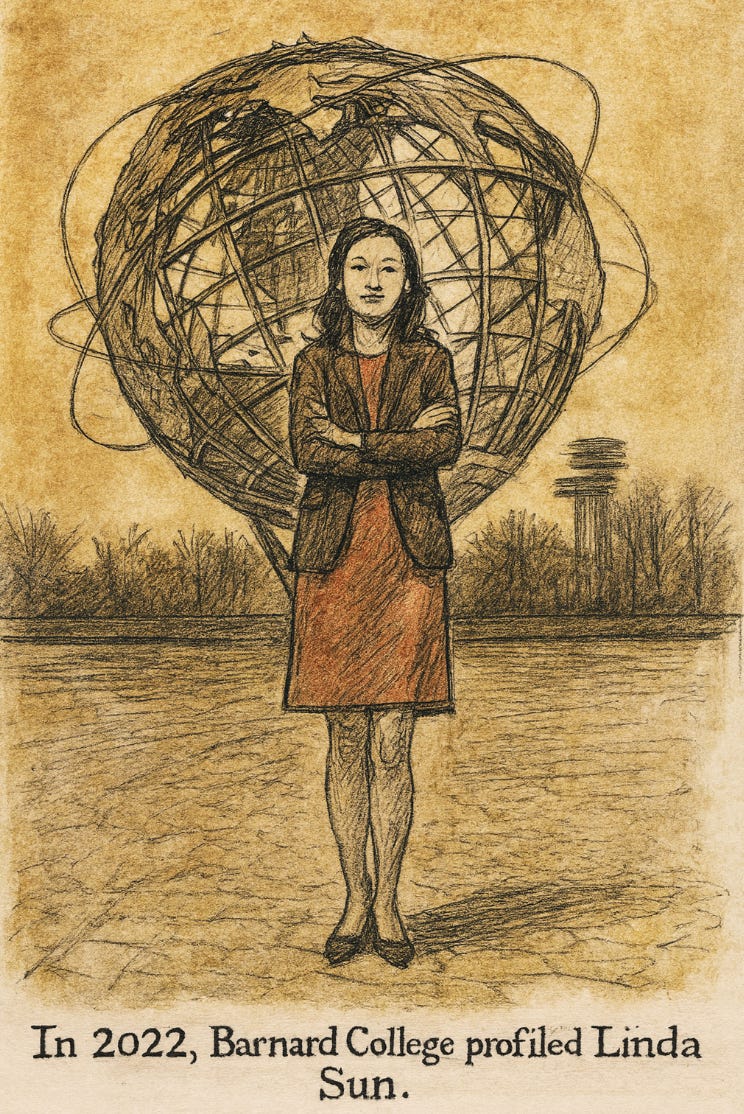
Sun’s job for governors Cuomo and Hochul was Chinese community outreach, including dealings with the Chinese consulate and community groups. Barnard College’s alumni magazine once profiled her as “a bridge between worlds,” saying that in her new role as Hochul’s deputy chief of staff she helped “immigrant communities — and all New Yorkers — find their voice in local government.”
According to the government’s case, however, figures from both the consulate and New York–based hometown associations were, in effect, using Sun to advance Beijing’s agenda – and paying her through underground channels and community proxies.
The indictment portrays CC-1 as president of a Henan hometown association in New York who directed Sun to open doors for Henan with New York officials. Prosecutors say this included having Sun forge Kathy Hochul’s signature on a welcome letter used in U.S. visa applications for Henan delegations, and drafting invitations for a proposed trip by “Politician-2” (understood to be Hochul) to Henan — all to advance “the PRC government’s political interest to be seen as having received an important U.S. public official.”
For the U.S. government, the alleged contract was broad, open-ended, and effectively drafted in Beijing.
“CC-1 and CC-2’s concerted efforts on behalf of Linda Sun reflected ongoing compensation for her political activities on behalf of the Henan provincial Government,” prosecutors wrote in a November 30 letter. “Indeed, the Henan provincial government directed CC-1’s activities with Sun; contemporaneous business meetings coordinated by CC-1 between Hu and Henan provincial leaders thus represent the PRC government’s economic compensation to Sun and her family.”
The indictment alleges that CC-1 and CC-2 “rewarded her by aiding” Hu’s China-based commercial ventures, unlocking a flow of seafood and later PPE contracts from a Chinese business partner that quietly transformed the couple’s finances.
Sun and Hu’s lawyers, meanwhile, argue the evidence must be sharply narrowed. For money to count as a bribe – and to support a money-laundering charge tied to high-end homes and vehicles – they say the funds moving into the couple’s accounts must be tied directly to a specific political favour, a classic, concrete quid pro quo.
Prosecutors say that framing is far too narrow, and that Sun and Hu’s lawyers have flooded the docket with motions over the past year trying to kill the money-laundering case, even after Judge Cogan ruled the jury should see evidence captured from CC-1 by border officials.
“The defendants have repeatedly argued that the laundering of proceeds of business opportunities created for Hu through the intervention of CC-1 and CC-2 must be limited temporally to the acts of intervention themselves.”
But the government counters that the law looks at the entire revenue stream created by those interventions.
If the Sun case – which U.S. legal experts describe as a novel corruption and foreign-agent trial – ends up as a model for how other Western nations understand China’s more sophisticated interference schemes, that distinction will matter.
“But for that intervention, the business opportunities—and the funds that flowed thereafter—would not have existed,” they write. To reinforce the point, they cite Professor Julian Ku’s testimony that in China, provincial approval is “a necessary precondition” for foreign businesses to operate in Chinese provinces – a condition “a foreigner such as Hu could not have met without assistance.”
In practical terms, the government argues, Hu could not have accessed China’s markets with his seafood export business without New York–based Henan community leaders setting up licensing and opportunities through Henan officials – assistance that, in the prosecution’s theory, effectively functioned as a payoff for Sun’s political work in New York.
And they say Hu’s own behaviour shows he knew the money was dirty: his “assiduous concealment of money from the Business Partner, both through nominee accounts and cash pickups, as well as the coded language he used to track the money in his internal accounting, suggest his recognition that the revenue stream was illegal.”
The government says the evidence will show that CC-1 and CC-2’s efforts to help Hu’s China–based business opportunities “began in 2016,” not just in 2017–2018 as the defence claims. In their account, that timing matters: shortly afterwards, Hu’s “economic fortunes drastically changed” and he began receiving repeated deliveries of cash, with his own ledger entries referring to “Cash China – Sandy.” “Sandy” is the first name of the money remitter Hu allegedly used to repatriate funds from his business partner.
On top of that, the government wants to use what it calls “certain marital communications” to show the couple were engaged in “jointly undertaken criminal activity,” to monetise Sun’s access to the governor’s office while performing political tasks for Henan province.
“Indeed,” prosecutors write, “the communications at issue reflect the assistance of the PRC Consulate, CC-1 and CC-2 in Hu’s PRC-based business activities, coupled with Sun and Hu’s solicitation and eager acceptance of such assistance.”
In their view, that undercuts the defence’s attempt to narrow the foreign-agent charges against Linda Sun.
“The Court should reject the defendants’ suggestion,” they conclude, “that the only possible direct evidence of Sun’s FARA violation would concern acts undertaken at the direction, control or request of the foreign principal or the affirmative failure to register.”
Defence Argues CC-1 Perjury Trap
In the early days of trial, jurors heard from Homeland Security Investigations Special Agent Matthew Harris, who testified that in January 2020, Zhang Fuyin, former president of a New York Henan association, was stopped at John F. Kennedy International Airport after a trip from China. Harris said Zhang was questioned and his two mobile phones were briefly seized, imaged and returned later that day.
That earlier airport encounter, and the phone records it produced, set the stage for the current fight over a second border interview – one the defence says has been downplayed and delayed by prosecutors.
In a November 17 letter, Sun’s lawyers revealed that on May 6, 2025, Customs and Border Protection officers stopped CC-1 as he re-entered the United States from an overseas trip and questioned him about the Sun–Hu case. That interview – memorialized in what the defence calls the “Brady Interview” – was not turned over until August 18, 2025, a delay they say raises serious disclosure concerns.
The report, they argue, is “directly contrary to the government’s allegations.” According to the defence summary, CC-1 told border officers that he never assisted Chinese government officials beyond handling logistics for visits in his role as president of a U.S.-based association; that he had no personal relationship with anyone in the Henan provincial or Zhengzhou municipal governments; that he tried, unsuccessfully, to help Sun and Hu start a lobster business in Henan in his association capacity; that he had no personal relationship with CC-2 and did not know of any personal relationship between CC-2 and Sun; that his association, which aims to promote trade between New York and Henan, is funded by member donations, not by New York governments, the Chinese state or anyone in China; and that he “denied having any ties to the Chinese government,” saying he had not met with Chinese government representatives since 2020.
Those statements, the defence says, are at odds with the prosecution narrative that casts CC-1 as a covert proxy for Beijing and a key facilitator of Hu’s China-based business empire.
After receiving the Brady report, the defence subpoenaed CC-1. His counsel responded that he would invoke his Fifth Amendment privilege if called, based on his potential exposure as an unindicted co-conspirator whose devices had been seized and whose communications were already in evidence.
When the issue came before Judge Cogan on November 10, prosecutors declined to offer CC-1 immunity. They told the court that his statements at the border were “directly contradicted” by the electronic communications they intend to introduce.
In their November 17 letter, Sun’s lawyers argue that prosecutors have named CC-1 as a co-conspirator, seized his devices, put his messages before the jury – and then blocked the defence from cross-examining his own account by refusing immunity, while hinting that any testimony favourable to Sun would be perjurious.


Meanwhile back in Canazuela this activity would be interpreted as, not being a problem.