Linda Sun Case Points to Wider FBI Counterintelligence Probe Into Numerous Alleged PRC Agents Across U.S. Governments
The filings and exhibits also flag Brooklyn power broker John Chan—and include defense claims that figures cast as suspect community leaders were major donors for Governor Kathy Hochul.

BROOKLYN — In the landmark Linda Sun fraud and money-laundering case, the FBI’s dedicated unit for countering Chinese interference operations across the U.S. government was looking well beyond Sun herself, toward a broader set of suspected Chinese agents active inside New York State government, and toward a notorious Brooklyn diaspora power broker: a former Triad figure from Hong Kong, convicted of heroin trafficking, human smuggling, and illegal-casino racketeering, whom The New York Times has described as a political kingmaker and force in alleged pro-China election campaigning.
“His targets have been politicians on either side of the aisle who might be perceived as acting against the interests of the Chinese government — by supporting Hong Kong’s anti-Beijing protests, for instance, or attending a reception for a visiting dignitary from Taiwan,” The Times reported.
The man, John Chan—whom prosecutors flagged standing beside Linda Sun at a community event—is also tied to the same Chinese consul general and anti-Taiwan activities Sun was allegedly entangled with, and is so highly connected in Beijing and Albany that, even after receiving a reduced sentence in a major Chinese racketeering case, he drew public support from top New York Democrats, including Hillary Clinton, Senator Chuck Schumer, and Congresswoman Grace Meng, whose aide was also under the FBI’s scrutiny, as The Bureau’s investigation into case files and public records reveals.
In the public version of United States v. Linda Sun, the government framed a much narrower but still explosive case: a fast-rising political aide who managed outreach to Chinese- and Taiwanese diaspora communities for Governors Andrew Cuomo and Kathy Hochul, while secretly acting as an undisclosed agent of the Chinese Communist Party—using her access to block Taiwanese officials, shape New York’s policies on issues Beijing cared about, and facilitate Chinese government interests.
In the prosecution’s telling, Sun traded her loyalty to Beijing for greed, and, with her husband, covertly amassed a small empire through Beijing-linked bribery, multimillion-dollar pandemic-era kickbacks, and money-laundering schemes.
As narrowly focused as it was, the U.S. government’s case to jurors was still vast and sophisticated, asking average citizens to confront what national-security units across Western capitals have spent decades trying to decipher: Beijing’s United Front influence apparatus, which seeks to mobilize Chinese immigrant communities as vectors for foreign influence and intelligence campaigns.
The case against Linda Sun centered on her alleged involvement with Chinese community leaders in New York who, prosecutors said, held Chinese Communist Party-linked titles and acted as proxies in efforts to influence New York State—allegedly using Sun’s position as both an access point and, prosecutors contended, a conduit for benefits that enriched Sun and her husband through privileged business dealings in China.
The most explosive allegation was that Sun and her husband exploited New York’s procurement system to steer more than $44 million in pandemic PPE contracts to Chinese vendors with undisclosed personal connections, while collecting millions of dollars in kickbacks that prosecutors say were later laundered into luxury purchases and real estate.
And yet this sprawling case was ultimately narrowed by classified-information constraints, national-security limitations, and the defense’s successful efforts to keep some evidence—particularly material touching Sun’s alleged ties to Beijing-aligned diaspora leaders—out of the jury’s view.
Still, a careful parsing of testimony suggests Sun’s lawyer also argued that several of the community leaders cast by prosecutors as suspect figures were, at the same time, major donors for New York Governor Kathy Hochul.
The Bureau’s wider frame of understanding in the Sun trial comes through a review of trial transcripts and exhibits in the high-consequence case, which is set to resume in late January after a hung jury in December.
Sun and her husband deny all allegations, and at least one juror apparently agreed with their lawyers’ closing argument that U.S. prosecutors presented no “smoking gun” proving Linda Sun was a covertly paid Chinese agent.
Under cross-examination, FBI Special Agent Garrett Igo testified that when he interviewed Sun at the height of the COVID pandemic—during a doorstep visit to the Queens home she shared with her husband and co-accused, Chris Hu—his core focus was not Sun, but a “spy” for Beijing’s feared secret police, the Ministry of State Security, who used a Chinese consulate “Overseas Chinese Affairs Office” title as cover for dealing with Sun.
It was Linda Sun’s meetings with the Chinese MSS officer at diaspora meetings—the same venue for a number of photos featuring Sun with community leaders such as John Chan—that the FBI’s anti-Chinese interference unit was most concerned with, Igo testified.
Igo also acknowledged that he exchanged texts with other FBI personnel about Sun even though he was not part of the criminal investigation into her alleged Beijing-tied bribes and money laundering.
Those chats, Igo testified, were “about a political influence by the Chinese with our government, the US government.” And he confirmed they discussed “pro-Chinese people working in New York State government”—with Sun only one individual suspect among others in government.
Tense Doorknock Meeting
Igo testified that he first met Sun on July 15, 2020, after he and an FBI intelligence analyst turned up unannounced at her Queens address, slid a business card into the mailbox, and then interviewed her a block from the house on a sidewalk stoop because of COVID.
Igo was struck by his meeting with Chris Hu, who answered the door and said his wife was not home.
“I tried to get some more details about where she was, and I offered him my business card, to ask that she contact me,” Igo told prosecutors in the Brooklyn courtroom.
“Did he take it?”
“He kind of pointed to the—I believe to the right—and I was a little caught off guard. I didn’t know what he was doing. But he either said, or I realized, that he wanted me to put it in the mailbox that was attached to the front porch of the house.”
Igo walked back to his car, and called Sun, who said she would meet him near her home.
Sun introduced herself as the diversity officer for then-Governor Andrew Cuomo. Her job, she said, was to liaise with the Asian American community, “specifically the Chinese and Taiwanese communities.”
But Igo told jurors he was there for another reason. He wanted to ask about a man named Li Qing.
In the interview, he showed Sun photographs. She identified the man in the images as “Li Qing,” a consul in the Overseas Chinese Affairs section of China’s New York consulate, and acknowledged that they had each other’s phone numbers and WeChat IDs, saw each other regularly at community events, and often sat together. Li, she said, would ask about her family and “what initiatives Governor Cuomo was pushing at the time.”
Only after she described that relationship did Igo disclose what the FBI believed about Li.
“We told her that Li Qing was actually a Chinese spy with China’s Ministry of State Security,” he testified — a covert officer tasked with monitoring diaspora groups Beijing calls the “five poisons,” and with “promoting views that are sympathetic to the Chinese Communist Party, while suppressing pro-Taiwan or any kind of alternative views.” The point of the conversation, he said, was to “put her on notice,” to warn that Li was “potentially dangerous.”
Igo told the jury he expanded that warning. Some consular officials, he said he told Sun, were in the United States to “promote friendly relations,” but “there were others, not just Li Qing, who were in the United States for nefarious purposes.”
He named one of them: deputy consul general Qiu Jian, whom he described as Li’s second-level supervisor — a man who “likely would have known that Li Qing was a spy with the Ministry of State Security” and therefore “likely did not have her best interests at heart” if he was allowing the relationship.
He also raised Foreign Agents Registration Act obligations directly. “We gave her warnings,” he said, telling Sun that “if one was operating on behalf of a foreign government, particularly the Chinese government, without registering under the Foreign Agents Registration Act, FARA, that they would be in violation of the law.” He added a broader caution: the Chinese Communist Party, he told her “will always seek a further price for the free travel and titles that it gives people.”
By the end of the interview, Igo testified, he hoped Sun might cooperate but “didn’t feel that she had been super forthcoming.” She called back an hour later to say her WeChat exchanges with Li were largely “holiday greeting emojis” and some photos from community events. After that, he never heard from her again.
But later-introduced WeChat messages show how Sun described her work when she thought she was speaking privately to the Chinese side. In a January 24, 2019 exchange with consulate political officer Shen Xi, the same official Igo said was in charge of political outreach, Sun wrote:
“I very much value my relationship with the consulate and have done many things to make the relationship between the state and the consulate flourish during my tenure with the Governor. Certainly I have managed to stop all relationships between the TECO and the state. I have denied all requests from their office.”
In another thread, with Chinese diplomat Zhou Zhiyong in 2016, she messaged after a series of invitations and VIP tickets for a baseball-stadium ceremony: “I had the Lt. Governor’s staff decline this invitation to visit Taiwan.”
Igo also testified about what he’d been hearing more broadly from diaspora sources.
He told Sun that many overseas Chinese community leaders held formal titles with PRC bodies — “overseas council member,” “overseas youth committee member” and the like — positions that often came with invitations to state events in China.
Sun, he said, replied that “everybody holds a title” and that such credentials were “useful to have because that’s how you can get some invites back to these PRC government events back in China.” She did not say whether she held one herself, and Igo conceded he did not press her.
Prosecutors later produced records showing Sun received the title from Beijing as an “eminent young overseas Chinese” after a 2017 political tour.
WeChat exhibits also showed how PRC officials paired that title-and-invitation culture with appeals to ethnic solidarity and to Sun’s family business interests.
In one January 29, 2020 exchange, as the COVID-19 crisis intensified in China and Chris Hu’s export company was helping move donated PPE supplies, Consul official Shen Xi sent Sun a message that read: “Blood is thicker than water. Overseas Chinese in the eastern United States continue to donate to support epidemic prevention and control. Please say thank you to your husband and his company. Much appreciated.” Sun replied: “Thank you so much Simon!”
Read alongside Igo’s warnings, that exchange looks like a case study in the dynamic he described: a consulate official invoking “blood” ties and overseas Chinese unity, and a senior New York aide responding not as an at-arm’s-length public servant.
The jury also saw a 2019 video from a Manhattan protest against a visit by Taiwan’s president — footage hosted on the Voice of Chinese website. Igo walked jurors through the scene, identifying an array of United Front–linked association bosses standing shoulder to shoulder with Sun in an anti-Taiwan demonstration in front of Kathy Hochul’s office.
Starting from the right, he named Zheng Deliang, president of the United Fujianese American Association; Liang Guanjun, head of the United Chinese Associations of the Eastern United States, which Igo noted has registered under FARA as an affiliate of the Chinese Overseas Friendship Association; real-estate developer Andy Zhu; New World Mall owner Shao Lianwu; Voice of Chinese editor “Kenny” Chen Jianrong; Myanmar Chinese Overseas Association leader William Su; and Fujian, Shandong and other regional association chiefs.
In a separate group photo, he picked out a line of men including entrepreneur Morgan Shi, former Henan Association president Zhang Fuyin, FARA-registered Liang, his secretary general Lin Xuewen, and others, with Sun in the middle.
Defense lawyer Michael Abell used those images to make a different point on cross-examination. He suggested the protest took place “right in front of the office where she worked,” asked whether Igo knew there were other Hochul staffers at the event, and told the agent that “some of the people in the picture are significant donors to Governor Hochul.”
The King of Brooklyn
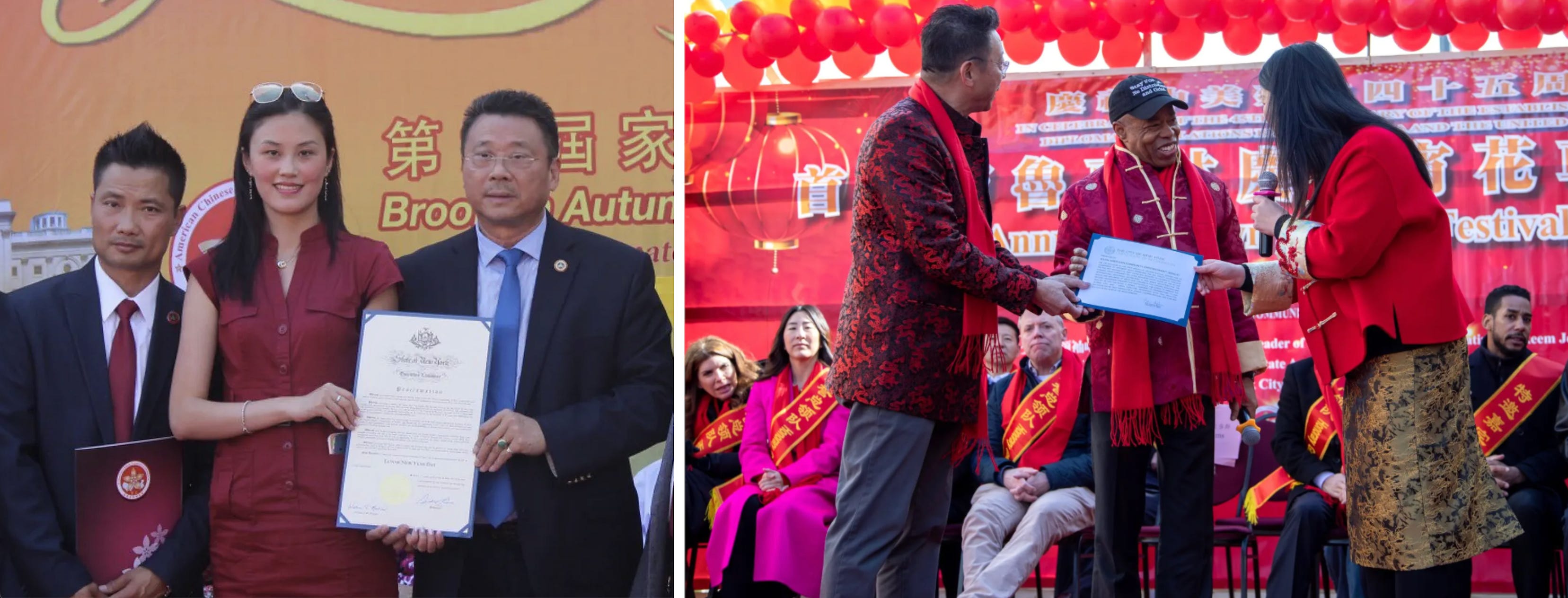
Another government exhibit, numbered 105.22, shows a Brooklyn Autumn Moon Festival. Linda Sun stands in a maroon dress, holding what appears to be a framed New York citation bearing state insignia, while a man in a dark suit stands beside her, also holding the document.
“Do you recognize any of these people?” the prosecutor asked Igo.
“Yes. The guy in the middle is a guy named Chen Shan Zhuang. He also goes by the name John Chan. He’s a very well-known community leader here in New York.”
It was a fleeting moment in the trial. And Igo’s brief response in court stood out in contrast to the thousands of words spent celebrating Chan in Chinese diaspora media—and profiling him in America’s paper of record.
A year earlier, in December 2024, The New York Times laid out the explosive outlines of John Chan’s story—one that connects directly with a number of the key people, incidents, and alleged Chinese interference activities that surfaced in Sun’s case.
In that investigation, the Times reported that Chan, a 69-year-old Brooklyn businessman, was the only American diaspora delegate invited to a March 2024 session of the Chinese People’s Political Consultative Conference, the central body—according to America’s Central Intelligence Agency—in China’s United Front influence system. Reporters described him as a figure with “remarkable proximity to the highest levels of power in China,” someone Beijing could call on for favors, who has quietly become a power broker in New York’s Chinese-language politics.
His life story and path to American power—from Hong Kong gang member and “snakehead” human smuggler to Brooklyn restaurateur, nonprofit founder, and kingmaker in Chinese-American politics—is the stuff of Hollywood scripts.
The paper reported that Chan once belonged to the Wo Lee Kwan triad and, in the early 2000s, pleaded guilty to a racketeering charge that included human smuggling, heroin trafficking, and operating illegal gambling parlors in New York. Facing a potential life sentence, he cooperated from jail against Chinatown boss Frank Ma—whom an FBI agent called “the last of the Asian godfathers.”
According to the Times, Judge Denny Chin noted Chan’s “extensive cooperation,” adding: “The results were quite good,” and “The Ma organization was dismantled.” Chan was sentenced to time served and released; Ma was later convicted and sentenced to life in prison, the Times reported.
In its December 2024 investigation, The New York Times also highlighted Chan’s rapid pivot from government witness to community leader celebrated by America’s political elite.
In 2014, U.S. Representative Grace Meng issued a proclamation declaring July 26 “John Chan Day,” writing that “Mr. Chan has pursued and exemplified the American dream.” The Times reported that, as his profile rose, letters of support poured in from Hillary Clinton, Senator Chuck Schumer, and other prominent figures, while Chinese-language outlets dubbed him “The King of Brooklyn.”
The Times also noted that Chan, through his lawyer, declined to discuss his criminal past, and did not engage with the paper’s questions about his role in American and diaspora politics within New York’s Democratic circles.
And for Congresswoman Meng, the Times wrote: “Asked recently about Mr. Chan’s efforts to influence U.S. elections, she said in a statement: ‘I am totally against any foreign government influencing or manipulating our democracy.’ She said she had been unaware of his criminal record.”
This is where the singular photograph of John Chan and Linda Sun—a government exhibit that Igo did not explain to the jury beyond identifying Chan—connects the court record to the Times’ reporting.
Another set of exhibits, numbered in the 800s, shifts the focus to Capitol Hill. Igo testified that Government Exhibit 806 is “a true and accurate depiction of Xiqing Sidney Li,” and that Li “works for Congresswoman Grace Meng as an aide.” He added that Li “is or was affiliated with the Henan Association,” and believed he may have been a vice-president there at some point. Asked whether Li was registered under the Foreign Agents Registration Act, Igo answered: “Not that I know of, no.”
As The Bureau has reported, in his closing arguments in December, prosecutor Alexander Solomon explained how the leader of the same Henan Association, Fuyin Zhang, reported to the Chinese government through Consul General Huang Ping—whom trial testimony described as a close associate of Linda Sun, and whom the Times reported was also connected to John Chan.
Keep reading with a 7-day free trial
Subscribe to The Bureau to keep reading this post and get 7 days of free access to the full post archives.


