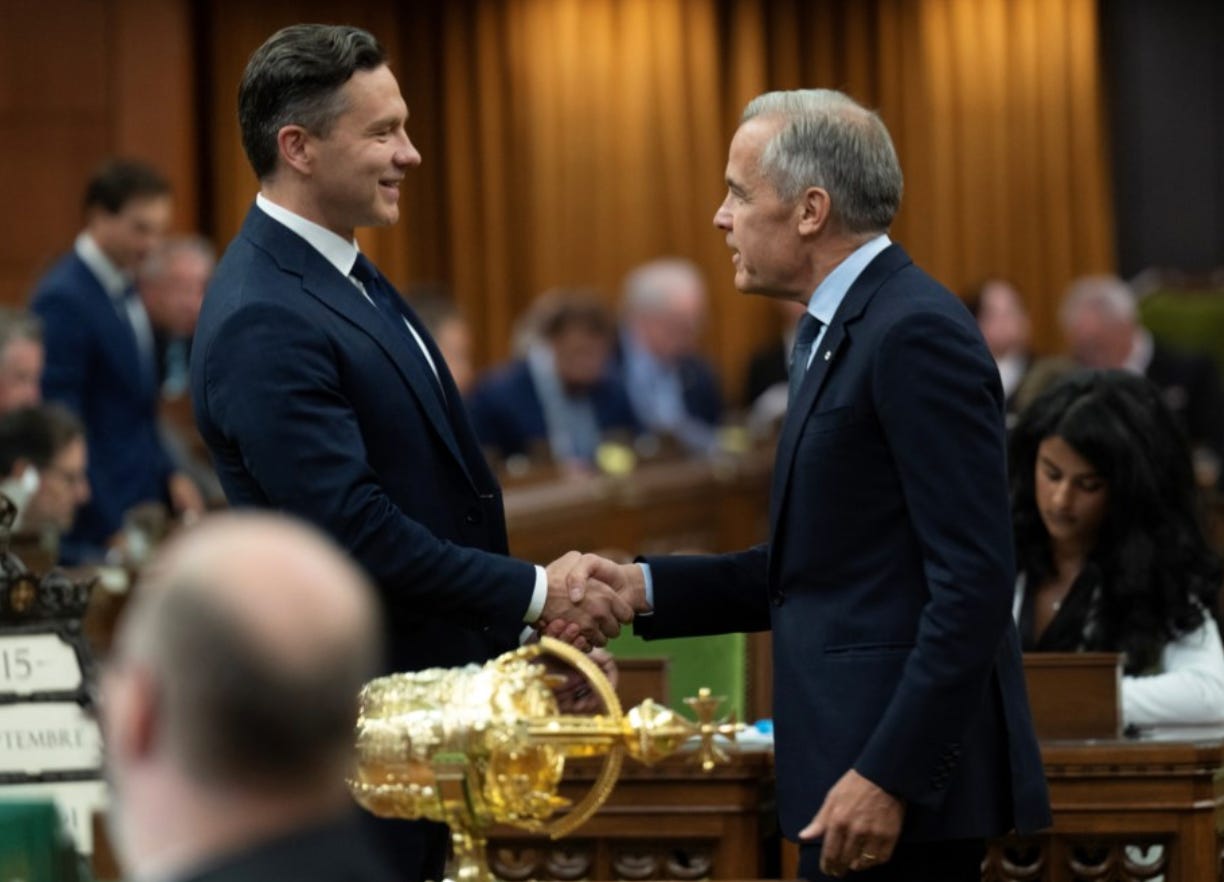
Why Won't Carney and Poilievre Address Systematic Corruption and Spell Out a Counter-Strike?
A Former RCMP Leader Questions Why, After Books, Inquiries, and Media Exposés on Foreign Interference and Mafia Infiltration, Canada's Political Leaders Still Offer No Clear Plan to Fight Back.
By Garry Clement
OTTAWA — Canadians are not short on warnings.
Over the last several years, the country has been presented with a growing library of books, investigations, and front-page reporting outlining a pattern that should alarm any democracy: foreign interference, transnational organized crime, illicit finance, and institutional fragility converging inside Canada.
The Toronto Police narco-corruption investigation is a blaring red alarm of corroboration underscoring these prior warnings. An emerging aspect of that ongoing investigation is whether narco-prosecutions have also been compromised, among the systemic legal loophole factors explored below.
Again, none of this should be surprising.
Wilful Blindness by Sam Cooper; Undercover: 50 Years of Dirty Money, Organized Crime and the RCMP by the undersigned; Canada Under Siege by Optimum Publishing; and The Beaver and the Dragon by Charles Burton, Under Assault by Dennis Molinaro—alongside extensive media coverage of foreign interference, money laundering, and the exploitation of Canada's open systems.
And yet, after all this, Canadians are left with an obvious question:
Why, in the face of repeated warnings, have neither Prime Minister Mark Carney nor Conservative Leader Pierre Poilievre offered a clear, credible policy agenda to confront China's infiltration efforts, and the related incursions of Latin Cartels and Middle East terror financiers—while also addressing the justice-system weaknesses that make serious prosecutions increasingly hard to complete?
Even more pointedly: why is there no serious national political messaging around a public inquiry into allegations that Prince Edward Island has allegedly become a forward operating base for the People’s Republic of China, and that parts of the system may have been captured?
This isn’t a partisan question. It’s a governance question.
We must accept the hard reality that this is a national-security threat that behaves like organized crime.
To be clear: the issue is not “China” as a people, a culture, or a diaspora community. The issue is the Chinese Communist Party state apparatus and its documented global playbook: coercion, influence operations, intimidation of critics, co-opting elites, and using economic leverage to shape foreign decision-making. China’s political elite acts like a well-oiled transnational organized crime group who is overseen by an autocratic and ruthless ruler.
In Canada, these tactics do not appear in isolation. They interact with a second threat ecosystem that has long been tolerated, normalized, and under-prosecuted: transnational organized crime and illicit finance.
Influence operations require access. Illicit finance provides the lubricant. Weak enforcement provides the opportunity. And institutional caution—especially when wrapped in the language of diplomacy, trade, or “not inflaming tensions”—provides the cover.
Canadians can see the pattern. So why can’t our leaders articulate it and the sad reality is that the cost of telling the truth is political. It is all about maintaining elected power regardless of the cost to Canada.
The first reason is economic. Any Prime Minister has to weigh security imperatives against trade, investment, inflation pressures, and jobs. Naming a hostile state’s interference operations too loudly risks retaliation and economic disruption. So, Ottawa tends to prefer managerial language: “concerns,” “guardrails,” “dialogue,” “resilience.”
The second reason is political risk. In a country that rightly fears racism and scapegoating, politicians worry that speaking plainly about CCP interference will be misinterpreted as hostility toward Chinese Canadians. That fear is real. But it has created a vacuum where legitimate security concerns are left unaddressed—while communities targeted by Beijing’s intimidation tactics are left exposed. Unfortunately, most of the diaspora communities are looking to the government to provide leadership and reflect an understanding to the reach of the CCP within their communities.
The third reason is institutional self-preservation. If you acknowledge that foreign actors have exploited Canadian systems for years, you are also acknowledging that the Canadian state failed to stop it. That means uncomfortable questions about law enforcement, intelligence, regulators, and political decision-making. Few leaders volunteer for that kind of accountability.
But the biggest reason is simpler: Canada’s current justice system is not built to manage complex national-security and organized-crime prosecutions at scale.
Jordan and Stinchcombe can only be described as the system’s pressure points. These two Supreme Court decisions—both rooted in fundamental Charter rights—have become pressure points that sophisticated criminals and hostile foreign actors can exploit resulting in serious unintended consequences.
R. v. Jordan set presumptive ceilings on how long criminal cases can take before delay becomes constitutionally unacceptable. R. v. Stinchcombe requires broad disclosure by the Crown to ensure full answer and defence.
In principle, these are not “loopholes.” They are pillars of a free society. But in practice, when cases involve massive data, international financial trails, encrypted communications, and multi-accused conspiracies, the result is predictable: disclosure becomes mountainous, trials become years long, and delay applications become strategic weapons.
We can argue that the dismissal of these cases isn’t a failure of the Charter and acknowledge that it’s a failure of capacity and modernization. This has created an environment wherein Canada can publicly acknowledge threats while privately knowing that the odds of successfully prosecuting the most complex files are low.
We need to demand why neither Carney nor Poilievre appear to have a serious plan to deal with this sad reality.
Prime Minister Carney may prefer a “stability” posture: reassure allies, rebuild economic confidence, keep diplomatic lines open, and avoid escalation. That approach is understandable—but it becomes dangerous when stability turns into inertia. Pierre Poilievre, meanwhile, has made political hay from public anger over foreign interference, but has not yet presented a detailed, credible governing blueprint that would survive first contact with the bureaucracy, the courts, and Canada’s federal-provincial division of powers.
Both leaders are trapped by the same reality: fixing this problem is not a slogan. It is a long, expensive, legally complex reform agenda. It requires money. It requires coordination. It requires confronting vested interests. And it requires explaining to Canadians that national security is not just about fighter jets and border patrols—it’s also about prosecutors, judges, digital disclosure systems, financial intelligence, and political courage.
And then there’s PEI: why no inquiry?
If allegations of PRC capture in PEI are as serious as reporting suggests, Canadians should expect a clear public position from national leaders. Yet we hear very little and we need to ask why it is only the authors of the previously cited books, the former Solicitor General, The Honourable Wayne Easter the PEI for Democracy that keeps the pressure on.
For both leaders I am sure they are aware that inquiries are dangerous. A public inquiry can reveal facts, expose networks, and restore public confidence. But it can also collide with active investigations, compromise prosecutions, and force governments to disclose information they would rather keep classified—or politically inconvenient.
There is also a jurisdictional problem. PEI can call an inquiry. But any inquiry touching foreign interference, intelligence operations, immigration pathways, and financial crime rapidly implicate federal agencies and federal authorities.
That complexity becomes an excuse. Ottawa waits for the province. The province waits for Ottawa. And the public gets silence.
Canadians don’t need performative outrage. They need a governing plan that respects rights while restoring state capacity.
Here is what that could look like—without undermining the Charter:
A serious foreign influence transparency regime with enforcement teeth, not just registration symbolism.
Massive investment in prosecution capacity for complex organized-crime and national-security cases: more Crowns, more paralegals, more forensic accountants, more trial support.
Court modernization: digital disclosure infrastructure, standardized disclosure protocols, and dedicated complex-case courts that can manage mega-trials without collapsing under their own weight.
Illicit finance enforcement that actually bites: beneficial ownership verification, stronger penalties, and better coordination between FINTRAC, CRA, CBSA, and police.
Public accountability where evidence supports it: including a PEI inquiry if thresholds are met, with terms of reference designed to protect active investigations while still surfacing institutional failures.
Canada is not naïve because Canadians are uninformed. We are naïve because our political class keeps treating national-security infiltration and organized crime as separate files—when they increasingly behave like a single system.
If Prime Minister Carney and Pierre Poilievre want Canadians to trust them with the future, they should stop circling the issue and start naming it: a sophisticated foreign state and criminal networks are exploiting Canada’s institutional weaknesses—and our justice system is buckling under the weight.
The remedy isn’t panic. It’s competence.
Garry Clement is a former RCMP officer with over 30 years of experience investigating organized crime, money laundering, and national security threats. He served as the RCMP's Director General of the Proceeds of Crime Program and led numerous high-profile investigations into transnational criminal networks.


This has long been my biggest concern with our current government - and my only real concern with Poilievre.
The overt, and in-your-face criminality that continues to go on, long after Trudeau-the-Witless was justly shoved out the moon door.
The criminality that infests all levels of government, from foreign interference - starting with the still-unaddressed NSICOP report. (The Hogue whitewash was just that) Chinese Police Stations still operating unchallenged. The government's ongoing addiction to third party contracts which are riddled with criminal theft of literally hundreds of billions of Canadian taxpayer dollars ... see anything with SNC Lavelin involvement, including the current largest pork barrel project in Canadian history, the High Speed Rail System from Quebec City to (eventually) Toronto. Undemanded, unnecessary, serving no practical purpose other than keeping the trough full so that politicians, mostly from Quebec, can continue to gorge.
All of these 3rd party contracts - if indeed necessary - should and can be done by our bloated civil service.
Randy 'the other Randy' Boissonault, ArriveScam, the multi billion dollar SDLC green slush fund, and on and on. Far too many to list in anything other than a book. All of these crimes are dealt with by the government as one-off issues. They are not that. They represent an untold amount of money - hundreds of billions of dollars, likely more than a trillion, and that is not an exaggeration. Whenever any of these issues reach critical mass, or can-no-longer-be-ignored status, the government simply resorts to its nuclear option, Prorogation. The electorate has a very short attention span - fostered by the MSM. Problem solved.
No one, including Poilievre, has addressed this issue, except with a scattered, shotgun, one-at-a-time approach.
It is difficult to view our government as anything other than a Mafia-styled criminal organisation.
What with the Liberal control of the media, a Conservative election victory with a needed majority is going to be virtually impossible. The MSM is every bit as much Canada's enemy as China or the Muslim world.
But even the unlikely event of a Conservative majority would not solve the current problems. This government criminality seems now to be woven into our national DNA, tacitly accepted by the sheep.
Poilievre needs to take a stand, step up and address government corruption as a single issue.
Canada is subsumed to the city of london bankers , who are facilitating a modern « opium war » to fill globalist coffers.