


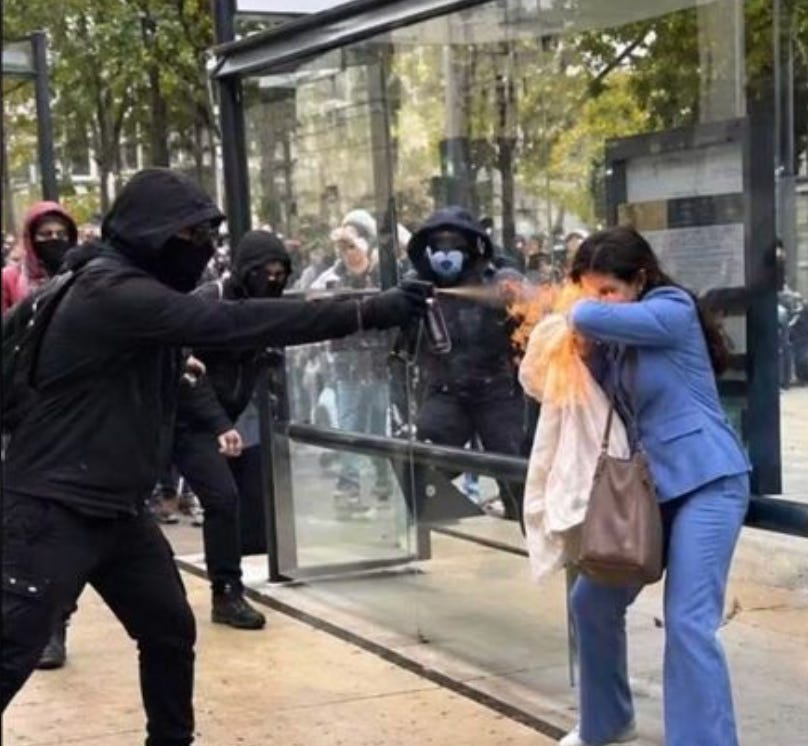
OTTAWA – On Thursday in Marseille, a woman told a group of youths to stop wrecking a bus shelter. One of them, masked, turned an aerosol can into a makeshift flamethrower and sprayed fire into her face. The video has gone around the world. A 15-year-old, identified through street cameras, is in pretrial detention, and prosecutors are pursuing a charge of “act of barbarism.”
We were told this was a student protest. It began in late September at high schools around Paris, over grievances that may be real enough, in the middle of a government austerity drive.
On Thursday, October 1, police made 1,949 arrests and 305 police officers and gendarmes were injured.
By Friday, at least 65 school staff had been hurt, 40 of them principals. A teacher in La Ciotat was doused with gasoline, then beaten by two attackers. In Paris, a trainee police lieutenant was chased down by a pack of youths and kicked on the ground to cries of “kill her.”
In Marseille, rioters looted a fire truck and burned it. In Nantes, fire gutted the entrance hall of a high school. Earlier in the week, Interior Minister Laurent Nuñez reported seven cases of hydrochloric acid thrown at officers. A union official in Marseille told Europe 1 that groups began gathering one day last week at 3:30 in the morning, almost all masked, with Molotov cocktails already prepared.
French intelligence reached the same conclusion.
A note from the intelligence service of the Paris police prefecture, revealed by Le Figaro, states that the movement’s origins “quite evidently lie in the exploitation of student union structures and political movements close to the far left.” It warns of a possible “strategy of conflagration” ahead of elections.
It names France Unbowed, Jean-Luc Mélenchon’s party, alongside far-left outfits including Révolution Permanente and Le Poing Levé, and records some 20 of the party’s national elected officials at the September 29 mobilizations.
Prime Minister Sébastien Lecornu’s office, citing intelligence services, blamed “an organized maneuver by France Unbowed and its ultra-left proxies.” President Emmanuel Macron, speaking during a state visit to Spain, accused politicians of turning up outside schools to “stir up” students. Bruno Retailleau, the former interior minister, called the reported contents of the intelligence note “damning.”
You don’t need a leaked document to see it.
French critics have warned for years of a “red-green” alliance between the hard left and Islamist currents in the suburbs, and the intelligence note focuses on Seine-Saint-Denis, a France Unbowed stronghold. The note, as published, documents the red. It does not establish the green.
Even so, the state’s own intelligence apparatus is accusing a party led by a leading presidential contender of riding a wave of street violence six months before the vote.
On Friday, France’s 10-year borrowing cost briefly topped 5 percent, the highest since 2002. Public debt stands at €3.6 trillion, 119 percent of gross domestic product, a level not seen since 1946. The state spends 57 percent of national output, the most in the European Union. This year, for the first time, Paris will spend more on interest than on its national education budget, which pays for the very schools now behind barricades. The finance ministry expects the interest bill to reach €91 billion next year.
Michael A. Arouet, a widely followed market commentator, put it bluntly last week: “The next euro crisis will begin in France. The first, which began in Greece, will feel like a walk in the park compared with what comes next.” He argues markets already price French debt as junk. All three major rating agencies still rate France solidly investment grade, for now, but agencies tend to follow markets, not lead them.
Could Europe rescue France? Greece needed €288.7 billion across three bailouts. The euro zone’s rescue fund can lend up to €500 billion. France’s debt is more than seven times that. A rescue would mean rewriting the rules and asking German and Dutch voters to underwrite Paris.
Nor would the damage stay in Europe. During the Greek crisis, Canada’s finance minister, Jim Flaherty, warned that “Canada is not an island.” France’s economy is more than ten times the size of Greece’s. A French debt crisis would be felt in American and Canadian banks, pension funds and bond markets.
On September 16, Mark Carney sat in the front row in Strasbourg as Ursula von der Leyen offered to open the door for Canada to become the European Union’s first “associate member,” a status that does not yet exist. The chamber gave him a standing ovation, and he embraced the idea before the European Parliament the next day. Days later he stood beside President Macron in Saint-Pierre-et-Miquelon, agreeing to deepen space and defense cooperation. A Canada-European Union summit opens in Montreal on October 29.
Diversifying trade makes sense. Canada sends about 70 percent of its exports to the United States and only 5.5 percent to the European Union.
Associate membership is something else.
It ties Canada’s political future to a bloc whose second-largest economy is rioting and running out of fiscal road.
Its southern frontier saw up to 2,000 people cross into Spain’s Ceuta enclave in ten days this summer, with at least 18 dead.
Its eastern flank is under steady Russian pressure. In August, a drone rigged with explosives, reportedly assessed by American intelligence as Russian, was found beside a Ukrainian cargo plane at Germany’s Leipzig/Halle airport. Last month, Russian Gerbera drones crashed in Romania and Moldova, and a suspected sabotage fire hit a Starlink station in Poland.
Before Carney signs Canadians into deeper bonds with a union under assault from within—in France—and externally, on its eastern flank, Canadians deserve to hear him explain what associate membership would oblige Canada to.
And what, exactly, is gained by joining a house that can no longer pay its bills while its streets are on fire?
Carney is contemplating a new digital currency for trade settlement between the EU and Canada. Many questions arise from this and would be considered to be an assault on the US dollar as the reserve and international trade settlement currency .
Canada, France, Germany are led by former investment bankers…. carney left his employment with Goldman Sachs to parachute into the Canadian gov in 2004 to prepare to bail out the banks… he saw what was coming as the banks handed out subprime mortgages (Goldman one of the worst offenders) and placed himself, not to help the country, but the banks. Hank Paulson & Mario Draghi employed the same strategy… both also with Goldman. They looted us. They’re looting us again.. this is their sole aim. Wake up. this gang is trying to destroy Russia to get the riches of Ukraine & has murdered all of its men to get there, now Putin is bombing the women. These bumbling b@stards have never worked a full day in their lives & are driving us toward world war… without a doubt… if you think otherwise you are as stunned as Kaja Kalas.