


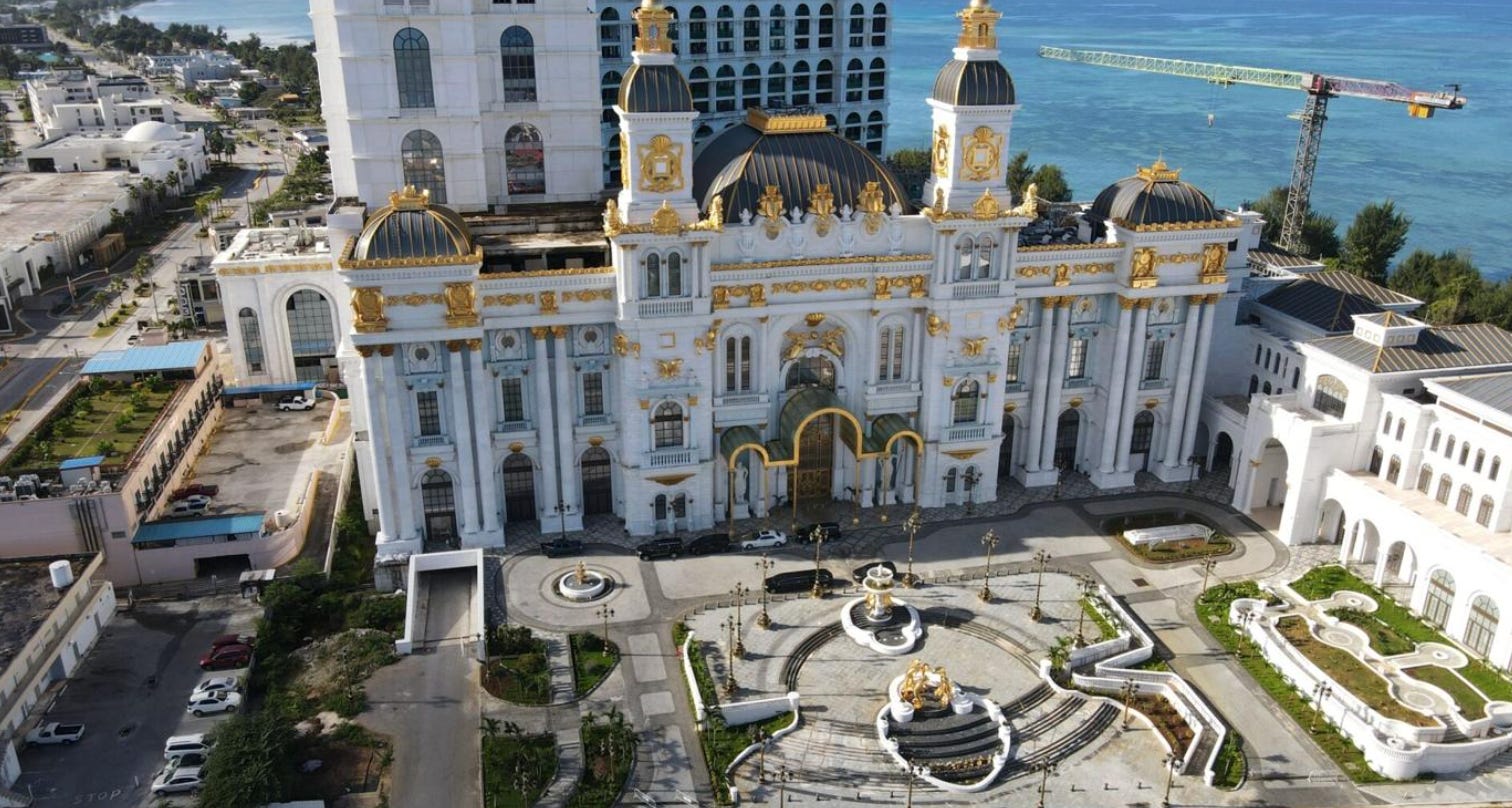
SAIPAN – The irony was almost too neat, and Jim Kingman felt it land as he sat in the gleaming, barely used federal courthouse on Saipan in the summer of 2024 and watched the United States government close the book on Julian Assange.
They had come a very long way to do it. The head of the Justice Department’s national security division flew in that morning; by early afternoon the WikiLeaks founder had pleaded guilty to a single Espionage Act count over the disclosure of Bradley Manning’s classified files, been sentenced to time served, and was gone — three hours, beginning to end, the federal lawyers not bothering to feign curiosity about the island they had chosen as the stage.
Kingman, a Harvard Law School graduate who had spent years prosecuting fraud, financial crimes, and child exploitation in Texas before arriving in 2023 to lead the CNMI government’s anti-corruption task force, had grown skeptical — maybe that is too soft a word — about Washington’s national security lens on Saipan, and about the inroads of an adversary that made Assange look like a saint.
To be blunt, he felt like a man disabused of an earlier faith in justice. Absent any self-deprecation, he would tell friends that his appointment as the corruption investigator probing the island’s casino hotel amounted to little more than a patsy’s role.
So as the argument unfolded about how Assange’s leaked secrets had imperiled American national security, Kingman, who had prosecuted here and read the place far more closely than its visitors, sat thinking about the airport they had flown into that morning: a port of entry that by his account had gone twenty-five years without answering an audit, functioning all the while as a channel for cheap labor to feed the United States’ appetite for clothing.
The undermining of national security, he thought, was not the thing being adjudicated in this room. It was the room itself — the whole island, and Washington’s long, deliberate refusal to look at Beijing’s saturation of its every nook and cranny.
He was not the only person in that courtroom who understood the island for what it was.
Kevin Rudd, the former Australian prime minister, was there too, and only months earlier Kingman had attended a gathering on strategic competition in the Pacific where Rudd had spoken about Chinese operations of the kind the Australians had been confronting for years.
“Rudd definitely knows the game,” Kingman recalled, in an interview. He had sat in that courtroom half-wishing the visitors from Washington and Canberra would simply stay.
“I just want these people to stay here for just a couple days, because they’ll see it as fast as I do of what’s happening here.” None of it, he said, came to fruition. The plane left. The island went back to being what it had been: a piece of America well familiar to Beltway insiders from the days of Jack Abramoff’s influence — his efforts, exposed in media reports, to attack the lawmakers who sought to turn over the rocks and examine the unsavory face of coerced Chinese labor. From the casino to the labor cases still grinding through the courts over abuse on the sprawling hotel project, it was, for Kingman, a place Washington still refuses to examine.
“When I first got on island, the very first morning, I looked down and I see the gigantic Imperial Pacific Casino three quarters built and just rotting away, towering over the entire rest of the island,” Kingman recalls. “And I immediately am like, ‘Oh, this whole thing is a gigantic Chinese money laundering operation.’ And I was a little bit shocked that the guy that brought me out there, didn’t give me any sort of heads up on that.”
To understand why a Texas prosecutor came to see himself as a token investigator in Saipan — empowered on paper but constrained in practice — you have to understand the casino, and to understand the casino, you have to understand what came before it.
Saipan is a strip of coral and limestone in the western Pacific, closer to China than to Hawaii, an island of roughly fifty thousand people that flies the American flag. For thirty years after United States Marines took it from Japanese forces in 1944, it idled in the sun, known mostly for the bases it had once housed and the battle that had nearly erased it. That changed in 1975, when the islands voted to become a United States commonwealth and the Ford administration, hoping to give a near-empty economy a pulse, handed the new Commonwealth of the Northern Mariana Islands an extraordinary bargain. Goods made there could enter the mainland with no quotas, tariffs, or duties, and could carry the “Made in the USA” label. In exchange, the commonwealth was exempted from federal labor and immigration law — free to set its own wage floor and to admit foreign workers on its own terms.
Entrepreneurs from China, Taiwan, and South Korea rushed in and built garment factories, sewing clothes for some of the most familiar labels in American malls, and recruited their workforce from the farms and slums of the Asian mainland. In the two decades after the treaty, the commonwealth’s population more than tripled; by the late 1990s, the islands were shipping roughly a billion dollars in textiles to the U.S. mainland each year.
But over time, and under the radar, according to former prosecutors, local officials, and regional analysts, operators linked to Chinese global-influence political bodies known as United Front networks — most of them nominally businesspeople or investors — subtly gained a strategic foothold for Beijing inside the American system itself.
The workers who made those clothes lived something closer to indenture than the American Dream. A congressionally mandated task force reported that 91 percent of the private workforce consisted of foreign laborers, many paying off the fees their employers had charged to bring them across the ocean.
Although the reporting from Saipan does not draw the comparison, the economics and the population flows suggest a system resembling the snakehead human shipments then flooding the West Coast of North America, which — according to American and Canadian intelligence and immigration assessments of the period — moved through Hong Kong and Fujian-based criminal networks and, according to classified Canadian intelligence from 1993, reported by The Bureau, involved Chinese Communist Party leaders in Fujian, and the Ministry of Public Security.
The living conditions and the harsh repayment demands documented on Saipan echo what those same intelligence reports described of the smuggled laborers who worked in underground factory conditions in Vancouver, New York, San Francisco, and Toronto. On Saipan, federal investigators documented guarded barracks, systematic underpayment, retaliation against those who complained, and contracts that forbade workers from falling in love or becoming pregnant. The task force called the islands a national embarrassment.
When reform finally threatened — a 1997 Senate vote to extend United States immigration law to the islands — the commonwealth’s government, and the textile interests it served, turned to Washington for protection. They hired the lobbyist Jack Abramoff, then at the firm Preston Gates, who massaged the assignment into an ideological crusade aimed at right-wing lawmakers, and was eventually paid millions.
Abramoff’s method was the junket.
He and his deputies flew more than a hundred members of Congress, aides, and conservative writers to Saipan; in a memo to the islands’ principal textile patron, intercepted by The Washington Post in 1998, he wrote that thanks to those trips the commonwealth had many friends on the appropriations committees, and in his own strategy documents he called the trips one of the most effective ways to build permanent friends on the Hill. By the measure that counted, it worked.
Despite years of documented abuse, Congress passed not a single bill to reform the islands’ labor regime. The scandal eventually helped send Abramoff to prison, but the machine he had built on Saipan — the lesson that proximity to power could be purchased, and that the federal government could be made to look away — outlasted him.
The garment industry collapsed in the 2000s, when the trade loopholes that had built it finally closed. But the appetite it had created for easy money did not, and a new industry arrived to feed it — one already flourishing in Macau and taking hold, on a smaller scale, in the government-run casinos of British Columbia. The VIP gamblers from China who drove it, the “whales” of Las Vegas lore, could generate turnover out of all proportion to their numbers, provided the gaming houses they visited turned a blind eye to Chinese mafia lenders, underground bankers and loan sharks.
The vehicle on Saipan was Imperial Pacific International, a company controlled by a Chinese business family with deep roots in Macau’s junket trade.
It won the sole casino license on the island in 2014 despite having never built or operated a casino, and before its permanent building was finished it was already running a temporary floor — what Kingman describes as a training operation to break in new dealers, eleven VIP tables tucked behind a duty-free shop.
Those eleven tables, he says, turned over more money in a single quarter than the great houses of Macau. It was those figures, reported to international gaming regulators, that first drew the notice of journalists, and then of the FBI. “At no point was it ever intended to make money,” Kingman told The Bureau. “It was intended to launder money.”
The model that replaced the garment trade was, in a sense, its mirror image. The old economy had extracted value by shipping goods outward — clothing built on coerced labor, stamped “Made in the USA” and sold to American consumers.
The new economy ran the value the other way, pulling corruption money out of China and washing it across the tables, the gaudy building almost incidental to the flow. In Kingman’s reading, the purpose of those funds carried a deeper aim than mere profit. The labor abuses did not disappear in the transition; they were rebuilt on the construction site.
The casino’s contractors brought thousands of Chinese workers to Saipan, confiscated their passports, and worked them in twelve-hour shifts for less than the minimum wage. Doctors at the local hospital recorded more than eighty serious injuries on the site in ten months. The scheme came undone only when a worker fell from the scaffolding and died in March 2017, prompting an FBI raid that uncovered a cabinet of confiscated passports and lists of undocumented laborers.
Federal authorities ultimately recovered nearly fourteen million dollars in back wages for roughly twenty-four hundred workers, and seven Chinese construction workers later won a landmark forced-labor and human-trafficking judgment of more than five million dollars. A federal grand jury indicted three IPI and contractor executives on a seventy-one-count case alleging they had moved more than twenty-four million dollars into the United States to promote illegal activity.
And yet, on the gravest questions — the corruption, and the money laundering that Kingman believes was the casino’s actual purpose — the cases never came. IPI was never charged with casino money laundering, even after the November 2019 raids that swept up not only the company’s offices but the governor’s office and the offices of a consultancy and a realty firm.
Investigators and former officials involved would later tell reporters that the probes lacked federal resources and the attention of Washington. The FBI agents on the ground in Saipan, Kingman says, ended up pushed out; the investigation, in his account, was undermined from within, “not because there’s anything wrong with the facts, but just because the Feds didn’t want it to work.”
That last is his characterization, and it is an allegation rather than an established fact. But the documented pattern around it is not in dispute: the evidence was abundant, and the serious indictments never materialized.
If Kingman sees the machine from inside a courtroom, others have described it from the altitude of national strategy. Tony C. T. Hu — a former Defense Department China director with deep expertise in Beijing’s global warfighting and clandestine capabilities — laid out the same architecture at a briefing this winter in Ottawa, attended by Taiwan’s ambassador to Canada, Harry Tseng, and his staff. Before he walked his audience through carrier strike groups and missile silos, Hu took up a question that has preoccupied Western security services for years but rarely surfaces in public: whether China is weaponizing migration into strategic islands such as Saipan. His answer was flat — yes, and it reaches to the highest levels of the Chinese Communist Party. “If you look at Tonga — it’s a country that’s only got about 20,000 people — you’ve got 4,000 Chinese there or something. They’re changing the demographic so that they can change the elections.” Asked whether the same approach extends into the Western Hemisphere, from Saipan to Samoa to Vancouver, Belize, and Bermuda, Hu was unequivocal: “Same thing. Same intention.”
The mechanism he described is one The Bureau has documented at length: organized-crime networks — including the junket operations that move billions through casinos from Macau to Vancouver, Saipan, and Sydney — harnessed to what Hu calls a “grand strategy” directed from Beijing. “Most of these criminal activities involve high-level people,” Hu said. “CCP people. And they benefit from it monetarily, but they also have a grand strategy. So it’s a win-win for them. They’re untouchable inside of China, and they just keep on doing it.”
When The Bureau put that fuller interpretation to Kingman directly — that the laundering was a means to an end, the patient purchase of proxy influence over a strategically vital American island in the second island chain — he affirmed it. “What you’re describing is accurate,” he said.
He also recognized another element that some U.S. intelligence sources and experts on China’s so-called “hybrid warfare” recognize: the deliberate flooding of narcotics into a target population.
As a prosecutor, Kingman had watched it unfold in rural Texas.