


OTTAWA – I joined Brian Lilley for a wide-ranging conversation that started with the machinery of Beijing’s foreign influence in Canada and Conservative leadership politics, then moved into MP Larry Brock’s departure and Brian’s explosive scoop: Brock disclosed to his party leaders that Mark Carney’s party had dangled a judicial appointment before him amid Carney’s floor-crossing campaign.
I started with the documentary record on Beijing’s 575 United Front Work Department community groups in Canada, including a group that pressured two successive party leaders to step down.
Drawing on Jamestown Foundation research into Chinese Communist Party influence operations in Canada, I explained how these United Front organizations are tasked with targeting local politicians and community leaders, mobilizing voters behind candidates viewed as supportive of Beijing, and applying pressure to political parties and institutions.
This isn’t about one political party, and it doesn’t require us to assume that any individual politician understands or acquiesces to Beijing’s community networks.
The broader picture is roughly 575 organizations, or 576, counting the organization led by a Canadian senator and now confirmed to The Bureau as having Beijing links, operating in Canada within systems that Beijing can mobilize to surround politicians, shape political narratives and, ultimately, try to influence elections and leadership contests.
Brian then gave a striking example from his own experience.
The morning after Erin O’Toole lost the 2021 election, Brian received a cold call from a man he had never heard of—and who, Brian said, had no obvious reason to have his number. The message was simple.
O’Toole had to go.
Brian’s interpretation was equally clear. O’Toole had been hawkish on China from the beginning. Beijing disliked him and, in Brian’s view, wanted him removed.
I added what Canadian intelligence reporting has shown. In my reporting, I described intelligence intercepts involving Chinese consular officials discussing the need to push a message through diaspora communities that electing a leader like O’Toole would be comparable to electing Donald Trump.
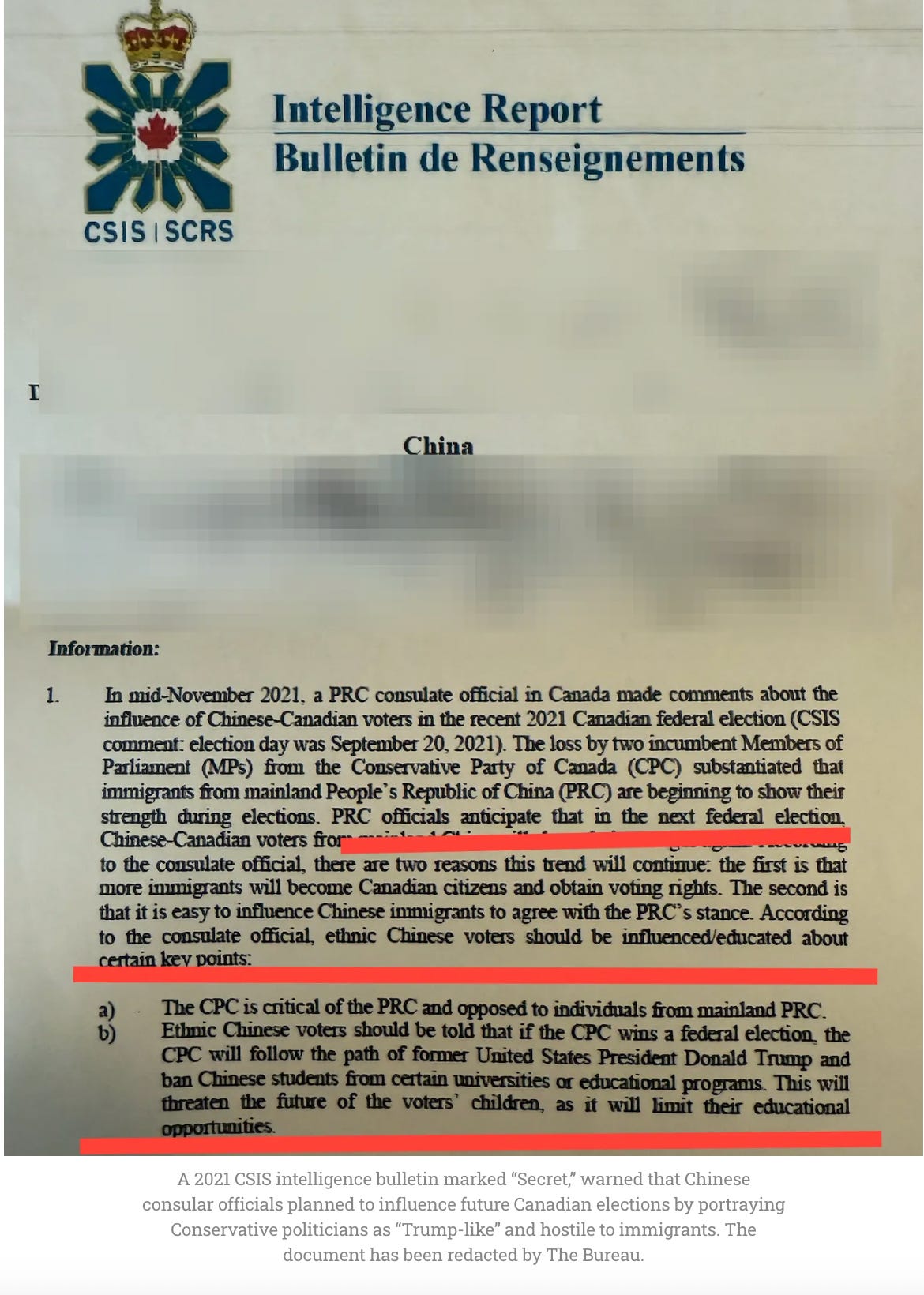
That brought us to the current leadership question.
A leadership vacancy creates an opportunity. Members can be signed up. Networks can be activated. A preferred candidate doesn’t have to be Beijing’s ideal candidate—just somewhat “less bad” from Beijing’s perspective.
My reporting showed that a Chinese proxy agent, according to CSIS reporting I obtained exclusively, attempted to influence a federal party leadership contest in 2022 by paying for memberships, recruiting CCP members to join the party, and seeking to make it less hawkish toward Beijing.
While CSIS did not name the Conservatives, my sources inside the party and within the diaspora pointed to a network that sought a leader other than Poilievre, I told Brian.
I also told him that we know the Chinese Communist Party studies Western political systems and individual politicians in extraordinary detail. The objective, as I put it to Brian, is fairly simple: they are trying to win inside our system.
From there, I turned the questions back on Brian.
On party operative Kory Teneycke, I pressed Brian on speculation that Teneycke had been working back channels to encourage a Jason Kenney leadership bid.
Then we got into Larry Brock.
Brock’s departure, Brian said, has nothing to do with dissatisfaction with the Conservative leadership.
Brock had been on leave from his position as a Crown prosecutor and faced a September deadline to make a permanent choice.
The more significant disclosure involves what happened earlier this year. According to Brian, the Liberals dangled the possibility of a judicial appointment in front of Brock. Brock declined and immediately reported the matter to the Conservative whip and House leader.
Brian’s assessment is that nobody crossed the legal threshold for an inducement. But he believes the Liberals should still have to answer for what happened—and that Brock should not be blamed for reporting it.
We closed on two larger questions I’ve been looking at.
The first is whether consulting firms and law firms—including firms employing former senior politicians—are increasingly being used as access points into Canadian political institutions.
The second is what a decade of Liberal Party judicial appointments has done to public confidence in the courts.


