'That's Crazy': Conservative MPs Confront Canada's Refugee Chief Over Iranian Regime Suspect Shielded From Public View
The head of Canada's Immigration and Refugee Board also confirmed for the first time that more than 23,000 asylum claims were approved without a hearing.
OTTAWA — The head of Canada’s refugee tribunal told a parliamentary committee Monday that she does not know the name of a suspected senior Iranian regime official whose identity her own board concealed from the public in a deportation hearing — and that the concealment was granted at the man’s own request.
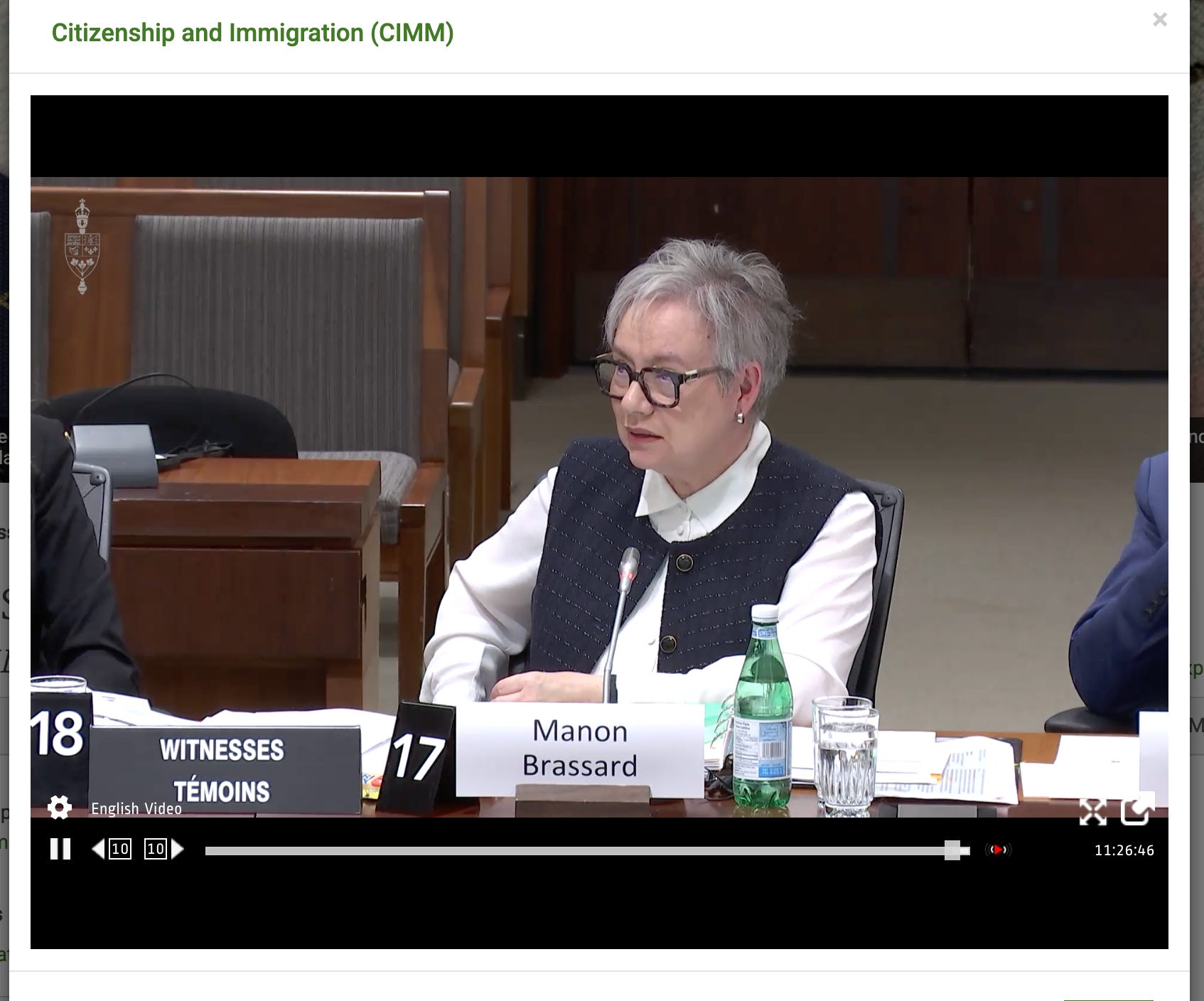
Manon Brassard, chairperson of the Immigration and Refugee Board, appeared before the House of Commons immigration committee to answer for the first time to an explosive C.D. Howe Institute report — first reported by The Bureau.
The report found the IRB had accepted tens of thousands of asylum claims from a list of nations that didn’t require in-person interviews, including Iran and Syria. It documented acceptance rates running nearly double those of Canada's peer nations, and a backlog that has grown from 17,000 claims in 2016 to nearly 300,000 today. She confirmed for the first time that more than 23,000 of those claims were approved without a hearing or a single question asked.
But Conservative MPs used the hearing to hammer Brassard on a separate threat: a Global News report revealing that a suspected senior Iranian regime official had appeared before the board for a deportation hearing on February 6 — and that the IRB had banned reporters from publishing his name and sealed all records in the proceeding.
Conservative MP Costas Menegakis, who represents Richmond Hill — home to one of the largest Iranian-Canadian communities in the country and an area reeling from fears that Revolutionary Guard networks could be targeting the Iranian diaspora and Jewish communities — bluntly asked Brassard to name the suspect. It was one of more than two dozen cases brought against suspected senior Iranian officials living in Canada since 2022, a campaign that has produced just one deportation in nearly four years while the board has shielded most subjects from public identification and permitted five to remain in the country.
“I don’t know his name,” Brassard told the committee.
“Your department was there,” Menegakis replied.
“Yeah, but I don’t know the name of every single person who makes a claim,” Brassard said.
When Menegakis pressed further, Brassard acknowledged the case but said the name “is confidential.”
Menegakis demanded to know why the board was “prioritizing the privacy of an alleged member of a terrorist organization over the safety of Iranian Canadians.” Asked whether the IRB grants the same anonymity to suspects linked to other terrorist organizations — naming the Islamic State and al-Qaeda — Brassard said the board applies the law as written.
Menegakis then asked how many of the hundreds of thousands of pending asylum claims belong to individuals with alleged ties to the Islamic Revolutionary Guard Corps. Brassard said she had no number to provide. Asked how many are in the queue for deportation, she referred him to the Canada Border Services Agency.
A CBSA official at the hearing said he also lacked the specific data.
“Could one of you answer why there’s only been one deportation in almost four years?” Menegakis asked.
Neither witness answered directly.
Conservative MP Michelle Rempel Garner pressed harder in a subsequent round, challenging Brassard on the legal basis for concealing the Iranian suspect’s identity entirely.
Rempel Garner turned first to the CBSA official, asking directly: would the agency have recommended deportation without evidence that the individual was a senior member of the Iranian government — or would it simply have invented that finding?
“Yes,” the official acknowledged, confirming that the agency would have evidence.
“So in what universe would you go against Section 166 of your law and withhold this person’s identity from the public?” Rempel Garner demanded of Brassard. “Why would you do that?”
A colleague of Brassard’s said the legislation requires proceedings before the immigration division to be closed to the public when a board member orders a confidentiality order.
Rempel Garner was unmoved. “This is a deportation hearing,” she said.
“Why would you protect the identity of a senior Iranian government official in Canada on a deportation order requested by the CBSA?”
“That’s crazy.”
“Okay. Well, that’s your view,” Brassard replied.
“No, I think that’s the public’s view,” Rempel Garner shot back.
The question of what constitutes a deportable Iranian official has been tested before — and the IRB’s answer has frustrated the Iranian-Canadian community.
Menegakis raised the case of Afshin Pirnoon, a civil engineer who served as director general of Iran’s Road Maintenance and Transportation Organization for 22 years before arriving in Canada on a tourist visa in 2022 and working as an Uber driver. The CBSA alleged he was a longtime senior functionary and political asset of the Islamic Republic and sought his removal.
The IRB declined, ruling in August 2025 that despite two decades of service Pirnoon did not qualify as a “senior official” and had not exerted significant influence over government policy. The board member found that “meeting with representatives of the Supreme Leader does not necessarily lead to the conclusion that Mr. Pirnoon influenced government policies and decisions.” The minister of roads under whom Pirnoon served was Mohammad Eslami — now on sanctions lists in Canada, the European Union, and the United Kingdom for his alleged role in the development of nuclear weapons, and currently the head of Iran’s Atomic Energy Organization.
“What is the IRB’s threshold for significant influence if a 22-year official in the Iranian regime does not meet it?” Menegakis demanded of Brassard.
“It depends on the degree of involvement that official has in the decision making of their government,” Brassard said, “and that is something framed very much so by the federal court, and that’s what we apply.”
Asked whether she found it acceptable that only one person had been deported in nearly four years from a list of suspects the government itself had flagged for removal, Brassard was blunt: “No comments to make on that,” she said.
The Islamic Revolutionary Guard Corps deportation cases were not the subject of the C.D. Howe report — but Iran ran through both threads.
Its author, James Yousif, a lawyer and former IRB adjudicator, identified Iran as one of the high-risk nations that had appeared on the IRB’s country list, meaning Iranian nationals could have their asylum claims accepted without a hearing or a single question asked, even as the board was granting confidentiality to suspected Iranian regime members facing deportation in separate proceedings.
Brassard pushed back on several of the report’s findings while confirming its core numbers.
She said approximately 23,000 claims had been processed through the paper-based File Review stream without an oral hearing — broadly consistent with the numbers Yousif documented through access to information requests covering January 2019 to February 2023, with the policy continuing to operate in the years since.
She disputed that the policy was a response to backlog pressure or that it created a security gap.
On security, Brassard argued that front-end screening by the Canada Border Services Agency and Immigration, Refugees and Citizenship Canada — including RCMP and CSIS checks — occurs before any file reaches the IRB, and that the minister is notified and given the opportunity to intervene before any claim enters the paper stream. “When we see something, we say something,” she said.
Conservative MP Brad Redekopp pressed her on the precise vulnerability Yousif identified: that rules requiring the IRB to notify the ministers of public safety and immigration when security flags arise during a hearing cannot be triggered if no hearing takes place.
Brassard acknowledged the mechanism but said the minister’s intervention opportunity upstream of the IRB compensates for it. “The minister has — and my colleagues can testify to that — they will look at the claims before it even gets to the IRB,” she said. “If they detect issues around security, if they detect issues around identity, they can tell us.”
She also disputed that the policy functions as a fixed country list. “There’s never a real established list,” she said. “It’s a guide.”
Redekopp challenged her on that point, noting that the IRB’s own 2019 published list included countries such as Afghanistan, Iran, Syria, and Russia — nations he said could not reasonably be described as low-risk.
Brassard defended the program’s scale. Ending the program entirely, she warned, would reduce the number of claims heard annually, drive up interpreter and legal aid costs, and slow processing for claimants she described as presenting well-founded, non-complex cases — typically women and families fleeing documented persecution.
“We would lose efficiency,” she said. “We are required by law to move expeditiously.”
Yousif, testifying separately before the same committee, was asked directly what he would tell the IRB to do. “I would ask them to end the policy of accepting asylum claims without asking any questions,” he said.
Canada’s asylum acceptance rate reached 79.8 percent in 2024 — among the highest in the world. Ireland accepted 30 percent of claims that year, Sweden 40 percent, Germany 59 percent. The claims backlog, which stood at 17,000 in 2016, has grown to nearly 300,000.
Editor’s Note: This story was clarified to note Yousif’s report found the IRB had accepted tens of thousands of asylum claims from a list of nations that didn’t require in-person interviews, and these nations are listed in an Appendix of the C.D. Howe report.


This is what a gvt run Open Border looks like. We don't need a wall we need a regime change.
But Trump is a bad man or if you prefer, a mad man.
Honestly, the denialism in Canada on so many concerning issues is beyond mind boggling.