


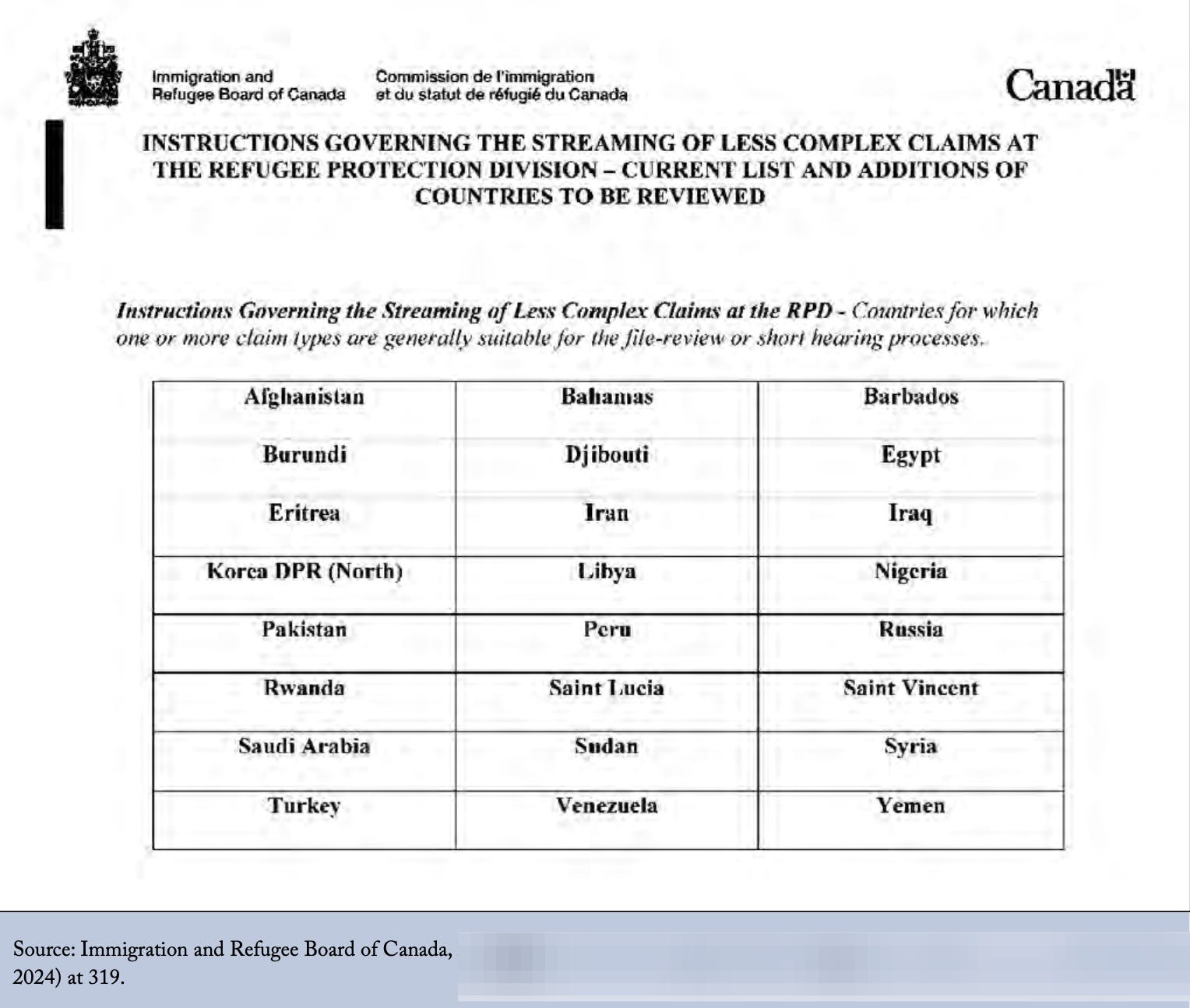
OTTAWA — A sweeping new border control investigation has revealed that since 2019, Canada’s refugee hearing board has been quietly accepting tens of thousands of asylum claims without ever questioning the migrants, effectively rubber-stamping applications from some of the most dangerous countries on earth — Afghanistan, Iraq, Syria, Russia, Pakistan, and Iran — through a paper-based process that is wide open to fraud and bypasses the security screening architecture designed to protect the nation.
The findings, published by the C.D. Howe Institute in a report by former immigration and refugee board member James Yousif, expose what may be one of the most consequential — and least understood — vulnerabilities in Canada’s immigration system.
A border control policy meant to reduce refugee claim backlogs has not only failed, but may have amplified the pressures it was meant to relieve, becoming a magnet for international fraud and human smuggling networks, with Ottawa approving roughly 80 percent of asylum claims — nearly double the rate of Ireland, Sweden, Germany, and Belgium.
Equally troubling, amid what the report portrays as a systemic breakdown, the Immigration and Refugee Board may have modified its internal evidence packages to support its paper-review policy change — which favours quickly accepted refugee claims over rejections, which require more work and post-decision scrutiny.
Yousif, a lawyer and former Canadian immigration policy director, found that among the countries whose nationals were fast-tracked for acceptance without a hearing, thirteen are home to active terrorist organizations listed by the Government of Canada itself.
Internal government briefing documents obtained through access-to-information requests acknowledged the risk: “The countries that can be expedited … are also countries that represent the highest concerns in terms of the serious inadmissibilities and … exclusions for the Public Safety Portfolio.”
In plain language: the countries whose claims Canada fast-tracks without questioning are the same countries that produce the greatest number of security threats — and the system may be vulnerable to exploitation by individuals seeking to implant criminal and terror networks transnationally.
Yet under the policy, a national of any of these countries can enter Canada, submit a paper application to an initial check system that is vulnerable to fraud and forgery according to Yousif, and enter society without checks and balances.
“That means that a person from a country on the Immigration and Refugee Board’s Country List can enter Canada, make a claim for asylum, and receive a positive determination in the mail, without being asked a single question,” the report says.
It explains that in-person questioning is one of the most effective methods for refugee adjudicators to detect fraud and test the credibility of a claim.
Between January 2019 and February 2023 alone, at least 24,599 people were granted asylum in Canada this way — receiving their positive determination in the mail, sight unseen. The true number is almost certainly far higher, as the policy has continued to operate in the years since.
The policy, it argues, has effectively broadcast a roadmap to those seeking to exploit the system.
“It signals in advance to false claimants, human smugglers and other intermediaries which specific countries and claim types may receive less scrutiny and faster processing, thereby identifying precisely which fabricated narratives are most likely to succeed.”
And every fraudulent claim that succeeds carries permanent consequences.
The report notes that accepted claims entail “significant permanent downstream fiscal implications” through “ongoing cost implications for social programs at every level of government.” Once a fraudulent claimant is accepted, they gain access to permanent residency, family sponsorship, healthcare, and social services — costs that compound across decades and cannot be easily reversed.
These are the types of cost implications that have attracted furious scrutiny and tense immigration-control standoffs in U.S. states such as Minnesota, where federal investigations have exposed — and continue to probe — widespread immigration and social-services fraud.
Meanwhile, the File Review policy did not achieve its stated objective.
Despite the IRB more than doubling its annual decision output and expanding its workforce from under 1,000 to over 2,500 employees, the asylum backlog exploded from roughly 17,000 claims in 2016 to nearly 300,000 by late 2025 — a 1,450 percent increase. The policy was designed to reduce that backlog.
The contrast with the United States is stark — and likely significant to current border and trade disputes between Washington and Ottawa.
On Dec. 16, 2025, President Trump expanded travel restrictions on nationals from countries with what the White House called “demonstrated, persistent, and severe deficiencies in screening and vetting” — including Afghanistan, Eritrea, Iran, Libya, Somalia, Sudan, and Yemen.
All of these nations, save Somalia, were discovered by Yousif on the IRB’s File Review policy list. While Washington restricts entry from these countries on security grounds, Ottawa’s refugee tribunal has been accepting claims from their nationals without so much as a conversation.
The findings, from an insider expert on a system that has come under wide public criticism, come at a time when Canada is already struggling to cope with a historic surge in irregular migration, industrial-scale immigration fraud, and organized criminal exploitation of its borders.
The report also lands on the same fault lines The Bureau has documented in its exclusive reporting on the South Asian diaspora extortion wave: an ecosystem that Surrey Mayor Brenda Locke has described as a major national-security vulnerability.
The Bureau’s government sources, corroborated by the mayor’s public warnings, pointed to an immigration and border-control system so volume-strained — and so exposed to fraud intermediaries and forged documents marketed to migrants by organized-crime networks for massive profit — that foreign mafias can use Canada’s pathways not only to extract money from migrants, but to recruit, coerce, and mobilize them into violence.
Investigators believe some of that violence is entangled with overseas political conflict, including tensions involving the Indian government and Punjabi separatist networks.
A System Built to Survive Under Trudeau’s Administration
The origins of the File Review policy tell a story of institutional self-preservation that, according to the report, may have reshaped Canada’s entire asylum landscape with incentives that gravely undermine the nation’s national security and economic integrity.