


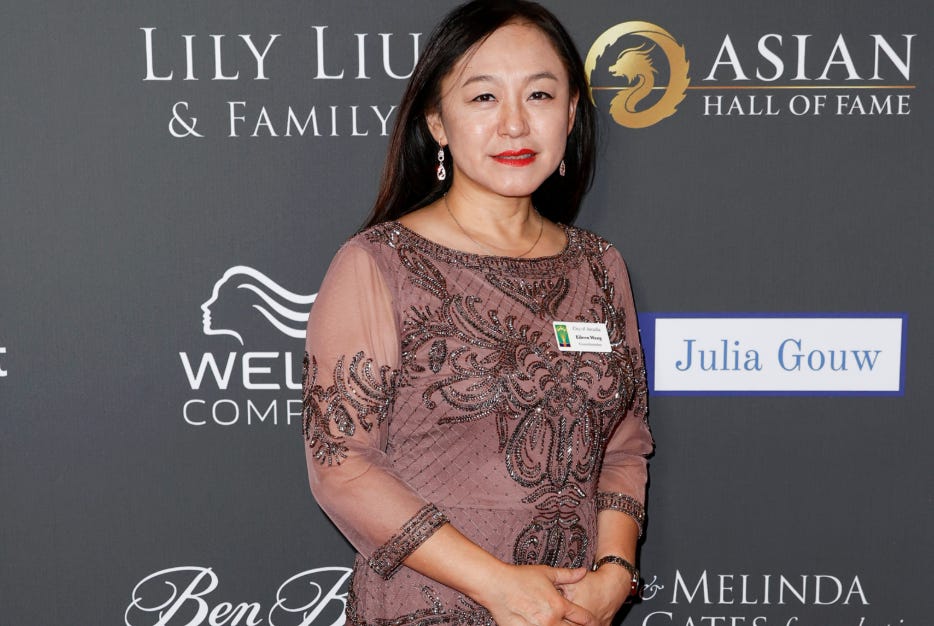
LOS ANGELES — The mayor of Arcadia, a wealthy Los Angeles suburb that federal investigators have previously identified as a hub for Chinese underground banking networks, has admitted to secretly working as an agent of the People’s Republic of China — co-running a fake news operation with a former People’s Liberation Army officer that pushed Beijing-scripted propaganda denying slave labor in Xinjiang, the Justice Department announced Monday.
Eileen Wang, 58, has agreed to plead guilty to a single felony count of acting as an unregistered foreign agent, a charge carrying a maximum sentence of ten years in federal prison. Her admission appears to make her the first elected official in United States history to plead guilty to acting as a covert agent of the Chinese government.
The Bureau has previously reported on the case of her co-conspirator, Yaoning “Mike” Sun, 65, of Chino Hills — a former People’s Liberation Army officer now serving a four-year federal prison sentence after pleading guilty to acting as an illegal agent of a foreign government in October 2025. Wang and Sun were engaged to be married, and Sun served as treasurer of her 2022 election campaign.
Together, they operated within Beijing’s United Front Work Department foreign influence networks alongside a senior PRC intelligence agent, John Chen, of Chino, who had attended elite Communist Party functions and met personally with President Xi Jinping.
The Sun indictment — which did not explicitly name Wang, identifying her only as “Individual 1” — described Sun boasting to Chinese handlers that he had helped elect a “New Political Star” with connections to prominent California politicians, and reporting her 2022 city council victory up the chain to his intelligence contacts.
In August 2023, Wang and Sun traveled together to China and met with PRC officials — a visit prosecutors presented as a direct operational conduit between Beijing’s overseas apparatus and local American elected politics. Sun subsequently sought $80,000 from his handlers to expand operations targeting “anti-China forces,” with Wang’s successful election as the centerpiece of that ask.
The mechanics of the propaganda operation they ran together, as laid out in Wang’s plea agreement, are damning.
In June 2021, a PRC official contacted Wang and others through WeChat with pre-written news articles, including an essay published in the Los Angeles Times under a Chinese government byline. The article stated: “China’s Stance on the Xinjiang Issue — There is no genocide in Xinjiang; there is no such thing as ‘forced labor’ in any production activity, including cotton production. Spreading such rumor to defame China, destroy Xinjiang’s safety and stability, weaken local economy, suppress China’s development.”
Within minutes of receiving the directive, Wang posted the article to U.S. News Center and sent the official a link confirming it was live. The others in the group chat did the same. The official responded: “So fast, thank you everyone.”
By August 2021, Wang and three other members of the same group chat were amplifying the same article across their respective websites at the official’s request. Wang personally edited the article on the PRC official’s instruction, then sent a screenshot showing the piece had been viewed 15,128 times. The official replied: “Great!” Wang’s response: “Thank you leader.”
The Xinjiang content speaks directly to Beijing’s top foreign policy concerns. Forced labor in Xinjiang supply chains is among the most contested trade and human rights issues between China and the West, and sits at the heart of current Canada-United States-Mexico Agreement review discussions, in which supply chain transparency and forced labor provisions are live pressure points between all three governments. Content denying those practices, distributed through elected officials and outlets designed to resemble independent community journalism, carries direct impacts on global labor standards and serious diplomatic consequences.
In November 2021, Wang communicated directly with Chen — identified in court documents as a high-level member of the PRC intelligence apparatus. Wang asked Chen to post a news article from her website, writing: “This is what the Ministry of Foreign Affairs wants to send.” Chen pleaded guilty in November 2024 to acting as an illegal PRC agent and conspiracy to bribe a public official, and was sentenced to 20 months in federal prison.
Wang was elected to the Arcadia City Council in November 2022 and resigned as mayor on Monday.
“Individuals in our country who covertly do the bidding of foreign governments undermine our democracy,” said First Assistant United States Attorney Bill Essayli. “This plea agreement is the latest success in our determination to defend the homeland against China’s efforts to corrupt our institutions.”
Wang’s case lands in a state with a long record of Chinese intelligence and organized crime penetration of political networks.
Former Congressman Eric Swalwell of California was reported by Axios in 2020 to have been targeted by a suspected Chinese intelligence honey-pot operative named Christine Fang, who fundraised for his campaigns and placed an intern in his congressional office — an operation that prompted an FBI counterintelligence briefing to Swalwell. He was never charged.
The late Senator Dianne Feinstein employed a staffer for nearly two decades who was identified by the FBI as a Chinese intelligence asset — a case that again produced no charges.
In San Francisco, state Senator Leland Yee pleaded guilty in 2015 to felony racketeering charges stemming from an FBI investigation into public corruption and arms trafficking with connections to Chinatown organized crime networks, including the Ghee Kung Tong fraternal organization. Yee was sentenced to five years in federal prison. None of those cases produced a finding that an elected official had acted as a directed agent of the Chinese government. Wang’s admission is the first of its kind.
Arcadia’s emergence in a federal foreign agent prosecution is, for investigators familiar with the region, unsurprising.
The Bureau’s prior reporting on Project Sleeping Giant — a sweeping DEA investigation led by former senior agent Don Im — documented Arcadia and the surrounding San Gabriel Valley as operational ground zero for Chinese underground banking networks directly linked to Sinaloa cartel fentanyl cash flows. DEA surveillance teams tracked cash couriers from a stash house on Naomi Avenue in Arcadia to parking lot exchanges with known Sinaloa narcotics couriers. A post-election luncheon central to the Sun indictment was held in Rowland Heights — the same suburban enclave where Sleeping Giant investigators traced a drug stash house and intercepted $500,000 in cash in December 2022.
Don Im, who personally briefed China’s Ministry of Public Security in Beijing in 2017 on how Chinese citizens use WeChat to purchase drug dollars and pay manufacturers to ship goods to Mexico, described the broader system to The Bureau in extensive interviews: a trade-based money laundering architecture in which Sinaloa fentanyl cash circulating in American cities is auctioned on WeChat to wealthy Chinese nationals seeking to move capital overseas.
Those Chinese nationals deposit funds into Chinese bank accounts controlled by US-based underground brokers, then pay a premium for laundered dollars on the American side — covering real estate purchases or university tuition fees without ever triggering an international wire transfer, neatly evading Beijing’s strict capital controls.
The drug dollars that pay for Los Angeles real estate and Ivy League tuition are, in this way, the same dollars generated by fentanyl sales on American streets. In the same transaction, Chinese cash brokers in league with mainland manufacturers who win those currency contracts ship goods into Mexico, where cartel business arms sell the products for pesos — completing the money-washing chain in a single stroke that simultaneously benefits the cartels, Chinese nationals seeking to quietly move wealth abroad, and Beijing’s export economy.
That system, Im argued, operates with the knowledge of Beijing’s provincial authorities and has been woven into the Belt and Road Initiative’s infrastructure and shipping networks. The San Gabriel Valley, with its dense concentration of wealthy Chinese nationals and community associations, sits squarely within its geography.
The federal scrutiny bearing down on Arcadia extends beyond foreign agent prosecutions and narco-banking networks — into territory that is, by any measure, bizarre, and that carries its own resonance with Wang’s dissemination of Xinjiang-linked propaganda.