Op-Ed: The Enemy Is Already Inside the Gates. Mark Carney Just Opened Them Wider.
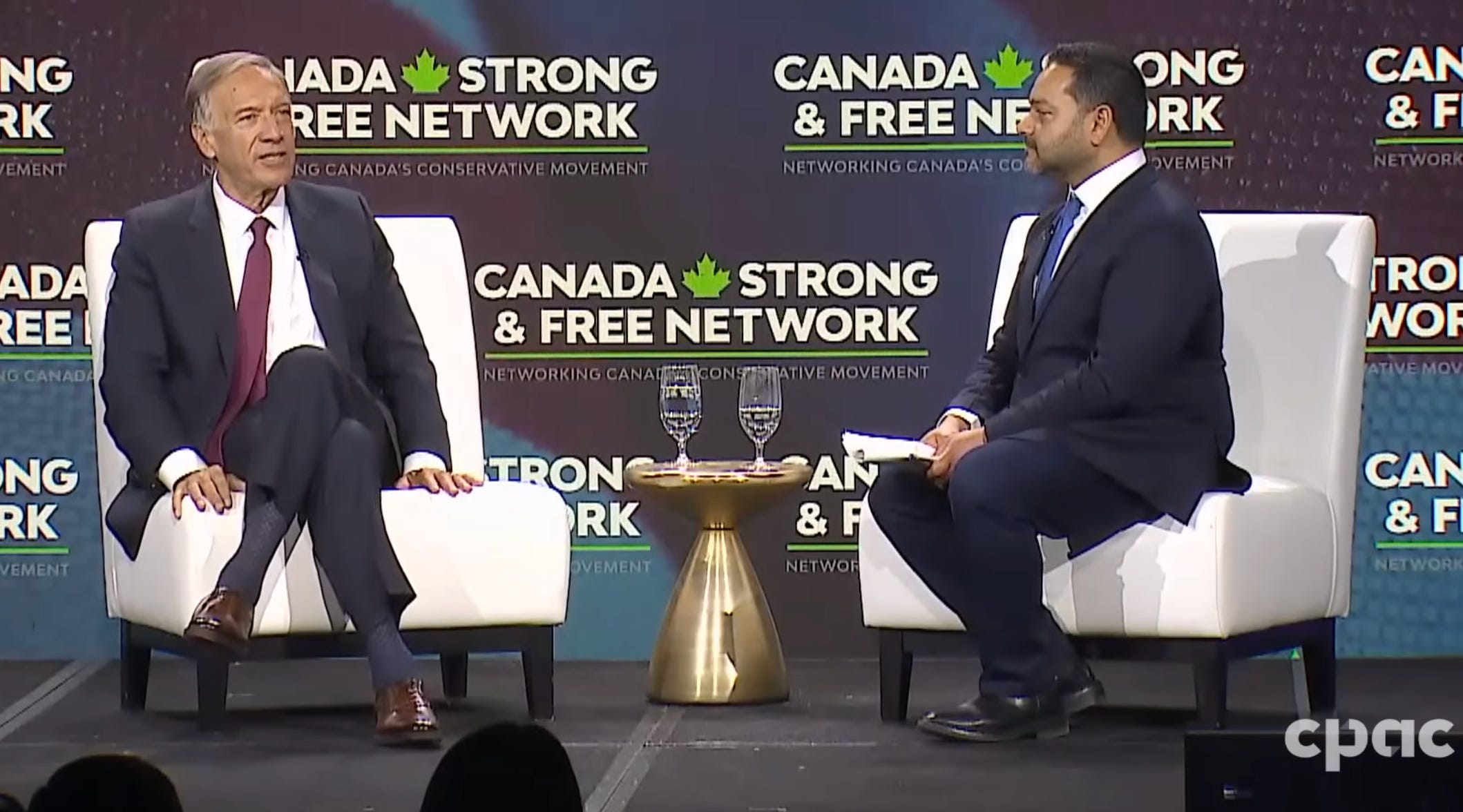
Governments change. The alliance does not. In Ottawa, former Secretary of State Mike Pompeo delivered a warning that underlines themes The Bureau has been reporting for years.
OTTAWA — When the Chinese consulate in Houston was ordered closed in July 2020, it did not go quietly. Within an hour of being told they had 72 hours to vacate, the staff set the building on fire.
What followed was, in the account of the man who ordered it done, a revelation. “Within two days,” former CIA Director and Secretary of State Mike Pompeo told the Canada Strong and Free conference in Ottawa, “we had identified hundreds of Chinese agents operating in the United States, most of which we were unaware of. They started getting tickets to fly out. You could just see the network light up.”
Pompeo had spent about five months with FBI Director Christopher Wray assembling the operation. The Houston consulate, he said, was running “the largest spying operation ever conducted inside the United States that we’re aware of” — allowed to continue for years because Washington feared escalation. The State Department, he noted with dry precision, was always against shutting it down. “The good news was I became Secretary of State,” he said.
The network that lit up when Houston burned was not a rogue operation. It was a window into China’s vast foreign interference networks. The window revealed how much remained unseen. “My gosh, what do we still not know?” Pompeo recalled discussing with Director Wray.
It is the right question for the United States.
The Bureau has reported on the Linda Sun case in New York, where only two people are charged — but Jamestown Foundation researcher Cheryl Yu’s work points to a much wider constellation of relationships involving more than 20 potential access agents with documented United Front ties in New York political circles.
For Canada, in cities from Toronto to Vancouver and Montreal, the answer is likely orders of magnitude greater — and more concerning, because in Mark Carney’s government, the gates have been opened wider.
In Ottawa last week, Pompeo offered a deliberate reframing of the China threat. The debate in Western capitals has long been organized around Taiwan — will Beijing invade, when, what would the West do.
His answer was direct: “I’m much less worried about Taiwan than I am about Denver, or Los Angeles or Phoenix or Ottawa or Toronto.”
The Chinese Communist Party, he said, is “hard at work inside the gates” — in universities, in corporate supply chains, in the phones of every Canadian parent’s child. “They are inside the gates in ways that I think we’ve been very naive about this risk.”
He was not speaking in vague abstractions. He told the audience — with the dry humor of a man who has seen the classified files — that he would wager Party-affiliated operatives were sitting in that very room. They would not be easy to spot, he added. “They look like me — like they’re white Italian dudes.”
This is a former CIA director with full visibility on the depth of China’s penetration — not only in America, but almost certainly Canada as well. Pompeo credited the Canadian Security Intelligence Service as an excellent, non-political partner of the CIA.
It means he knows what CSIS director David Vigneault knew — including Vigneault’s oversight of a high-profile, sensitive investigation into a Beijing-directed federal election interference network in 2019, centered in Toronto. Pompeo was made CIA director in 2017 and promoted to Secretary of State in 2018. He likely knows what Vigneault knows about Canada’s vulnerabilities to CCP election interference and elite capture operations. Quite possibly more.
He described Chinese students paying full tuition at American universities, then directing funds to research laboratories to extract intellectual property.
What has been revealed in United States schools — most notably the University of Michigan — in Chinese intelligence penetration of science labs almost certainly pales in comparison to China’s penetration of Canada’s Level Four lab in Winnipeg, which involved dangerous research from an alleged People’s Liberation Army-linked network that ultimately worked on the bat filovirus project in Wuhan, a thread that Pompeo touched on.
More broadly, he described a West that has failed to demand basic reciprocity.
China blocks foreign students from advanced physics programs, forbids foreign land purchases near military installations, and grants none of the access it extracts from ours. But the West allows China’s proxies to run wild.
None of this will surprise readers of these pages. The Bureau has been reporting the inside-the-gates threat in Canada for years — not as theory, but from classified documents, federal intelligence assessments, and primary-source interviews with senior law enforcement and intelligence figures.
A classified June 2019 report of the National Security and Intelligence Committee of Parliamentarians, reported by The Bureau in July 2023, states in unredacted form that Chinese officials conducted “unauthorized trips to Canada,” paid Chinese-language journalists to “locate and track individuals,” arrested relatives in China as leverage, and actively discouraged targets from reporting covert activity to Canadian police.
The Bureau’s reporting on the Don Im DEA series documented in granular detail fentanyl and money laundering networks run through Chinese Triad-linked organizations, with Canada serving as a command node. Our interview with David Asher — a former senior United States government official in Pompeo’s State Department, who worked transnational criminal networks at the highest levels — traced Chinese criminal and intelligence infrastructure through Canadian financial institutions, with Toronto and Vancouver functioning as a center of gravity for global fentanyl laundering.
The Bureau has also reported extensively on transnational repression on Canadian and American soil — the targeting of Hong Kong activist Frances Hui in Boston, whose parents were detained by Hong Kong national security police in April 2025; the bounty placed on Canadian citizen and pro-democracy candidate Joe Tay; the Security and Intelligence Threats to Elections Task Force warning of a coordinated transnational repression operation against Tay’s campaign one week before election day.
Pompeo, standing in Ottawa, was describing the same landscape.
The sharpest moment of the Canada Strong and Free conference came when Member of Parliament Shuv Majumdar put a direct question about Prime Minister Mark Carney. Majumdar noted that Carney had traveled to Beijing and then to Davos, where he delivered a speech about “rupture” — nodding and winking towards the United States — and that since taking office, Carney had moved on “decision after decision” to tilt toward Beijing: blocking Taiwan’s air access to Canada while accelerating a deal for a Chinese airline, pursuing deeper partnership with a government he had himself, during the campaign, called the greatest threat to Canadian national security and the Canadian way of life.
“In this era of geopolitical rivalry with China being the threat that it is,” Majumdar asked, “what would be your advice to Canadians about that threat and the direction that this government is going?”
Pompeo said he tries to be kind to leaders who, out of frustration with Donald Trump or Washington’s negotiating tactics, conclude the answer is to pivot toward the Chinese Communist Party. “It’s very shortsighted,” he said, “because they will sell your nation’s values down the river in two seconds.”
He used the COVID pandemic as Exhibit 1, making it clear that, as former CIA director, he was still bound by secrecy laws. All the same, he told the conference that by late 2019 and early 2020, the United States government had “high confidence” and “good evidence” the virus had originated in a Chinese laboratory — a conclusion he reached as CIA director. He said he does not believe it was intentional. But what followed was. Xi Jinping, he said, “put people on airplanes and sent them to Europe. He knew what he was doing then.” The leaders now hedging toward Beijing, Pompeo suggested, are making their calculations about a government that responded to a catastrophic lab failure with deliberate, lethal concealment. “You’re going to get your head handed to you,” he said. “And they will do it slowly and with a smile.”
Which brings us to the agreement that Mark Carney signed with Beijing during his visit — a memorandum of understanding between the Royal Canadian Mounted Police and China’s Ministry of Public Security.
Michael Lucci, chief executive of State Armor, a United States non-governmental organization currently pursuing legal and legislative applications across multiple states to implement new laws weeding out Chinese Communist Party influence, has reiterated precisely what The Bureau has argued: that Carney’s secret memorandum of understanding with the Ministry of Public Security risks enabling transnational repression on Canadian soil.
The Ministry of Public Security is not a neutral bureaucratic counterpart. It is the same apparatus that the National Security and Intelligence Committee of Parliamentarians documented running covert operations in Canada. It is the same apparatus that tasks the united front networks — Canada hosts, according to the Jamestown Foundation, 575 documented united front organizations, nearly five times the American rate per capita. It is the same apparatus that, in the account of diaspora groups who fled it, has pursued, surveilled, and coerced Canadians of Chinese and Hong Kong origin.
Ten Hong Kong diaspora organizations spanning four countries wrote to the Canadian government in February expressing “deep fear and anxiety” about the memorandum of understanding. They have not received a substantive response. The full text of the agreement has not been released. No safeguards have been publicly described.
The message from both Pompeo and Lucci in Ottawa was clear. Presidents and Prime Ministers will come and go, but the bond between Canadian and American people is non-negotiable. We share values, an economy, security and freedom. The threat is not on the horizon or across the ocean. It is here, it is operating, and the appropriate response is not accommodation. It is clarity about values, reciprocity in policy, and the refusal to let irritation with an ally become an excuse to embrace an adversary.


Inside the gates is exactly what is taking place with the Chinese communist party.
We allowed them in without understanding their objectives, their intentions or their ambitions for global hegemony.
It’s a new World Order or a reform and checking of the institutions that embrace the totalitarian alternative to a world where individual freedom is still revered and embraced.
Carney, with the help of fellow Chinese communist business leaders like Dominic Barton, is actively transitioning Canada to a centralized net zero command economy, social credit society and censorship governance. Where is the red line before the USA takes decisive action as this is a clear and present danger to US national security?