


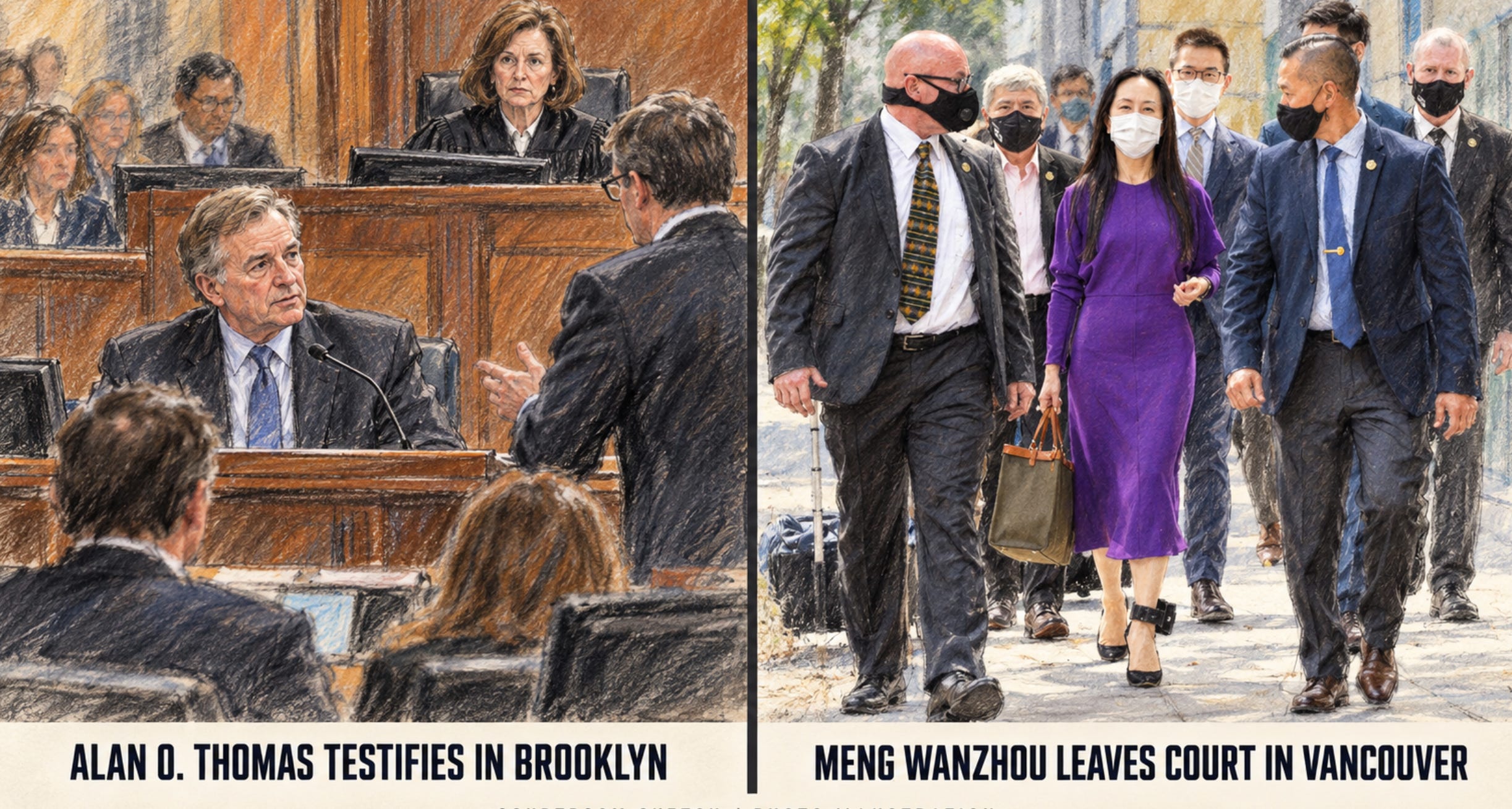
BROOKLYN — In pivotal testimony Wednesday, the senior HSBC banker who dealt directly with Huawei chief financial officer Meng Wanzhou told jurors that her assurances led him to believe the company’s business in Iran was aboveboard.
Prosecutors say Meng lied to the bank, and that Huawei ran a criminal enterprise that stole technology from foreign competitors and sold equipment into sanctioned markets, Iran among them.
Huawei says some employees broke rules, that no one in management drew up a blueprint for crime, and that the racketeering case remains unproven.
Meng described Skycom—the Hong Kong company conducting Huawei’s Iranian business—as a third-party partner and said Huawei had sold its Skycom shares. Her agreed statement of facts says Huawei actually transferred Skycom to another entity it controlled, continued directing Skycom’s operations and caused approximately $100 million in U.S.-dollar transactions to pass through HSBC and clear through the United States.
Alan Thomas, HSBC’s former deputy head of global banking for Asia-Pacific, testified that he accepted Meng’s representations “at face value,” considered Huawei’s Iran exposure small and was not overly concerned by reports about the company’s dealings there. HSBC subsequently continued its lucrative relationship with Huawei.
Huawei’s lawyers used their cross-examination to argue that HSBC already possessed information connecting Huawei, Skycom and Skycom’s new owner, Canicula. They also established that Thomas asked Meng no questions, took no notes, prepared no report of their meeting and remained involved in securing major Huawei business for the bank.
Meng herself is not in the Brooklyn courtroom.
As The Bureau has exclusively reported, a classified June 2019 Canadian Security Intelligence Service assessment said China’s Ministry of State Security was directed “from high levels” to prevent her extradition from Canada.
“CSIS assesses that the PRC prioritizes avoiding Ms. Meng’s extradition partly due to concern that she may cooperate with U.S. authorities during a criminal trial and reveal privileged information in the process,” the assessment says.
The document—titled PRC Strategy and Tactics to Influence the Meng Proceedings—said competing MSS bureaus were tasked with making the “largest possible impact,” while President Xi Jinping received reporting on the crisis directly from the intelligence service.
The MSS campaign, according to CSIS, combined trade retaliation, pressure on politically connected Canadian business leaders, clandestine interference surrounding Canada’s 2019 election and the detention of Michael Kovrig and Michael Spavor.
Meng never entered American custody. She signed a deferred prosecution agreement on September 24, 2021, and the Justice Department withdrew its extradition request. Canada terminated the proceeding, Meng returned to China, and Beijing released Kovrig and Spavor within hours.
The Brooklyn jury will not hear Meng explain the HSBC meeting or see her cross-examined about it.
But U.S. District Judge Ann M. Donnelly ruled in June that prosecutors may present Meng’s agreed statement of facts as evidence against Huawei. Meng was—and remains—the company’s chief financial officer.
That makes Thomas’s testimony the closest jurors have come to hearing the other side of the meeting at the heart of the government’s bank-fraud case.
The Hong Kong meeting
Thomas, who spent approximately 40 years at HSBC, met Meng at the Agnes B restaurant in Hong Kong on August 22, 2013. The meeting followed Reuters reports linking Huawei to Skycom and disclosing that Skycom had offered to sell embargoed American computer equipment in Iran.
Thomas testified that Meng spoke Chinese for approximately 95 percent of the meeting and delivered a Chinese-language PowerPoint through an interpreter. Meng said she was using an interpreter to ensure precision.
According to her agreed statement of facts, Meng described Huawei’s relationship with Skycom as “normal business cooperation” and called Skycom a “partner,” a “business partner of Huawei” and a “third party Huawei works with” in Iran.
She also said Huawei had once owned Skycom but had “sold all its shares.”
The statement of facts says those representations were untrue. Huawei had transferred Skycom from one Huawei-controlled entity to another, Canicula Holdings. Huawei continued controlling Skycom’s business, its country manager was a Huawei employee and people nominally employed by Skycom believed they worked for Huawei.
Meng also told Thomas that Huawei operated in Iran “in strict compliance with applicable laws, regulations and sanctions” and that neither Huawei nor its partners had violated export-control regulations.
Her agreed statement says those representations were also untrue because Huawei’s control of Skycom caused banks to provide otherwise prohibited services for its Iranian business while Huawei concealed the relationship.
Thomas testified Wednesday that he did not question Meng during the meeting. HSBC requested an English version of the PowerPoint but did not receive it until approximately two weeks later.
He said he was “not overly concerned” by the reports about Huawei because the Iranian business appeared limited compared with a company then generating approximately $40 billion in annual revenue.
According to the live courtroom account from Inner City Press, Thomas described an HSBC policy permitting relationships with companies whose overall sanctioned-country business remained below five percent, provided exposure to any individual sanctioned country did not exceed one percent.
“I was satisfied they were in compliance,” Thomas testified, according to that account.
Huawei’s lawyers confronted Thomas with internal bank records identifying Skycom and Canicula, seeking to establish that HSBC personnel understood more about the corporate relationships than prosecutors suggest.
One exhibit reportedly showed Skycom Europe sending €1.5 million to Skycom Iran. Huawei Technologies appeared as the applicant and shared a telephone number associated with the transaction.
The defence also explored HSBC’s financial interest in retaining Huawei.
Thomas acknowledged that the bank participated in a syndicated loan of approximately $1.5 billion to the telecommunications giant, earning about $15 million in fees. He agreed that nurturing the Huawei relationship was part of his job and that HSBC continued providing financing after concerns about Iran arose.
Prosecutors returned on redirect to what Huawei’s evidence did not disclose.
Asked whether one document shown during cross-examination contained anything indicating that Huawei was continuing to conduct Iranian business, Thomas answered: “No.”
The government’s theory is that general knowledge of Huawei’s Iranian operations was not the same as knowing Huawei secretly controlled Skycom—or that Iran-related payments were passing through the American financial system.
And we are doing business with these people?! Was it them who stole from Nortel Networks and brought them down, continue to sway elections, killing Canadians and our true friends the Americans with fentanyl the list goes on!
And we Canadians are doing business with these people?!