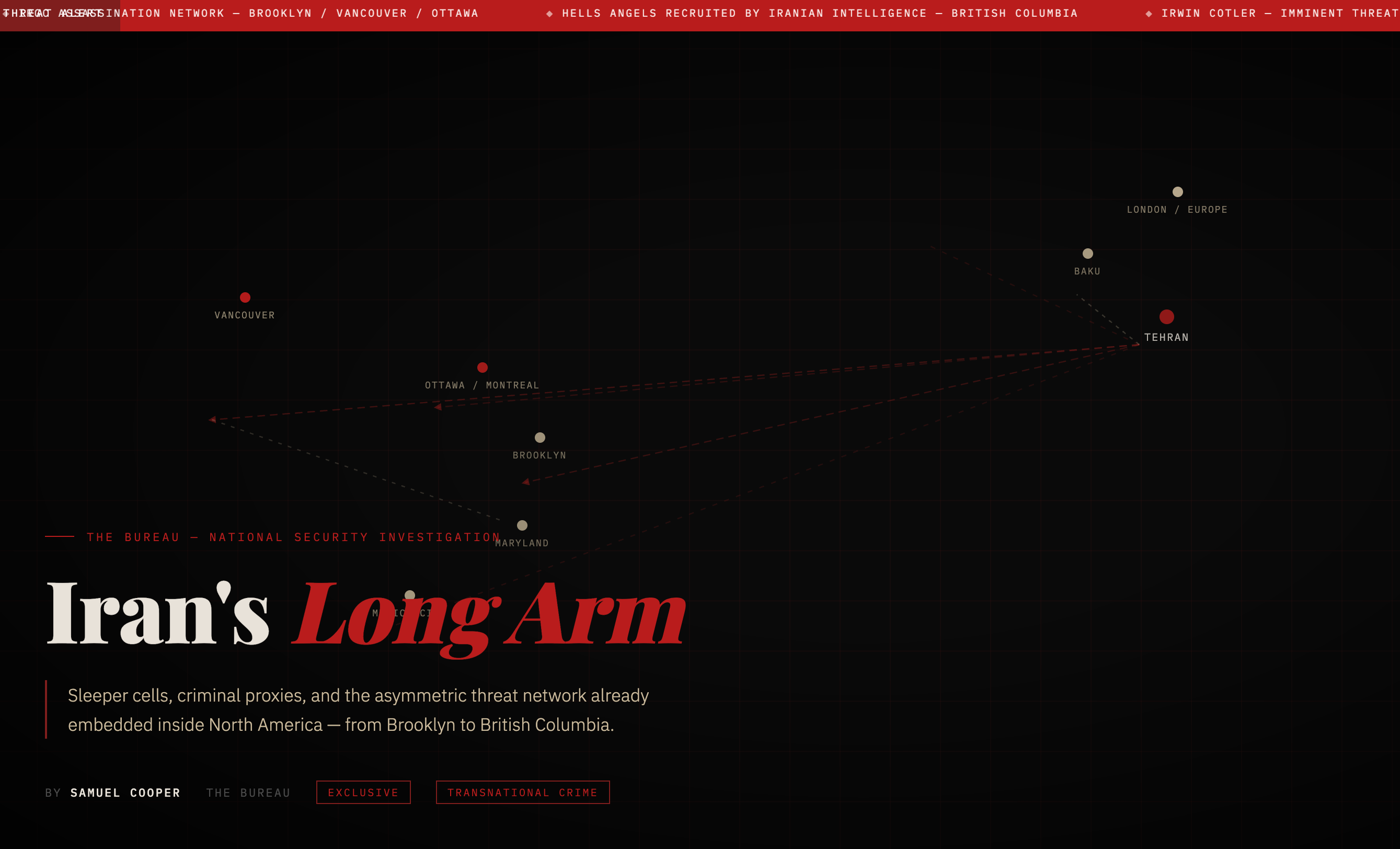
Iran's Long Arm: Sleeper Cells, Criminal Proxies, and the Asymmetric Threat Already Inside North America
WASHINGTON / OTTAWA — Even as kinetic strikes against Iran’s nuclear and military infrastructure have devastated the Islamic Republic’s conventional capabilities, a more shadowy threat remains intact and potentially primed for reactivation: a web of Iran-backed sleeper cells, proxy militias, and criminal mercenary networks already embedded inside North America — networks that have demonstrated the operational capacity to commit murder on American and Canadian soil.
That warning, from David Luna, a former senior U.S. government intelligence official, is not academic. It sits at the intersection of live court cases, active federal indictments, and documented threats against senior politicians and community leaders from Montreal to Brooklyn and beyond — including President Donald Trump himself — and most recently, a missing mathematician in suburban Vancouver.
Writing publicly this week, Luna said it remains unclear “to what extent these armed Iranian-backed proxies and terrorist sleeper cells have been neutralized in North America — Canada, Mexico, the United States — and the rest of the Western Hemisphere and Europe, and related threats and capabilities downgraded.”
He warned that Hezbollah sleeper cells or other proxy terrorist affiliates could be ordered to attack American and Western interests beyond the Middle East, noting that Iran has directed proxy groups including Hezbollah and Islamic Jihad to embed sleeper cells in the United States for activation in support of potential terror activity. Luna called on the Federal Bureau of Investigation, U.S. law enforcement, and Northern Command to prioritize the identification and disruption of Iranian intelligence and military operations — “especially now,” he wrote, that Supreme Leader Ayatollah Ali Hosseini Khamenei has been killed.
Luna spent 22 years inside the U.S. national security apparatus, including as a senior director at the State Department’s Bureau of International Narcotics and Law Enforcement Affairs.
His recent study through the International Coalition Against Illicit Economies found that Canada has become what he calls “an integrated ecosystem of criminality and corruption” — nearly 700 organized crime groups, networked across 48 countries, potentially laundering hundreds of billions of dollars annually. Iranian crime networks, his research found, are embedded within that ecosystem alongside Chinese Triads, Mexican cartels, and the Hells Angels, sharing logistics, financial corridors, and enforcement infrastructure. Canada, Luna concluded, is “a safe zone for the world’s most notorious crime groups” — and Washington is producing a more reliable intelligence picture of that criminal economy than Ottawa itself.
The federal prosecutions already on record make the threats Luna points to a court-tested reality.
In January 2024, the U.S. Department of Justice unsealed an indictment charging Iranian narcotics trafficker Naji Sharifi Zindashti — a contract killer operating under the direct orders of Iran’s Ministry of Intelligence and Security, according to the U.S. Treasury — with recruiting Canadian Hells Angels associates to assassinate Iranian dissidents in Maryland.
Damion Ryan, a full-patch Hells Angel from British Columbia facing separate drug trafficking charges linking Colombia, Mexico, Canada, and Greece, was allegedly promised $350,000 for the murders and paid $20,000 in expenses. His co-conspirator, Adam Richard Pearson, allegedly told Ryan the target should be hit “in the head a lot, make example.”
The plot was disrupted. Zindashti’s network, Treasury found, had carried out murders and kidnappings across at least five countries. It was, by the Justice Department’s own count, at least the third Iran-directed assassination conspiracy prosecuted in the United States since 2022 — and it ran through Canada.
The Iranian regime’s assassination campaign reached its most documented intensity in its pursuit of Masih Alinejad, the Iranian-American journalist, women’s rights activist, and Voice of America contributor based in Brooklyn. Over three years, Iran subjected her to at least three separate murder plots, deploying a senior Islamic Revolutionary Guard Corps general, Russian organized crime figures, and Afghan operatives.
A federal prosecutor described the campaign as “a spree of plots here and around the world.” In March 2025, a Manhattan federal jury convicted two Azerbaijani members of the Thieves-in-Law criminal gang in connection with a 2022 murder-for-hire plot against Alinejad, backed by a $500,000 Iranian government bounty.
The same network had also been tasked by the Islamic Revolutionary Guard Corps with arranging the assassination of then-candidate Trump before the 2024 election. “The same Islamic Revolutionary Guard Corps that ordered a massacre in Iran gave money to the assassins here to buy AK-47s to end my life,” Alinejad said outside the Manhattan courthouse after the verdicts.
In October 2024, Alinejad traveled to Ottawa to speak at a transnational repression conference. Simultaneously, the Royal Canadian Mounted Police were moving to protect Irwin Cotler — former Canadian justice minister, founder of the Raoul Wallenberg Centre for Human Rights, and architect of Canada’s Islamic Revolutionary Guard Corps terrorist designation — after foiling what the force described as an imminent assassination plot against him. Cotler, 84, was warned the attack was planned within 48 hours. Two suspects were reportedly apprehended.
The most recent Canadian case is unresolved.
Masood Masjoody, 45, a mathematician and Iranian dissident who had publicly called for the overthrow of the Tehran regime, disappeared from Burnaby, British Columbia, on February 2.
The Integrated Homicide Investigation Team has taken over the investigation, describing the disappearance as a potential targeted attack and ruling out local extortion. “The search still continues,” Integrated Homicide Investigation Team spokesperson Sgt. Freda Fong said, declining to confirm a foreign threat link for fear of jeopardizing the investigation.
In January 2024, Masjoody had shared The Bureau’s reporting on Iranian intelligence using British Columbia narcotics networks in dissident assassination plots, adding commentary in Persian calling for investigations into “the regime’s agents and Islamic Revolutionary Guard Corps in Canada.” The last post on his social media account was made the afternoon he vanished.
Nazanin Afshin-Jam MacKay, a prominent Iranian-Canadian human rights activist and wife of former Minister of Justice and Attorney General Peter MacKay, wrote on X that Masjoody “had been under threat for months” and “was trying to expose Islamic Revolutionary Guard Corps affiliates in Canada.”
The logic of deniability connecting these cases is apparent.
Rather than deploying agents of Iranian descent — which invites rapid attribution — Tehran has contracted its operations to insulated criminal intermediaries: Russian organized crime, Azerbaijani gangsters, Afghan fixers, Canadian outlaw bikers.
Canadian Security Intelligence Service Director Dan Rogers, in his first major speech as Canada’s new intelligence chief last year, warned that “the nexus between criminal groups and state actors challenges traditional definitions and complicates our efforts to respond.” Rogers said his agency had “reprioritized our operations” to counter Iranian intelligence proxies involved in “disrupting potentially lethal threats” against people in Canada, noting that transnational repression operations disproportionately target journalists, activists, dissidents, and community leaders.
FBI Assistant Director Suzanne Turner, in the context of the Ryan indictment, stated that the charges “show a pattern of Iranian groups trying to murder U.S. residents on U.S. soil.”
Luna, mapping that same pattern from Washington, warned this week that the full extent of Iran’s embedded networks in the West remains unknown — and that the FBI, Northern Command, and allied services must treat their identification and disruption as an urgent priority. Last year, Rogers, from Ottawa, was essentially saying the same thing.


The corruption is out of control and I wonder how many are imbedded in our governments?
Without a doubt, there are huge numbers of compromised politicians, either by choice (Carney) or diaspora type coercion and threats in Canada. Proof reigns in numbers of arrests immediately released on bail, prosecutions never reached, open borders, Ottawa’s maintenance of a legal system with no teeth, RCMP, other police networks, CSIS following orders from the PMO.
Canada is known in the underworld of crime, total corruption and complicity of government as the #1 place for uninterrupted business!!
Rest assured, even the most gullible Carney loving crowd should add 2+2 and get 4!!!