57 Hours Into War on Iran: Three U.S. F-15Es Lost Over Kuwait in Friendly Fire; Joint Chiefs Chair Details “Massive” Multi-Domain Strike
TAMPA, Fla. — Three United States Air Force F-15E Strike Eagles flying in support of Operation Epic Fury went down over Kuwait late Sunday in what United States Central Command described as an apparent friendly-fire incident, during combat that included attacks from Iranian aircraft, ballistic missiles, and drones.
In remarks Monday morning, Joint Chiefs Chairman Gen. Dan Caine provided the most detailed accounting of the war against Iran yet offered from Washington.
The downings came as the campaign widened across the Gulf.
Caine detailed what he described as a “massive overwhelming attack across all domains of warfare” now entering its third day, as United States and Israeli forces conduct sustained strikes against Iranian military infrastructure. He said the operation began with a daylight strike conducted by the Israeli Defense Forces, enabled by United States intelligence.
The first American shots, he said, were fired from sea, as United States Navy vessels launched Tomahawk cruise missiles against Iranian naval forces along Iran’s southern flank.
Caine described an integrated air-defense fight in which “the defense of the region is not ours alone,” with partners “surging in beside us.” Caine said he was aware of the loss of three F-15Es overnight, added that the United States knows it was “not from hostile enemy fire,” and said he would not comment further while the incident remains under investigation.
Central Command said the jets were mistakenly shot down by Kuwaiti air defenses; all six aircrew ejected safely, were recovered, and are in stable condition. Kuwait has acknowledged the incident, Central Command said, and the cause remains under investigation.
On land and in the air, Caine said, United States forces followed with “precision, standoff weapons — measured, deliberate, precise, and lethal.” In the first 24 hours alone, he said, more than 1,000 targets were struck, and “we are now roughly 57 hours into the operation,” with an initial phase focused on systematically degrading Iran’s command-and-control infrastructure, naval forces, missile sites, and intelligence networks — intended, he said, to “daze and confuse” Iranian forces.
Caine said coordinated space and cyber operations disrupted Iranian communications and sensor networks, helping establish local air superiority that he said will improve force protection while enabling continued operations deeper inside Iranian territory.
He said United States joint forces have launched hundreds of missions from land and sea, delivering “tens of thousands of pieces of ordnance,” with operations continuing to scale.
Among the most significant elements, he said, American B-2 Spirit bombers flew a 37-hour round-trip sortie from the continental United States to strike underground facilities with precision penetrating munitions — a mission profile he compared to “Midnight Hammer.” He said the operation included “several combat firsts,” but declined to elaborate.
Pivoting from his account of the scope of American strikes to close the briefing, Caine appeared to send a message to leaders in China and Russia, saying bluntly that the U.S. military can project power worldwide and across all domains of warfare in a way no potential competitor can match.
Defensively, Caine said Patriot and THAAD batteries — alongside Navy destroyers configured for ballistic-missile defense — have continued intercepting incoming threats.
“Our integrated air and missile defense network is performing exactly as it’s intended,” he said.
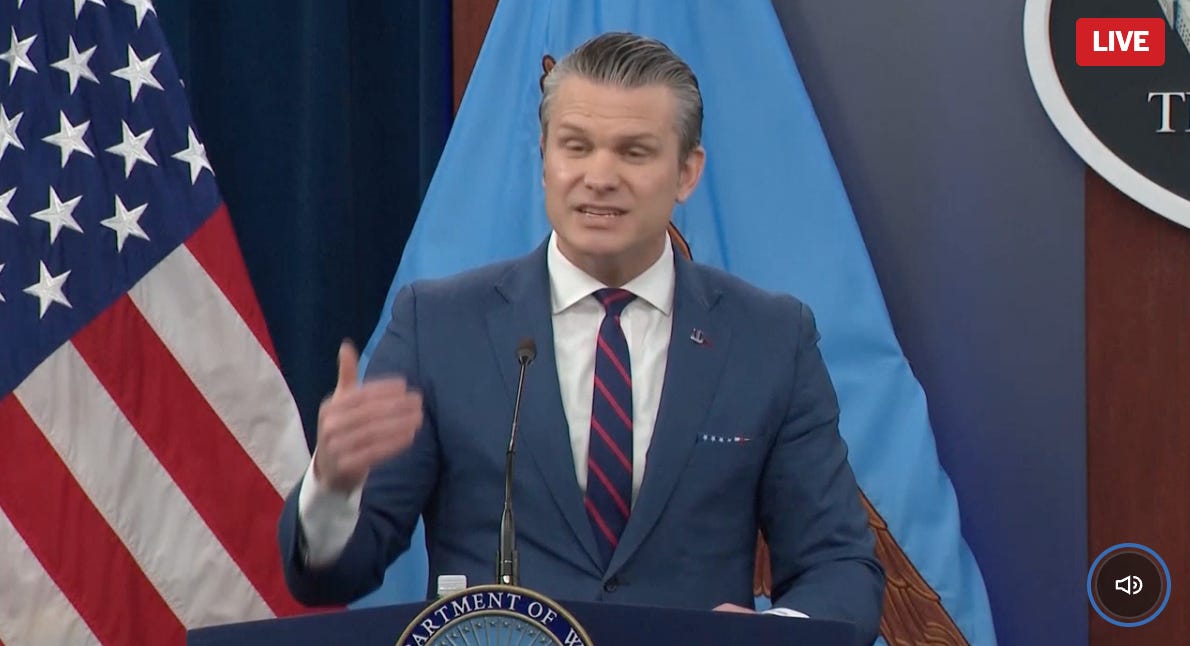
In responses to questions from one reporter, Defense Secretary Peter Hegseth told the press multiple agencies are monitoring the potential threats from Iranian “sleeper cells” that may be on the ground in the U.S.
While President Trump has stated Washington’s war-plan forecasts about four weeks of operations to conclude its mission of regime change and total degradation of Iran’s long strike missile and nuclear-program threats, Hegseth said he would not limit the government’s scope of operations or time frame, and would not speak to an exit strategy.
Britain, France, and Germany have signaled readiness to take defensive measures while urging a return to negotiations. Prime Minister Keir Starmer said Britain approved a United States request to use British bases for limited defensive strikes against Iranian missile depots and launchers, and said British fighter jets were already participating in defensive operations and intercepting Iranian missiles.
French President Emmanuel Macron, German Chancellor Friedrich Merz, and Starmer also issued a joint warning that they could enable “necessary and proportionate defensive action” to destroy Iran’s ability to fire missiles and drones “at their source.”
China has condemned the United States and Israeli strikes and called for an immediate stop to military actions, “no further escalation,” and a return to “dialogue and negotiation,” while stressing that Iran’s sovereignty, security, and territorial integrity should be respected.
One influential pro-Trump analysis argues the war’s real strategic center is Beijing, not Tehran. Writing in Tablet, author Lee Smith frames the conflict as part of a broader fight against what he calls a “China axis,” arguing that tariffs, sanctions, and military campaigns across multiple theaters are being used as instruments in a larger confrontation with China.
Smith points to alleged supply-chain pathways in which Chinese firms procure United States-origin components that reach Iranian front companies and then flow to Iranian proxies. He sums up the framework with a blunt line: “It’s all about China.”
Smith also quotes Donald Trump criticizing the 1970s opening to China: “The worst thing Nixon did wasn’t Watergate… It was allowing China to take advantage of this country.”
Central Command said additional information on the Kuwait friendly-fire incident will be released as it becomes available.


Smith also quotes Donald Trump criticizing the 1970s opening to China: “The worst thing Nixon did wasn’t Watergate… It was allowing China to take advantage of this country.”
Here's hoping the Liberal Gov't of Canada get this message.
Thank you Sam for the continued excellent and balanced reporting.
Balanced and excellent reporting.