Former Vancouver Mayor Says Premier Eby Aware of RCMP Investigation Into B.C. Cabinet Minister Over Alleged Chinese Government Collaboration

VANCOUVER — Kennedy Stewart, the former mayor of Vancouver, said in a broadcast interview Monday that British Columbia Premier David Eby is aware of an active RCMP investigation into a sitting cabinet minister suspected of collaborating with the Chinese government — and that senior NDP officials have been alerted to the matter with no apparent action taken.
“It’s come to my attention and I’ve reported it and in fact was interviewed for about four hours by lawyers working for the federal government about a B.C. cabinet minister under investigation for collaborating with the Chinese government,” Stewart told Global News anchor Jas Johal, a former Beijing-based reporter for the network.
“I know the premier’s aware of it,” Stewart continued. “I know that many members of cabinet are aware of this. This is an ongoing RCMP investigation that nothing’s being done about it.”
Stewart was initially interviewed in connection with a Global News report revealing that Chinese consular officials had pressured a Vancouver city hall employee to cancel a run of Shen Yun performances at the city-owned Queen Elizabeth Theatre. Shen Yun presents performances celebrating pre-Communist Chinese cultural traditions — programming the Chinese government has long sought to suppress abroad. The shows went ahead April 8 to 12, despite the consular pressure and bomb threats. But Stewart told Johal he believes British Columbia’s vulnerability to Chinese interference runs far deeper than a single incident at the civic level.
Stewart did not identify the B.C. NDP minister in question. The Bureau is not naming or speculating on the individual. No charges have been laid.
Stewart, who served as Vancouver’s mayor from 2018 to 2022, said he had signed non-disclosure agreements when he reported the matter nationally, and acknowledged taking a personal risk by raising it publicly. “I am even taking a risk mentioning this to you here,” he said. When Johal asked him to confirm the individual remains in B.C. government today, Stewart replied: “Yes.”
He described a pattern of foreign interference left unaddressed at both the civic and provincial levels, only leading to more Chinese meddling in Canadian politics. “You’re seeing what happens when you don’t address these things seriously — you’ll just get more and worse interference.”
Stewart said his information was corroborated through the questioning process with Canadian national security agents, and “by officials from Ottawa, they’re asking you questions, but I’m also asking them questions and I’ve had this confirmed.”
The remarks came as Prime Minister Mark Carney pursues a diplomatic and trade realignment with Beijing — a pivot The Bureau has reported reflects longstanding interests within Canada’s corporate and political establishment — and as British Columbia remains a hotspot for suspected Chinese foreign interference operations in Canada.
It is a concern Stewart raised with The Bureau as far back as November 2023, when this publication first reported on a classified CSIS intelligence assessment detailing Beijing’s efforts to infiltrate provincial and federal party leadership races, including reported interference in Vancouver’s 2022 municipal election. At the time, Stewart warned that Canada’s federal foreign interference inquiry was examining only a fraction of the problem. “For this federal inquiry,” he said then, “it’s like they are examining their front doors, but they don’t realize the whole back wall of the house is missing.”
The Bureau has previously reported on a number of investigations and intelligence assessments bearing on this broader landscape, none of which have resulted in charges.
In June 2024, The Bureau revealed that an officer from British Columbia’s Organized Crime Agency had investigated a Vancouver Police officer in connection with alleged police database breaches — specifically, suspected misuse of the Canadian Police Information Centre — and concerns that sensitive law enforcement data may have been passed to Chinese officials.
Documents related to the RCMP investigation indicated that Vancouver politicians had been interviewed. Questions included whether Vancouver police officers could have accessed CPIC to gather private information on Vancouver municipal politicians, and whether this data could have been shared with Chinese officials in connection to recent elections.
Records showed the investigation involved B.C.’s Office of Police Complaints Commissioner. Both the Vancouver Police Department and the OPCC and RCMP declined to confirm details, citing confidentiality provisions.
The Bureau did not identify the officer given the stage of the investigation.
Separately, a classified CSIS intelligence assessment dated October 31, 2022, reviewed by The Bureau, alleged that a senior Canadian politician running to lead a provincial political party clandestinely met with officials inside a Chinese consulate in 2022 and subsequently became Beijing’s preferred candidate, receiving campaign support from consulate proxies. The document, which did not identify the individual by name, referred to the figure as “CA3.” Because the B.C. NDP and Alberta United Conservatives were the only provincial parties selecting leaders in the relevant timeframe, CSIS monitoring was likely focused on one of those two contests. Both parties denied any awareness of the alleged meeting.
A separate CSIS document from January 2022 alleged that China’s consul general in Vancouver, Tong Xiaoling, stated that Chinese diaspora voters needed to be mobilized to elect a specific Chinese-Canadian mayoral candidate in Vancouver’s 2022 election. “This report demonstrates CG Tong’s continued interest in involving herself in Canadian electoral processes to benefit the PRC,” the document concluded, according to The Bureau‘s review.
The Bureau has also reported that in December 2021, then-Attorney General David Eby approved a $20,000 provincial grant to the Canada Committee 100 Society, a community organization with connections to former Conservative Senator Victor Oh, who is named as an advisory board member. The Bureau has also reported on a secret 2020 recording in which British Columbia Senator Yuen Pau Woo spoke to leaders of the Canada Committee 100 Society and pledged to use his office to defend the rights of Canadians to join community groups with designated ties to the Chinese Communist Party’s United Front Work Department.
”I’m very worried that the mainstream in Canada, including a lot of my friends, political leaders, and business leaders and media leaders, are falling into a very dangerous trend, what I call a litmus test,” Woo told the group.
“For example, your views in Hong Kong, your views on Tibet, your views on Uyghurs, your views on South China Sea, whether you belong to an organization that is officially part of the United Front. You know, many organizations are listed as part of a United Front list of organizations. And the fact that you are simply associated with one, is often used as a litmus test.”
Experts including Sino-affairs specialist Charles Burton raised concerns about the organization’s evident links to Beijing’s United Front apparatus — specifically through a member who held a seat on the Chinese People’s Political Consultative Conference, a body the Jamestown Foundation has identified as a core Chinese Communist Party organ whose membership provides evidential proof of United Front ties to diaspora community groups in the West.
The Bureau has further reported that three days before submitting to Ottawa’s Foreign Interference Commission that federal reports on election interference and WeChat disinformation were “problematic,” Senator Woo met in Vancouver with community leaders affiliated with Beijing’s Overseas Chinese Affairs Office, which Western intelligence assessments have identified as a key arm of the Chinese Communist Party’s overseas influence apparatus.
The February 3, 2024 meeting at Vancouver’s Chinese Canadian Museum was also attended by former Conservative Senator Victor Oh and Ottawa Liberal Member of Parliament Chandra Arya, and was arranged by Senators Woo and Oh, according to event accounts posted to WeChat. At the gathering, Senator Woo reportedly told attendees that Chinese Canadians are “now in a very dangerous period,” characterized media reporting on Chinese foreign interference as discriminatory, and said of efforts to establish a foreign agent registry: “They’re still trying to tag us. We have to fight back and teach our next generation to fight back.”
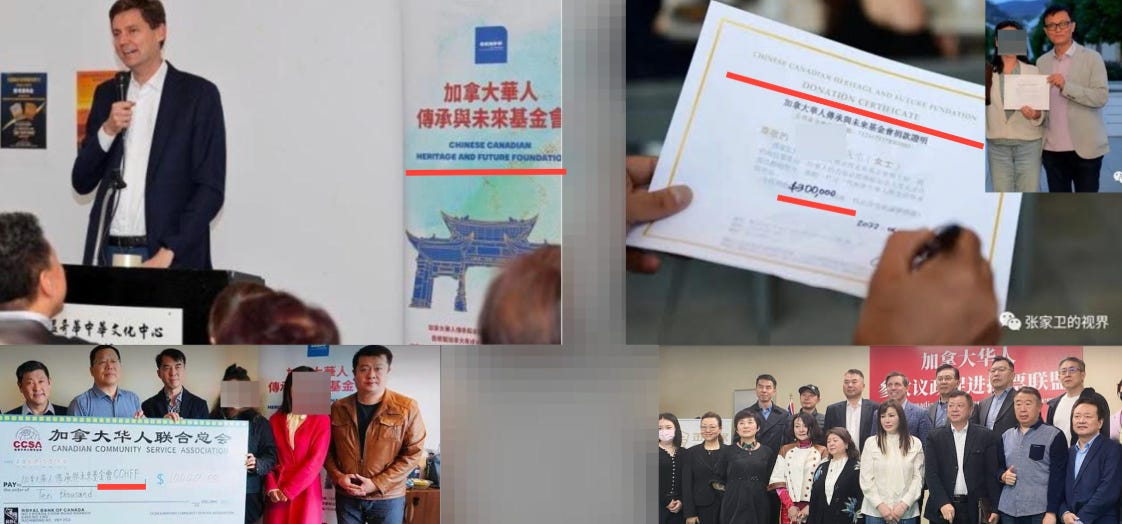
Then, in September 2025, Senator Woo co-founded a new advocacy group alongside former Conservative Senator Victor Oh. The organization was publicly presented as a defense of Chinese Canadians against what the founders described as “false or exaggerated claims” of foreign interference. Online reports and photographs show the group held a fundraiser in Toronto on May 1, 2026, attended by a number of elected officials.
That group subsequently became the subject of scrutiny by the same researchers whose work Senator Woo had publicly dismissed. Peter Mattis, head of the Jamestown Foundation and a former Central Intelligence Agency analyst, appeared before a parliamentary committee on transnational repression and was asked by Conservative Member of Parliament Shuv Majumdar to respond to Woo’s characterization of the foundation’s research — which Woo had called “disinformation,” “fearmongering” and “bad fiction.” The study, authored by Jamestown Fellow Cheryl Yu, had identified 575 organizations across Canada with documented links to the Chinese Communist Party’s United Front influence apparatus, finding Canada had the highest per capita density of such groups among the four Western democracies studied — nearly five times the rate of the United States. The work had also been raised in the United Kingdom Parliament.
After Woo’s attacks, The Bureau contacted Yu directly. She confirmed that Woo’s newly founded advocacy group met the same evidentiary criteria applied across the study, making it the 576th United Front-linked organization identified in Canada. A founding director of the group had attended multiple World Chinese Media Forums organized by China News Service, which the Jamestown report documents as operating under the direct oversight of the United Front Work Department.
Mattis, in his Parliament testimony, cited the group’s connections to the Chinese Communist Party and Canada’s longstanding failure to act against Beijing’s United Front interference operations. “What should we think of an organization whose leadership attends multiple world Chinese media forums in the PRC?” Mattis asked, describing such forums as “collaborating with the propaganda system, the United Front system to influence foreign audiences about how to understand China, to tell China’s story well.”
He described Woo’s dismissal of the methodology as “a kind of laziness.” The report, he told the committee, was “not blaming Canadians for not understanding.”
In response to detailed questions from The Bureau regarding the Jamestown Foundation’s identification of his group’s links to China News Service, Woo said the questions did not merit a response. He subsequently posted on X: “Thank you for drawing attention to my critique of the @JamestownTweets report, which offers no evidence of wrongdoing on the part of 575 Chinese Canadian organizations. It is all insinuation & ideology — and foreign interference.”