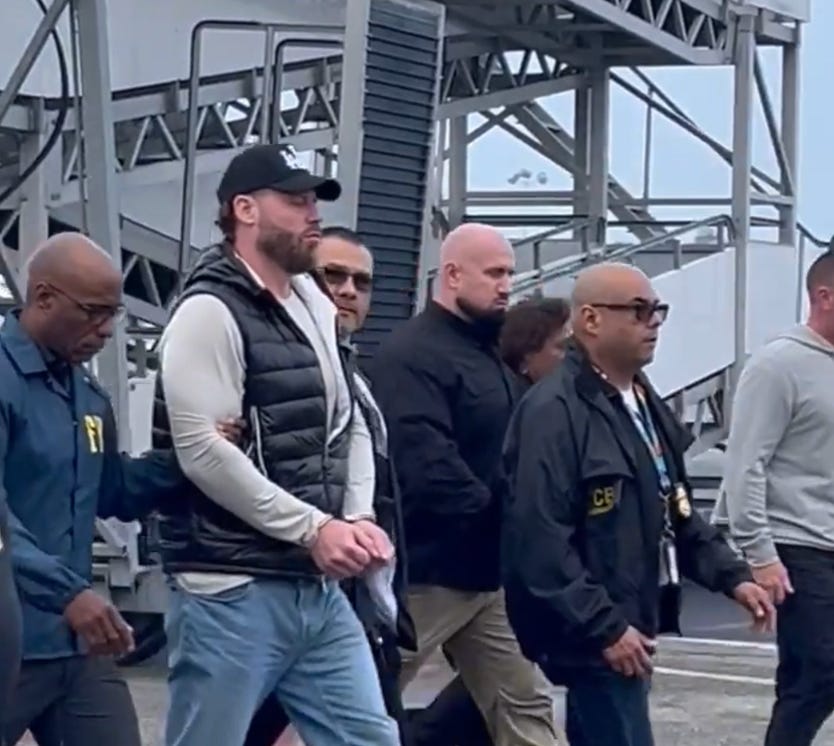
Federal Judge Pushes Ryan Wedding Trial to December, Finds Prosecution 'So Unusual and So Complex' It Defies Normal Trial Timelines
LOS ANGELES — A judge in Los Angeles has named two co-defendants alongside Ryan Wedding — the former Canadian Olympic snowboarder charged with leading a Sinaloa Cartel-linked cocaine trafficking and federal witness murder conspiracy — while pushing the proposed trial date to December 1, 2026, finding that the prosecution is so extraordinary in scale and complexity that it falls outside the bounds of normal federal trial preparation requirements.
The consolidation of all three defendants into a single December trial suggests prosecutors intend to try the witness murder conspiracy as the organizing legal theory — the crime that binds the network’s Canadian, Mexican, Colombian, and American nodes into a single criminal enterprise.
The co-defendants are Tommy Demorizi, 35, a Montreal man who spent nearly three months as a fugitive in the Dominican Republic before being arrested at Newark International Airport and arraigned in Los Angeles, where he has pleaded not guilty, and Yulieth Katherine Tejada, 36, a Colombian-born resident of the United States who was arrested in Orlando, Florida, in November 2025 as part of the sweeping international investigation — codenamed “Operation Giant Slalom” — that prosecutors say dismantled the upper tier of Wedding’s alleged criminal network.
The court order, signed April 13, 2026, by United States District Judge Sherilyn Peace Garnett, continues the trial date for Wedding and Tejada from July 28, 2026, to December 1, 2026. Demorizi’s trial, previously set for April 28, has also been continued to December 1. A status conference is scheduled for November 18, 2026.
In granting the continuance, Judge Garnett made a formal finding that goes beyond standard language.
The court found that “the case is so unusual and so complex, due to the nature of the prosecution and the number of defendants, that it is unreasonable to expect preparation for pre-trial proceedings or for the trial itself within the time limits established by the Speedy Trial Act.” The court further found that the ends of justice outweigh the public interest in a speedy trial, and that proceeding without additional time “would be likely to make a continuation of the proceeding impossible, or result in a miscarriage of justice.” The Speedy Trial Act ordinarily requires federal criminal trials to begin within 70 days of a defendant’s initial appearance.
Wedding, 44, a former Canadian Olympic snowboarder from British Columbia, was arrested in Mexico City on January 23, 2026, by the FBI’s Hostage Rescue Team in what Director Kash Patel described as a “complex, high-stakes operation with zero margin for error.” He faces nine counts, including conspiracy to distribute cocaine, conspiracy to export cocaine, and charges of tampering with and retaliating against a witness by “completed murder” — statutory language meaning a killing was carried out. He has pleaded not guilty.
Tejada was arrested in Orlando in November 2025. Demorizi, identified at the time as a fugitive believed to be hiding in the Dominican Republic, spent nearly three months on the run before being arrested at Newark International Airport, according to CBC News. He has since been arraigned in Los Angeles on eight charges, including conspiracy to commit murder and conspiracy to tamper with a witness, and is held at a downtown Los Angeles prison.
Both are named in the federal indictment as members and associates of what prosecutors describe as Wedding’s billion-dollar cocaine-smuggling ring. At the center of the murder charges is Montreal man Jonathan Acebedo-Garcia, a convicted fentanyl trafficker turned FBI informant who was shot to death in a Medellín restaurant in January 2025.
Wedding allegedly placed a bounty of up to $5 million on Acebedo-Garcia after learning he was cooperating with investigators. The killing was carried out by a hit squad linked to the Oficina de Envigado — the notorious Colombian crime syndicate with roots in the organization once run by Pablo Escobar.
Tejada’s alleged role was to help locate Acebedo-Garcia for assassination.
Prosecutors allege she was part of a network of associates operated by co-accused Carmen Yelinet Valoyes Florez, a Bogotá woman who allegedly used contacts in Colombia’s commercial sex industry to track the informant’s movements in Medellín. In November 2024, Florez allegedly sent Tejada a photograph of Acebedo-Garcia’s associate and asked her to confirm his identity — which Tejada allegedly did. On November 5, 2024, Florez allegedly sent Tejada a photograph of Acebedo-Garcia himself and asked whether she knew him. Prosecutors further allege that Wedding and Florez subsequently contacted Tejada by video call and asked her to travel to Colombia and lure Acebedo-Garcia to a location where he could be killed — in exchange for payment of her mortgage and corrective cosmetic surgery.
Prosecutors allege Wedding also contacted Atna Ohna — an alleged organized crime figure from Laval, Quebec, whose aliases included Tupac and Kim Jong-Un, and whom the indictment describes as “a hired sicario” for the enterprise — to help locate the informant.
Demorizi allegedly obtained Acebedo-Garcia’s phone number through co-accused Edwin Basora-Hernandez, a Dominican-born reggaeton singer based in Montreal. Wedding then allegedly paid to deploy spyware on that number in an unsuccessful attempt to find Acebedo-Garcia. Court documents note the phone “appeared to be off.” Ohna was ultimately paid $150,000, 30 kilograms of cocaine, and an “ornate” necklace with red jewels for tracking down the informant, according to CBC News.
The alleged network extends deep into Canada’s legal, financial, and media worlds. A Toronto-area lawyer named Deepak Balwant Paradkar is accused of advising Wedding to murder Acebedo-Garcia specifically to avoid extradition to the United States, and of providing Wedding with court documents and discovery materials he could not otherwise access.
Another Canadian co-accused, Gursewak Singh Bal, allegedly operated a website called “The Dirty News” and, in exchange for payment, posted a photograph of Acebedo-Garcia to help locate him for assassination.
A separate proceeding unfolding in Canadian courts has produced some of the most detailed allegations yet about the financial architecture of Wedding’s alleged enterprise.
Rolan Sokolovski, 37, a Toronto jeweller described by United States authorities as the operation’s chief money launderer and “de facto bank,” was arrested in Canada in November 2025 and denied bail by Ontario Superior Court Justice Peter Bawden, who found it likely that Sokolovski has access to “substantial, undisclosed” cryptocurrency, making him a “considerable” flight risk. The Ontario judge called the United States extradition case against Sokolovski “strong.”
At a previous bail hearing, a Department of Justice Canada lawyer told court that Sokolovski acted as the right-hand man for Wedding’s second-in-command, Andrew Clark — effectively placing him third in command of Wedding’s network. “He was the one in control” of the criminal organization’s finances, government lawyer Heather Graham told court. “He was the money-mover.”
Graham pointed to an October 2024 text message exchange between Clark and Sokolovski, as described in a police affidavit filed by RCMP Corporal Geneviève Laurin, CBC News reported.
Clark told Sokolovski that his cryptocurrency wallet had been blacklisted and “directed Sokolovski to change everyone’s wallets as soon as possible,” according to the affidavit. “Sokolovski confirmed that he would.” Graham told court the exchange demonstrated that Sokolovski held control over the cryptocurrency wallets of multiple co-conspirators across the network — a function, she argued, that went well beyond bookkeeping.
United States authorities accuse Sokolovski of laundering hundreds of millions of dollars through cash, cryptocurrency, and wire transfers on behalf of the enterprise. The United States Treasury Department has sanctioned Sokolovski and his Thornhill-based business, Diamond Tsar, which he allegedly used as a front to launder drug proceeds. Sokolovski, who went by the aliases “Sushi” and “Applepie,” is also accused of working with a former Italian special forces member to procure high-end motorcycles and luxury vehicles for Wedding, including an ultra-rare Mercedes said to be worth $13 million. In December, Mexican authorities seized an estimated $40 million worth of motorcycles during raids on properties linked to Wedding.
The trial, if it proceeds as proposed on December 1, would begin nearly one year after Wedding’s arrest. All parties — including Wedding’s defense team — agreed to the continuance.
As The Bureau has reported, the murdered FBI witness had been accused of operating a synthetic drug smuggling operation from Montreal targeting the American drug consumer market.
According to Colombian media, Acebedo-Garcia had been jailed for fentanyl trafficking in Quebec, and reporting from Montreal’s La Presse — citing United States court records — said that in 2009, Acebedo-Garcia and an accomplice were stopped for a traffic violation in New York State after returning from the Akwesasne Mohawk Reservation.
A search of their vehicle uncovered 23,000 MDMA pills. In a United States filing at the time, La Presse reported, prosecutors described Acebedo-Garcia as part of a “large-scale drug-trafficking organization,” noting that “the primary, and perhaps sole, purpose of the organization for which the accused worked was to smuggle large quantities of narcotics from Canada to the United States.”


