Experts Warn Canada Is China's "Prototype" for Democratic Infiltration
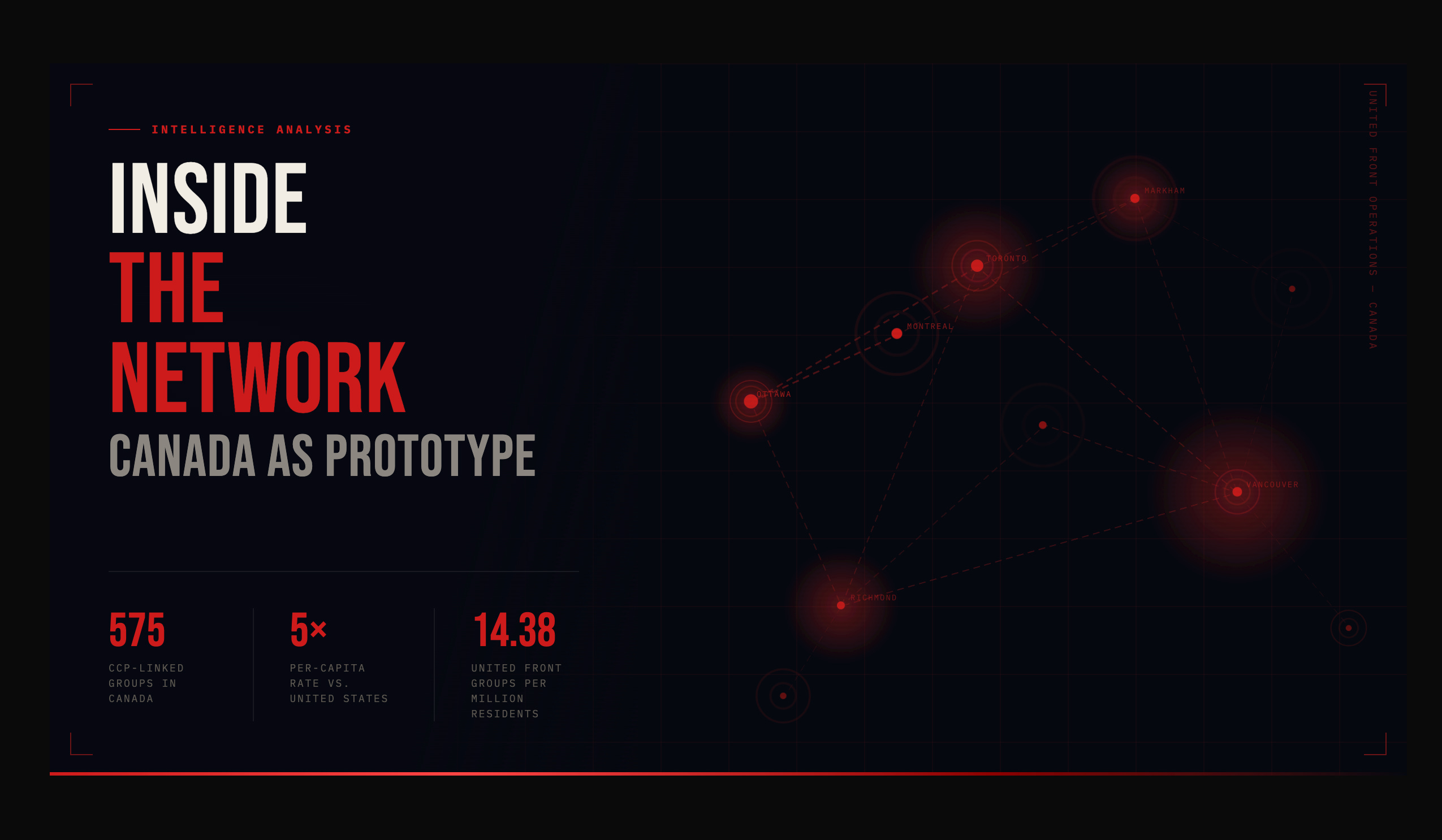
OTTAWA — In the wake of a groundbreaking Jamestown Foundation study mapping 2,294 CCP-linked organizations across four Western democracies — and finding that Canada, with 575 such groups, has nearly five times the per-capita penetration rate of the United States — experts including a former Chinese spy who defected to Australia are warning that Canada has become Beijing’s prototype for the kind of subversion that, in CCP doctrine, precedes kinetic warfare.
The Jamestown research, led by analyst Cheryl Yu under the guidance of former CIA China expert Peter Mattis, exposes a sophisticated system designed to steal sensitive technology, launder money, smuggle migrants, monitor and control diaspora communities, and advance Beijing’s ultimate strategic objective: displacing the United States as the dominant global power. Canada, the data suggests, has become a critical platform in that effort — not despite its closeness to the United States, but because of it.
The former spy known as “Eric,” who worked for Office No. 1 of China’s Ministry of Public Security from 2008 until 2022, has affirmed that conclusion. In his most recent disclosures to Western media since defecting in 2023, Eric told the Epoch Times that Canada is a “key target” for CCP infiltration, citing its relatively lenient immigration policies, less robust counterintelligence infrastructure compared to the United States, and its valuable membership in the Five Eyes intelligence alliance. Because it is safer to enter and exit the U.S. from Canadian soil, Eric explains, the CCP frequently uses Canada as a staging ground to access sensitive allied data while bypassing America’s stricter counterespionage scrutiny.
Eric’s own story is a brutal illustration of how that targeting works at the human level.
Originally a pro-democracy activist, he was coerced into espionage under threat of imprisonment and harm to his family, CBC and Australian media have reported. During his tenure, he was tasked with monitoring overseas Chinese dissidents — including Hua Yong, a vocal critic of the CCP and Xi Jinping, who eventually fled to Canada. Hua died while kayaking off the coast of British Columbia in late 2022. The RCMP ruled the death non-suspicious, but Eric has stated the possibility of CCP involvement “cannot be ruled out” — and in disclosures to Radio-Canada’s Enquête program, he supported that assessment with text message evidence from the phone he carried out of China when he defected.
According to those records, Office No. 1 formally designated Hua a high-value target and placed a bounty on his head — roughly the equivalent of US$20,000 for capture and repatriation. The orders, as quoted by Radio-Canada from the message logs, were chilling. In an exchange labelled internally “The target,” Eric’s superiors wrote: “Listen carefully to my request. It concerns Hua Yong. Our superiors find him troublesome and want to get rid of him.”
To get close, Eric constructed an elaborate false identity — posing on social media and encrypted apps as a radical anti-Communist militant, proposing the creation of a jungle “armed camp” and a guerrilla network he called “Brigade V.” Hua, in exile and under pressure, was taken in.
Eric also told the Epoch Times that detecting Chinese spies is extremely difficult even for professional intelligence agencies, due to the high capabilities and effective disguises deployed by some operatives.
Dimon Liu, a China security expert based in Washington, agrees with Eric’s assessment — and goes further. Canada, she argues, is being used as a prototype for CCP infiltration into democracies more broadly, unfolding in a deliberate sequence: elite capture, largely accomplished; institutional capture, underway; and civil society capture — for which she cited Yu’s Jamestown report as a concrete, freshly documented example.
The Jamestown data maps the architecture behind exactly what Eric and Dimon Liu describe.
Canada’s 575 documented CCP-linked organizations give Beijing a density of 14.38 united front groups per million residents — more than double the United Kingdom’s rate, more than triple Germany’s, and nearly five times the American rate of 2.89 per million. Yu’s research found that individuals heading these organizations were not operating in the shadows: they openly shared and advertised their access to Canadian prime ministers, provincial premiers, and municipal officials — a brazenness that Yu says has no real parallel in the other democracies studied.
“Canada is a very important target for the party because it’s open, it’s influential, and it’s intertwined with the United States economically and politically,” Yu told The Bureau. “The interesting thing I saw in cases related to Canada is that individuals linked with United Front system agencies openly share their access to Canadian leadership.”
The Jamestown findings substantiate each stage of Dimon Liu’s academic research on United Front influence with granular precision.
On elite capture: Yu’s research identified individuals with United Front-linked backgrounds who became candidates at the city and provincial level in Canada, cultivating close personal relationships with prime ministers and senior officials — relationships they then, according to the data, leveraged on Beijing’s behalf.
On institutional capture: the report documents how United Front networks in New York penetrated two successive gubernatorial offices, with a senior aide allegedly forging a governor’s signature to smuggle Chinese agents into the U.S. — a case Yu describes as merely the visible tip of a much larger problem, with more than twenty individuals in New York political circles alone displaying similarly concerning United Front ties.
On civil society capture: the 575 groups identified in Canada span community associations, business chambers, cultural organizations, and student networks — the precise connective tissue through which, as Liu argues, the CCP embeds influence at every level of democratic society before institutions even recognize the threat.
The United Front: War by Stealth
Central to this infiltration architecture, Dimon Liu argues, is the United Front itself — which she describes not merely as a political influence operation but as a non-kinetic preparation for actual warfare. Drawing on her 2021 paper ‘Entice the Enemy’s Best and Wisest’: China’s War of Stealth, Liu argues that the West now faces a territorially expansionist China willing to seize and fight for land from the South China Sea to the Himalayas — and that understanding the United Front is no longer optional. If politics is war by other means, to paraphrase Clausewitz, then the United Front, Liu writes, is the waging of war by stealth — and it is lethal.
The United Front is a series of stratagems directed by the CCP and implemented by swarms of agents and moles — often masquerading as dissidents, journalists, researchers, academics, interns, maids, nannies, and chauffeurs — to gather information, but far more critically, to spread disinformation, Liu argues, by misdirecting enemies into badly judged and self-destructive decisions.
Its tactics include elite capture — inducing democracy’s most influential figures, up to and including former prime ministers, secretaries of state, intellectuals, corporate titans, and wealthy financiers, to work for the CCP rather than their own countries — as well as “organizational capture,” designed to wreak havoc within multilateral institutions, government entities, and universities.
China’s subversion of the World Health Organization to conceal its responsibility for the COVID-19 pandemic, the influence of its Confucius Institutes, and the co-option of numerous Western figures stand as prominent examples.
Deploying what the CCP terms “combining the professionals with the masses,” United Front tactics use well-trained agents alongside legions of unwitting participants and useful idiots to divide and weaken targeted societies from within, Dimon Liu’s report says.
The endgame, as Liu frames it: when an enemy’s civil society and government institutions have been sufficiently undermined or co-opted, the CCP’s military is deployed for the knock-out punch.
This is how the CCP defeated the KMT and conquered mainland China — and how it now seeks to become the world’s primary power, this time backed by vast resources and the world’s second-strongest military.
Despite growing work by scholars such as Peter Mattis, Matt Schrader, Alex Joske, and now Cheryl Yu — whose Jamestown report represents the most granular open-source mapping of United Front networks in Western democracies to date — Dimon Liu warns that understanding of these methods remains sketchy and rudimentary among democratic leaders and the majority of China experts.


And yet, our government officials, our media, even our entertainers and artists, keep painting the United States as our number one enemy. When are we going to wake up? Are we going to realize that we had lost our country before we realize this?
“The endgame, as Liu frames it: when an enemy’s civil society and government institutions have been sufficiently undermined or co-opted, the CCP’s military is deployed for the knock-out punch.”
Cda now hiring Mercenaries (Chinese), walking right into the Trap!