


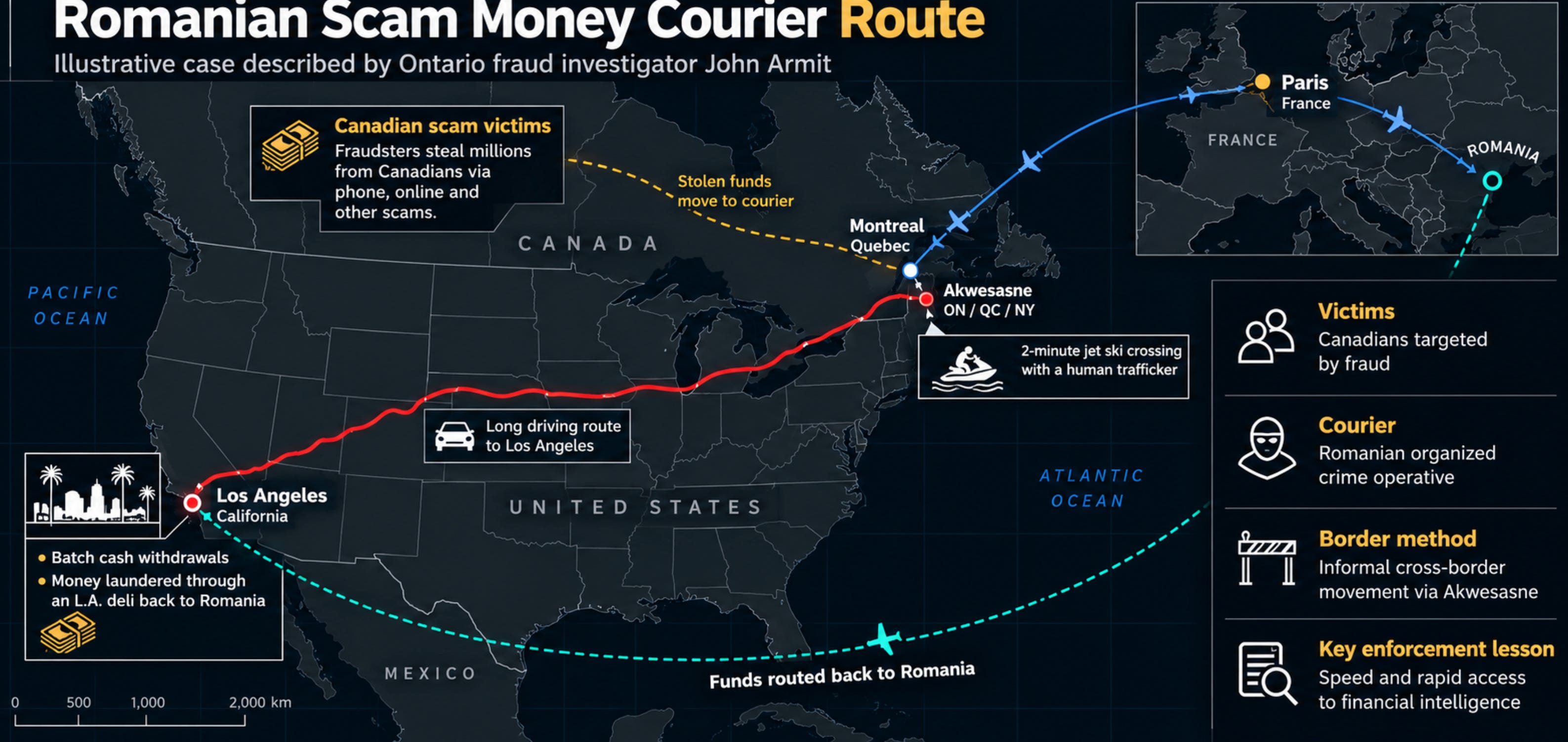
OTTAWA — The money was scammed from Canadian victims. The Romanian theft-gang operative sent to collect it, an Ontario fraud investigator said Tuesday, flew from Paris to Montreal and then crossed into the United States on a jet ski at Akwesasne, the Mohawk territory that straddles the borders of Ontario, Quebec and New York.
“Literally it was a two minute jet ski ride that this guy hopped on with a human trafficker,” said Detective Sergeant John Armit of the Ontario Provincial Police.
Armit described the transnational case at an Ottawa seminar on Chinese money laundering and scam networks targeting North America and operating across Asia, hosted by Harry Tseng, Taiwan’s representative to Canada. The Ontario investigation was a joint effort with American federal national security agents, and Armit said more details will surface in November.
From the border, Armit said, the Romanian national drove all the way to Los Angeles, where he made multiple withdrawals of the victims’ money. He was part of what Armit described as a syndicated organized crime group “that was laundering money through a deli in LA back to Romania.”
The case worked, he said, because of speed. “We looked at the wire in live time and the Bank of America had an STR,” he said, referring to a suspicious transaction report the bank had filed. “So it’s that rapid pace that we have to have and we have to cut the bureaucracy in Canada.”
The territory Armit described has figured repeatedly in The Bureau’s reporting. More than 70 gangs operate across these Mohawk territories, including networks directed by Chinese Triads and Mexican cartels, where contraband tobacco operations intersect with fentanyl trafficking and illegal firearms networks.
American court records have linked Akwesasne to large-scale narcotics-smuggling organizations moving drugs between Quebec, Ontario and New York. On July 30, American authorities arrested three Akwesasne residents in another alleged international narcotics-smuggling operation, the US Attorney’s Office for the Northern District of New York announced in August. Testifying before Congress in May, FBI Director Kash Patel said drug traffickers were moving into the United States “on tribal lands.”
Armit said this geography has opened a gateway for bad actors moving contraband, firearms and human-trafficking victims across the border at Cornwall.
Armit did not say whether his cases connect to the Chinese money-laundering networks that Taiwanese investigators described at the same event, which they say laundered about $343 million in US currency through Taiwan for Cambodia’s Prince Group.
But the methods he described ran along parallel lines: romance and investment frauds aimed at North American victims, corrupted insiders at financial institutions, and laundering routes built to move money across borders faster than police can follow.
In the last six months, Armit said, 10 officers he has been training as cyber investigators wrote 132 production orders, made five arrests and closed 28 files, with 18 more arrests “on deck” and 43 files still open.
A second case involving Nigeria’s “Black Axe” transnational mafia illustrated the reach of a single fraudster’s network. A woman living in Kemptville, about 45 minutes outside Ottawa, was 72 when a man began messaging her on Facebook, professing his love. She believed he was a U.S. Army general stationed in Afghanistan. By the time the deception was over, she had lost $150,000 of her life savings.
After she went to police, investigators found she was still in contact with the fraudster. They took over her identity online and told him to come and collect more money.
He drove in from Toronto, and officers arrested him with support from the force’s aircraft and Emergency Response Team.
Armit spent four months going through the man’s phone. “He had people inside financial institutions,” he said.
