

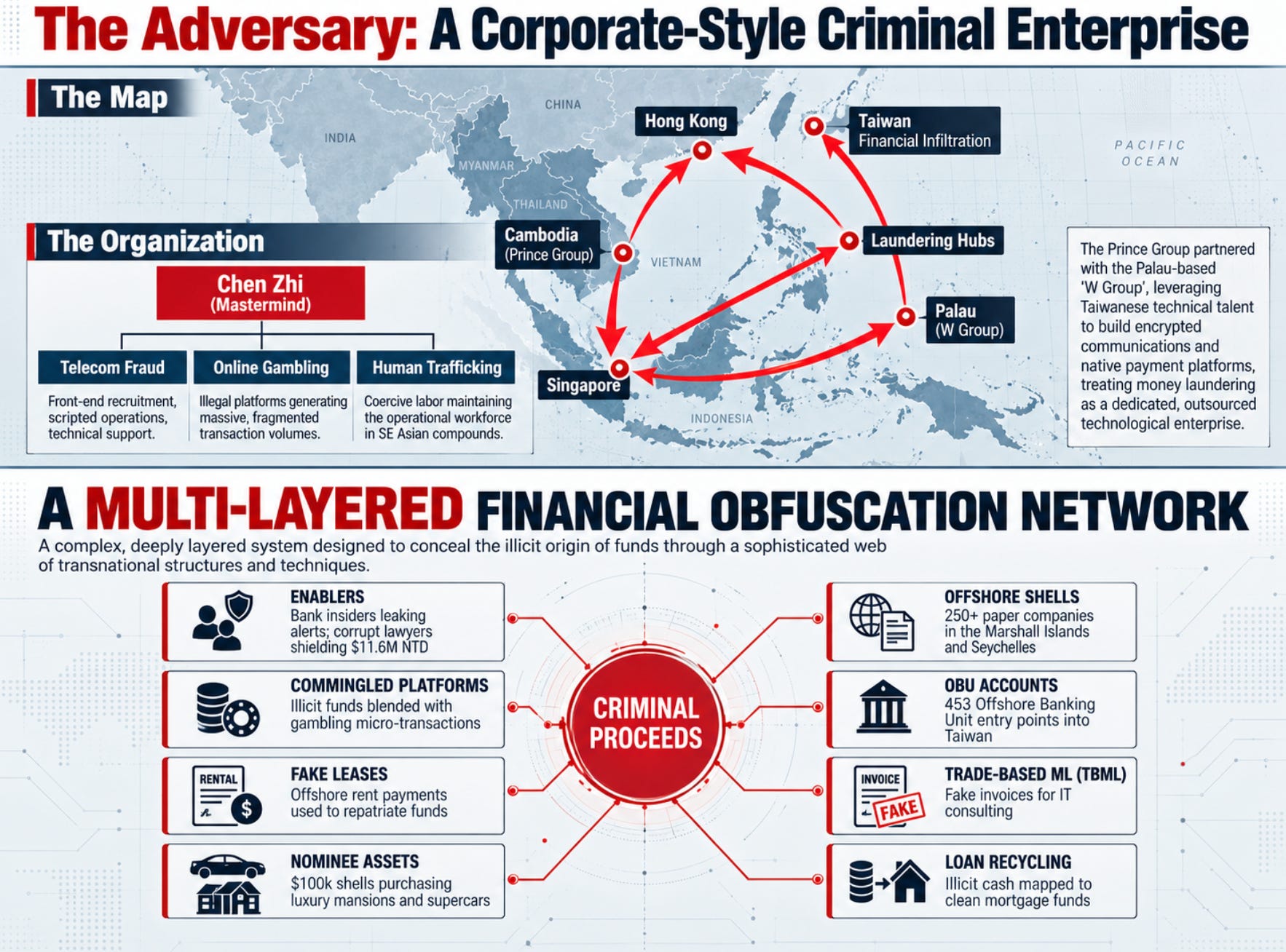
OTTAWA — For nearly six years, analysts inside Taiwan’s financial intelligence unit followed the Prince Group’s money. The Cambodia-based conglomerate, United States prosecutors allege, ran slave-labor scam compounds and drained billions of dollars from victims around the world, many of them in North America. The analysts traced its money through a laundering network that stretched from Cambodia to Hong Kong, Singapore and the Pacific island nation of Palau, and that targeted Taiwan’s high-tech industry and its sophisticated corporate, legal and banking systems.
On Tuesday, one of the investigators who helped dismantle the network’s Taiwan operations explained how it was done, speaking at an Ottawa event hosted by Harry Tseng, Taiwan’s ambassador to Canada.
As The Bureau has reported, the case reaches into Beijing’s security state. United States prosecutors allege that the Prince Group bought protection from inside China’s Ministry of Public Security and Ministry of State Security, its national police and civilian intelligence services.
Those stakes rose this month in California.
Wanying “Heather” Zhang, an Irvine realtor, was charged there with acting as an unregistered agent of the Chinese government after allegedly helping stake out the Seattle-area home of the son of Taiwan’s president, Lai Ching-te. A CBS News investigation has since traced the business ties of her alleged surveillance partner in two directions. One leads to a man whom reporters have identified as the unnamed Prince Group deputy who, prosecutors say, handled the group’s dealings with Chinese security officials. The other leads to a Southern California residence identified in a separate federal case as an alleged cash drop for a Chinese laundering organization working with the Sinaloa Cartel.
Questions about Beijing’s security services, and about the corruption that US prosecutors allege shielded the Prince Group’s enterprise, were not addressed by the officials in attendance Tuesday.
Tseng framed the case as proof that financial crime cannot be countered by any one nation alone.
“Financial crime is no longer a localized issue,” he said. The syndicate’s true challenge, he said, was cleaning its money, “and this is where Taiwan came into play.” He credited the October 2025 American and British sanctions and the US Justice Department’s bitcoin seizure as the turning point, after which Taiwan’s Ministry of Justice, its Investigation Bureau and Taipei prosecutors “struck locally.” He said the real-time sharing of data among Washington, London, Taipei and regional partners proved that “when law enforcement matches the technological agility of criminals, the law wins.”
“Financial security is global security,” Tseng said.
When Washington sanctioned the Prince Group, Taiwan’s financial intelligence unit had already mapped the group’s accounts and assets in Taiwan.
Beginning in late 2019, the unit analyzed 79 suspicious transaction reports filed by banks and sent 26 intelligence reports to law enforcement. Within 20 days of the sanctions, banks filed 153 more suspicious transaction reports. In November 2025, prosecutors, investigators and police struck 47 locations across Taiwan at once, seizing 18 properties, 26 luxury cars and dozens of bank accounts.
By the Investigation Bureau’s count, the Prince Group laundered about $343 million in US currency through Taiwan, and Taiwanese authorities have seized about $175 million in assets.
On March 4, 2026, the Taipei District Prosecutors Office indicted 62 defendants and 13 companies on organized crime, money-laundering and illegal gambling charges, in what Taiwanese officials presented as the largest money-laundering enforcement case the island has brought.
The enterprise behind that money has been documented in a federal complaint in the Eastern District of New York and in reporting by The Bureau. Prosecutors allege that Chen Zhi, the Chinese-born chairman of Prince Holding Group, ran at least ten scam compounds in Cambodia where trafficked workers were forced under threat of violence to run “pig butchering” investment frauds. One of Chen’s deputies boasted that the operation had earned more than $30 million a day in 2018, a figure the complaint notes “annualizes to approximately $11 billion.” A single laundering cell in Brooklyn, the filing says, moved more than $18 million stolen from more than 250 American victims. The Justice Department has moved to forfeit about 127,271 bitcoin, worth about $15 billion when the case was filed.
The complaint goes further. It alleges that Chen and his co-conspirators “used their political influence to protect the scam operations from law enforcement in multiple countries, including from the Chinese Ministry of Public Security (‘MPS’) and Ministry of State Security (‘MSS’).” Chen himself, the filing says, “boasted to others of his arrangements with the MSS to be informed of law enforcement actions in exchange for bribe payments.”
The machinery described in Ottawa on Tuesday by Special Agent Pei Lin of the Anti-Money Laundering Division of Taiwan’s Ministry of Justice Investigation Bureau depended on outsourced technology and layers of shell companies. Investigators found that the Prince Group partnered with a separate but affiliated network in Palau, which Lin called the W Group, and used Taiwanese software engineers to build encrypted communications and payment platforms. “They outsourced the technical infrastructure of their money laundering operation to software engineers in Taiwan,” Lin said. “Treating it like any other technology contract, money laundering as a managed service.”
Palau already figures in the American case. As The Bureau has reported, the Treasury’s October 2025 sanctions state that the Prince Group worked with Rose Wang, a Palau-based businesswoman who “is the vice-president of Palau’s Overseas Chinese Federation, which may conduct unofficial diplomacy for China.” In 2018, Wang introduced Wan Kuok-koi, the Macau triad boss known as “Broken Tooth,” to Palau’s then-president while Wan was seeking casino licenses. The Treasury sanctioned Wan in 2020 and describes the Hongmen association he heads as “directly linked to the Chinese Communist Party and its United Front Work Department.”
The money entered Taiwan through two channels, Lin said.
Shell companies registered in the Marshall Islands and the Seychelles, more than 250 of them by the Investigation Bureau’s count, opened 453 accounts in Taiwan’s offshore banking units, which serve nonresident clients. “In Taiwan, offshore accounts received lighter regulatory oversight,” Lin said. Dirty money was also blended into the group’s gambling platforms, so that it looked like ordinary player deposits from the start.
Inside Taiwan, the funds were layered through company after company.
Fake invoices dressed transfers up as payments for information-technology consulting, and fake leases made offshore money look like rental income. Shell companies with less than $3,000 in registered capital bought luxury mansions and supercars. At one of Taipei’s most prestigious residential towers, the syndicate acquired 11 units and 53 parking spaces, all since seized.
Some properties were bought outright with criminal cash and then immediately mortgaged. “The illegal cash disappeared,” Lin said. “A liquid bank loan appeared in its place.”
The group also built its own blockchain application, OJBK Wallet, which Lin described as “essentially a shadow bank.” Members converted Tether, a dollar-pegged cryptocurrency, into cash through in-person cash handoffs authenticated with photographs of banknotes. A member would request a withdrawal through the app and photograph the serial number of a specific Taiwanese banknote, which became the authentication token. A courier would then meet the member in person, match the physical note against the uploaded photo and hand over the cash. “Zero digital footprint. No names, no accounts, no cross-border wire records,” one of Lin’s slides read.
Two professionals protected the network, according to the Investigation Bureau: a bank insider who leaked internal warning alerts to the syndicate, allowing it to empty accounts ahead of scrutiny, and a lawyer who held physical cash out of investigators’ reach under what Lin’s slide called the guise of “regulatory escrow.” Taipei prosecutors have indicted a lawyer, identified in Taiwanese media only by his surname, on money-laundering charges over NT$11.6 million, about $360,000, in cash.
What made Taiwan’s strike possible, Lin’s presentation argued, was a special money-laundering offense identified as Article 20. The provision permits prosecution when assets have no reasonable explanation of origin and are associated with specified suspicious conduct, including false-identity accounts or attempts to evade anti-money-laundering controls.
It also “severs the requirement to definitively prove the upstream predicate crime (in Cambodia),” according to the presentation. Taiwan did not need evidence from Phnom Penh or Beijing to act. “Article 20 was the keystone,” one of Lin’s slides read.
Lin’s presentation also acknowledged the problem the law was meant to solve, listing among Taiwan’s strategic challenges “the latency between FIU intelligence production and prosecutorial prioritization.”
In January, Cambodia arrested Chen and sent him to China rather than the United States, and the Ministry of Public Security announced it had placed him under “compulsory criminal measures.”
As The Bureau has reported, an American NGO investigating wildlife and fentanyl trafficking and their connections to Prince Group networks has reported that some of its sources believe Chen is operating freely from China and that his arrest was a sham.
The Prince Group has denied the American allegations, telling the International Consortium of Investigative Journalists in March that “prosecutors used exaggerations, deceit, and outright impossibilities to convince a court to retroactively approve their theft of Bitcoin and to convince a grand jury of everyday Americans to indict an innocent man, Chen Zhi.”
In this case, I'm all for Chinese justice...