Closing Debate on Ottawa’s Anti-Hate Bill Risks Undermining Canada’s Religious Freedom
Op-Ed: To remove the existing defence for expression rooted in religious text or belief is a profoundly dangerous precedent.
By Elbert King Paul
I am writing as a concerned citizen to express my profound concern over the federal government’s March 9, 2026, move to close debate on Bill C-9, Ottawa’s anti-hate bill.
As recently reported by the National Post, Khaled Al-Qazzaz, executive director of the Canadian Muslim Public Affairs Council, said he and other Muslim groups representing hundreds of Muslim organizations opposed the bill and felt “ambushed” by the government’s decision to limit further debate.
That same day, the National Council of Canadian Muslims released an open letter to Prime Minister Mark Carney outlining its concerns. The letter said that despite “clarifications and amendments” that had helped address some civil-liberties issues, the bill still contained “fundamental flaws as a piece of legislation.”
On March 9, the government invoked closure in the House of Commons to halt debate on changes to Bill C-9. The motion directs the justice committee to vote on changes already proposed, without further debate. It also limits debate on the bill to a single day at each of its first two stages in the House of Commons.
This procedural rush is troubling enough on its own. But it is more troubling because it is being applied to legislation that touches some of the most sensitive freedoms in Canadian public life: freedom of religion, freedom of expression, and the limits of state power in policing belief and speech.
I strongly support the intention of Bill C-9 to protect access to religious sites and services in the Jewish community, especially in response to the horrific events recently reported by The Bureau concerning Toronto synagogue shootings following a suspected Iranian regime repression killing in Canada. It is imperative that the Jewish community’s request for protection be answered vigorously.
But efforts to address anti-religious threats must not undermine existing protections for other religious minority groups, or for Canadians more broadly.
The failure to adequately amend Bill C-9 is rightly being opposed by faith organizations and civil-liberties advocates representing millions of Canadians. These include the Canadian Conference of Catholic Bishops, the Evangelical Fellowship of Canada, Independent Jewish Voices, the Canadian Muslim Public Affairs Council, the Canadian Civil Liberties Association, and many others.
Their concern is not that hatred should go unpunished. Their concern is that a law intended to protect Canadians from hate could, if badly drafted, erode the constitutional freedoms of speech, conscience, and religion.
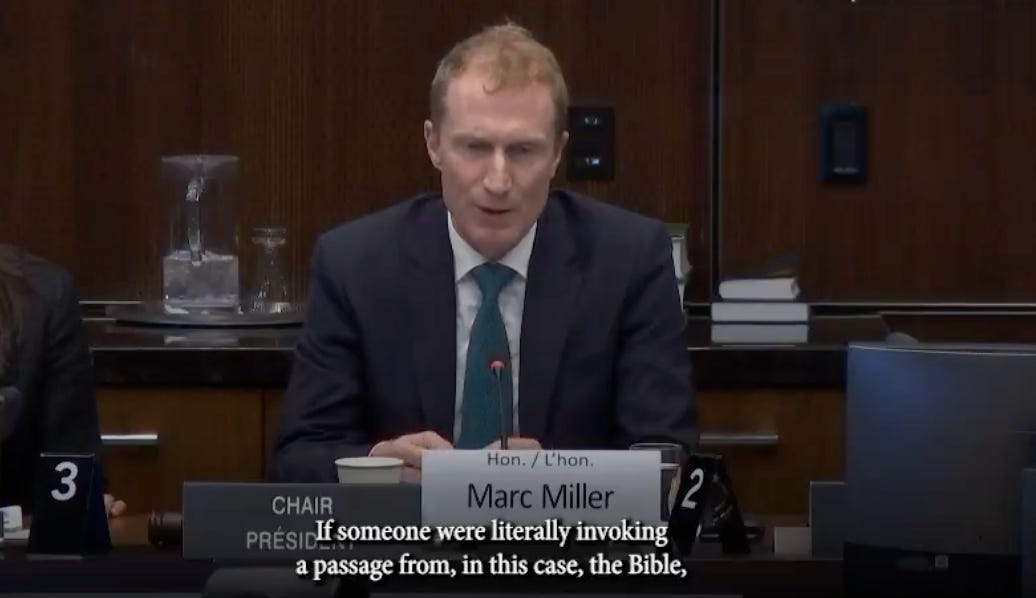
Specifically, the justice committee has amended Bill C-9 to remove the religious-belief defence from section 319(3) of the Criminal Code. Under this change, it would no longer be a defence to a charge of wilful promotion of hatred that a person expressed or argued a belief rooted in religious text or scripture.
While this defence has rarely been invoked and never successfully, it remains an important safeguard for religious expression. Its removal raises serious concerns for faith communities across Canada.
Those concerns are not theoretical. They relate to freedom of expression and religion, vague legal standards, and the risk of politicized or frivolous prosecutions. There is a justifiable fear that preaching, teaching, or expressing traditional religious views on issues such as sexual ethics could be alleged to constitute hate speech. Critics argue that the definition of “hatred” remains broad enough to invite subjective interpretations of scriptural teaching, encourage censorship, and narrow the space for legitimate public debate.
For millions of Canadians, scriptural texts are not casual opinions. They are the supreme authority of faith and conduct.
Equally troubling is the removal of the requirement for attorney general consent before prosecuting hate-propaganda charges. That consent requirement has long served as a gatekeeping mechanism, helping prevent weak, politically motivated, or vexatious prosecutions. Without it, many faith communities fear there will be no meaningful institutional safeguard against abuse.
These concerns go to the heart of Canada’s status as a liberal democracy.
In an age marked by totalitarian terror, ideological extremism, and increasingly dysfunctional governance, the benefits of an authentic liberal democracy are substantial. These include individual rights, universal participation, peaceful conflict resolution, separation of powers, economic opportunity, transparency, accountability, the rule of law, judicial independence, and a culture of self-critique.
The federal government’s decision to prematurely close debate on Bill C-9 is therefore more than a procedural maneuver. It is a breach of democratic principle, because it denies Canadians and their representatives an adequate opportunity to scrutinize legislation that affects foundational Charter freedoms.
Canadians have already seen how legislative and executive processes can be abused in ways that violate fundamental rights. The recent January 16, 2026, Federal Court of Appeal ruling on the Emergencies Act made that plain. As reported by the Canadian Constitution Foundation, the court found that the Trudeau government’s invocation of the Emergencies Act during the Freedom Convoy protests was unauthorized, unreasonable, and unlawful. The court found there was no national-security threat justifying the measure.
That ruling stands as a warning: governments do overreach, and democratic safeguards matter most when governments claim urgency.
After consultation within my professional community, I would argue that Bill C-9 in its present form, as amended, is discriminatory. It fails to give proper weight to Charter rights and to the foundational principles that have historically informed Canada’s understanding of freedom, conscience, and human dignity.
The intent of Bill C-9 is commendable. Canada does need to protect religious groups from persecution, intimidation, and violence. But to remove the existing Criminal Code defence in section 319(3) for expression rooted in religious text or belief is a profoundly dangerous precedent.
As N.T. Wright of Wycliffe Hall, Oxford, and Michael F. Bird of Ridley College, Melbourne, argue in Jesus and the Powers, a constitutional monarchy like Canada can draw on deep moral and spiritual traditions to build civil affection and common purpose. They point to the need for an ethos of confident pluralism: the conviction that people have a right to be different, to think differently, and to live without fear of reprisal.
That is the principle at stake here.
Canada should be able to protect vulnerable communities from hatred without criminalizing good-faith religious conviction. It should be able to defend synagogues, mosques, churches, temples, and their worshippers without chilling lawful expression. It should be able to confront extremism without empowering the state to police belief through vague and elastic standards.
Parliament should not force this bill forward under closure while such serious concerns remain unresolved.
I encourage concerned Canadians to call, write, or meet with their members of Parliament and ask them to support the retention of the religious-belief defence in section 319(3) of the Criminal Code.
We need to adhere to our values as Canadians. That means protecting people from hate. But it also means preserving confident pluralism and respecting the diverse views of others, including those with whom we may profoundly disagree.
Elbert King Paul, CPA CA


The Liberals are no longer Liberal, they are neo-fascist… Carney & his continued relationship with Brookfield are a prime example.. he really thinks he and his investment bank buddies should be able to run the entire show.. & to profit handsomely while we serfs shut up and pay ever higher taxes.
The investment bankers got us to this state of semi- bankruptcy with their subprime mortgage scams… which taxpayers ended up footing the bill for…. now they expect us to pay for their bets and thus far their bets are foolish…. The EV busses in Quebec, the battery plant, the cricket processing facility… all bankrupt taking our tax dollars with them… Now Carney has invested our pension funds heavily in India which is devolving quickly as their energy came mainly from the gulf region.
The carney liberals have no intention to listen to anyone, liberal beliefs are superior to all others, period, no debate, full stop.