UPDATE: CJNG Decapitation Strike Mirrors 2019 Operation Targeting El Chapo’s Son — 25 dead as Mexico pays blood price for not blinking
One day after Mexican Special Forces killed CJNG kingpin El Mencho, the country is counting its soldiers dead, tourists trapped, and cities smouldering. Will Mexico back off like it did in 2019?
JALISCO – On the morning of October 17, 2019, the Mexican state tried to arrest a Sinaloa Cartel boss and lost. Soldiers cornered Ovidio Guzmán — son of El Chapo — in the city of Culiacán, cradle of Mexico’s most powerful cartel. Within hours, thousands of gunmen in military-grade body armour and AK-47s flooded the streets. Buses and cars were seized and torched to block every route in and out. Family members of soldiers were taken hostage in their own homes. Barrett .50-calibre rifles were trained on government buildings. The Mexican Army, facing a city on fire, released Ovidio and retreated. President López Obrador called it a humanitarian decision. His critics said the cartel had shown it could bring the Mexican state to its knees.
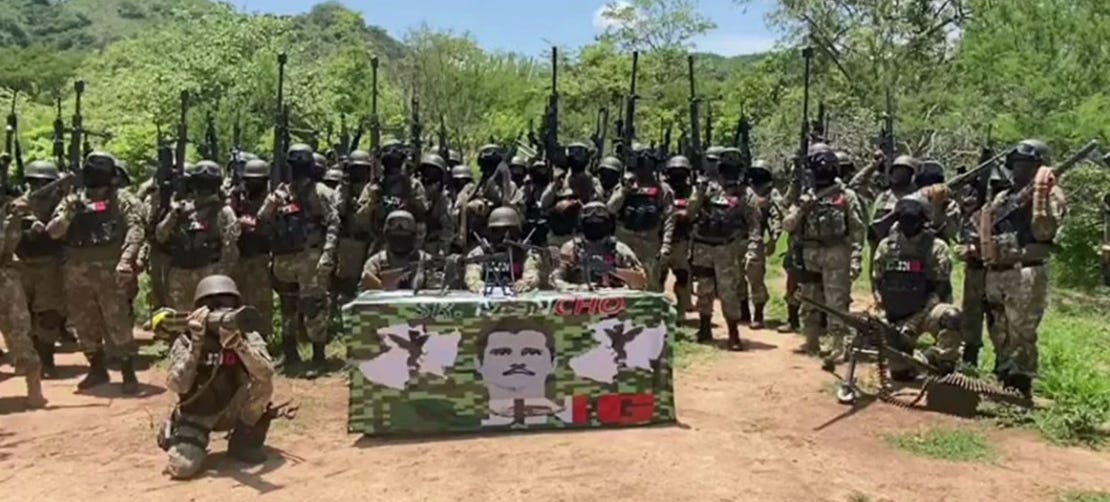
On Sunday morning, February 22, 2026, the Mexican state tried again — this time targeting the kingpin of CJNG, the Sinaloa splinter group that rose to contest its primacy, deploying systematic attacks on the state even more brutal than the organisation it broke away from. This time Mexican Special Forces, aided by U.S. intelligence operating under the Trump administration’s new anti-narco terror powers, appeared more ready to kill than arrest their target. The military’s official account of what it seized in the assault — “rocket launchers capable of downing aircraft and destroying armoured vehicles” — speaks for itself.
Twenty-two hours later, the Mexican state has not retreated — even as a wave of brutal retaliation broadly mirrors what happened in Culiacán.
Nemesio Rubén Oseguera Cervantes — El Mencho, founder and supreme leader of the Jalisco New Generation Cartel, arguably the most militarized and violent criminal organisation in the Western Hemisphere — was killed in a dawn raid in the mountain town of Tapalpa, Jalisco. He died in the air, being airlifted to Mexico City, several bullet wounds in his body. He had evaded capture for over a decade. He had a $15 million U.S. bounty on his head. Six years ago he tried to murder the man now running Mexico’s security apparatus.
The cartel’s response was instant, coordinated, and in some ways a near-perfect replay of Culiacán — without the outcome the cartel wanted, so far.
The human cost to the Mexican state is now significantly higher than first reported. Security Secretary Omar García Harfuch confirmed Monday that 25 National Guard soldiers were killed in Jalisco alone — in six separate cartel attacks in the hours following the Tapalpa operation. Defence Secretary Ricardo Trevilla Trejo wept publicly as he addressed the losses. One state attorney’s office official was also killed. No civilian deaths have been reported.
Trevilla also disclosed how El Mencho was finally located after more than a decade in hiding: intelligence services tracked a visit from a romantic partner to his safe house.
“There is an enormous unpredictability,” Vanda Felbab-Brown, a leading organised crime expert at the Brookings Institution in Washington, told Mexico’s Milenio newspaper. “But without doubt, this is as large an earthquake for the criminal landscape in Mexico, Latin America and the entire world as the arrests of El Mayo and El Chapo. I would say even more important.” The question now, she said, is: “Will Guadalajara end with violence as dramatic as Culiacán?”
The answer, as Monday began, was still unresolved.
By Sunday evening, Mexico’s Security Cabinet had confirmed 252 separate narco-blockade points across 20 states — vehicles seized, doused in fuel, and set ablaze at intersections, highway ramps, and bridge approaches from Jalisco to Tamaulipas to Baja California to Quintana Roo. By 8 p.m., 23 had still not been cleared. Schools were canceled Monday across several states. Jalisco’s Code Red — activated by Governor Pablo Lemus Navarro at the height of Sunday’s violence — remained in force. All public transport in the state remained suspended.
The death toll as Monday morning broke: at least 14 confirmed dead across Jalisco, Michoacán, and Guanajuato in the initial hours — a figure that would rise sharply. After 9 AM EST, Security Secretary García Harfuch confirmed 25 National Guard soldiers killed in Jalisco alone, in six separate cartel ambushes.
In Puerto Vallarta — Mexico’s third most-visited city, packed with foreign tourists on a February Sunday — CJNG operatives torched a Costco, burned heavy vehicles near the cruise ship ports, and sealed off the resort city from the highway network. In Guadalajara, Mexico’s second-largest metropolis and a 2026 World Cup host city, gas stations were set alight and gunfire rang out across working-class neighbourhoods. The Jalisco capital was described by journalists on the ground as a ghost town by nightfall. Videos verified by The Bureau showed panicked passengers sprinting through the departure terminal at Guadalajara’s international airport, though an airport spokesperson later asserted that no incidents had occurred inside the facility itself.
Across 20 states, kiosks burned. Pharmacies burned. Convenience stores burned. A fuel tanker was set ablaze near a Puerto Vallarta gas station. Threatening messages circulated on social media warning Guadalajara residents to stay inside by 5 p.m. or face violence — messages Mexico’s embassy in Washington denounced as disinformation, without fully extinguishing the fear they spread.
The scale was unprecedented. Culiacán, in 2019, was one city, one cartel, one operation aborted within hours. This was a narco-convulsion spanning two-thirds of Mexican territory, triggered by an operation that, this time, did not abort. The 2021 academic literature published in Small Wars Journal that describes Mexican cartels as “hybrid threats” — deploying conventional, paramilitary, and information tactics simultaneously against the state, and fighting off operations to disrupt cartel leadership — is precisely what is occurring now in Mexico.
The security boss who survived El Mencho
The personal dimension of Sunday’s operation has not yet received the attention it deserves.
On the morning of June 26, 2020, a 25-to-28-man CJNG assassination squad ambushed the convoy of Omar García Harfuch on Paseo de la Reforma — one of Mexico City’s most celebrated boulevards, running through the heart of the capital’s most exclusive district. Two of Harfuch’s bodyguards died in the street. A passing civilian woman died. Harfuch was shot three times.
From his hospital bed, he posted a statement directly blaming CJNG and calling the attack “cowardly.” Security analyst Alejandro Hope called it an “exceptional event” — noting that until that morning, no criminal group had dared confront Mexico City’s police at that level of force and sophistication. The attack, Hope said, pointed to an organisation not merely evading the law but actively trying to overwhelm it.
President Claudia Sheinbaum — who was Mexico City’s mayor at the time, and who personally announced the arrest of 12 suspects in the attack at a press conference days later — appointed him, upon taking the presidency, as Mexico’s Secretary of Security and Civilian Protection. Newsweek has reported that in the Sheinbaum government, García Harfuch has overseen more intelligence sharing with the United States than any previous minister in recent memory.
Reuters confirmed that the Joint Interagency Task Force-Counter Cartel — a new U.S.-military-led unit formally launched just last month, involving multiple American agencies and specifically designed to map cartel networks on both sides of the border — played a key role in the Tapalpa operation. CBS News separately confirmed that U.S. Navy SEAL instructors arrived in Mexico on February 15 as part of a classified programme targeting top-level cartel figures, training the Special Forces team that carried out the raid.
García Harfuch endorsed an account in a communiqué posted to @Defensamx1 — the ministry’s official account and the most credible official source to emerge from Sunday’s operation. Special Forces of the Mexican Army, it stated, supported by Air Force aircraft and the National Guard’s Immediate Reaction Special Force, planned and executed the Tapalpa operation. Military personnel came under attack and in defending themselves killed four CJNG members at the scene. Three more — including Oseguera Cervantes — were seriously wounded and died during air transfer to Mexico City. Two others were detained. Seized: armoured vehicles and “rocket launchers capable of downing aircraft and destroying armoured vehicles.” Three soldiers were wounded and transferred to hospital in Mexico City. U.S. authorities provided “complementary information” within the framework of bilateral cooperation.
The communiqué noted that National Guard troops and Army units in central Mexico and the states adjacent to Jalisco were being concentrated to reinforce security.
Last night, White House Press Secretary Karoline Leavitt put the American position plainly: the U.S. provided “intelligence support to the Mexican government” for the operation. El Mencho, she said, “was a top target for the Mexican and United States government as one of the top traffickers of fentanyl into our homeland.”
Fear now spreading among politicians and lawyers: DEA vet
The killing of El Mencho will reverberate far beyond the burning blockades and the smouldering resort towns. That is the assessment of Donald Im, a former senior official for Special Operations at the U.S. Drug Enforcement Administration, who spent years targeting Chinese criminal networks inside Mexico — the upstream suppliers and money launderers whose chemical precursors and financial infrastructure made the fentanyl flood possible.
Im argues that El Mencho’s longevity was never simply a product of violence, however spectacular. “He generated billions of dollars from drug trafficking to protect his empire,” Im said, “and exploit the weakness of a nation — the governance of a nation, and its neighboring countries.” He controlled territories in Mexico and Central America. He had easy access to wealthy nations with, as Im puts it, “insatiable demand for his products.” Money, Im says, was his second weapon — and in many ways his more durable one.
Which is why, Im argues, the killing itself is only the beginning of what must follow. “Now, identify all the lawyers and accountants involved in protecting him,” he said, “and remove the layer to expose his entire network — from China to North America, South America and Europe.” That network, Im made clear, is not purely criminal in its composition. There are, he suggested, a significant number of Mexican and perhaps American politicians, government officials, lawyers, and accountants — along with figures from other nations — who are “scared right now.” Scared, Im suggested, on two fronts simultaneously: not just from El Mencho’s army of sicarios, but perhaps also by U.S. and Mexican law enforcement investigations now empowered to follow the money wherever it leads.
Im testified before the U.S. House Financial Services Committee in March 2023 that trade leverage is among the most effective tools available against narco-trafficking — because cartels, at their core, are commercial enterprises. “It’s all about profit,” he said. “A full-spectrum supply chain involved in commerce, trade, and banking.” In that framing, the Trump administration’s combined deployment of tariffs, trade pressure, sanctions, law enforcement, and military intelligence — what Im calls a “multi-domain approach” — represents the kind of integrated pressure that has “long been overdue.”
And the elephant in the room, Im made clear, is China.
The template for what Chinese criminal infrastructure inside Mexico looks like — and how it operates at the highest levels of commerce, banking, and political access — was written in 2007, when Mexican authorities seized $206 million in cash from a mansion in one of Mexico City’s wealthiest neighbourhoods. The property belonged to Zhenli Ye Gon, a Chinese-Mexican businessman who is still sitting in a Mexican prison.
Ye Gon's methamphetamine factory in Toluca, Mexico was built with the direct assistance of Chinese workers and advisors dispatched under a formal supply contract with Chifeng Arker, an Inner Mongolia-based firm whose current parent company is nearly 50 percent owned by Shanghai state-linked entities, records reviewed by The Bureau indicate. Chifeng supplied not only the precursor chemicals but the technical expertise to run the plant — what U.S. extradition documents describe as "workshop housing design" and hands-on production start-up support.
What the Ye Gon case exposed — the intersection of greed, compromised judiciary, Chinese state-level chemical inputs and corruption at every level of government in Mexico and its neighbours — is, Im says, precisely the infrastructure that enabled El Mencho's empire to generate the billions that kept him untouchable for so long.
“Zhenli Ye Gon was not only involved in supplying precursor drug chemicals to Mexican cartels, but he also supplied industrialized pill presses,” Im says, adding “his most important wherewithal was full access upstream to China’s industries, banking, commerce and shipping.”
The challenge now, Im argues, is structural. The United States, he said, can do more to provide the economic access that makes legitimate alternatives to cartel employment viable. Without alternatives, the ecosystem that results in narco-state corruption cannot be reversed, according to Im.
El Mencho’s son, daughter, and brother are all in U.S. custody. His wife was released from Mexican prison only last year. The DEA describes CJNG as a franchise operation — around 90 affiliated organisations — that has never faced a succession question, because El Mencho never allowed one to arise. Some analysts are now looking at the modern history of cartel violence and asking whether regional bosses within CJNG will do what they have done before: fight each other for the throne. It is what happened after El Chapo was arrested — a succession struggle that eventually sparked a civil war between Sinaloa factions, a war that continues to this day, and one that paradoxically cleared the space in which CJNG rose to its current dominance.
Felbab-Brown, the Brookings Institution’s leading expert on non-state armed groups, identified the key variable: whether El Mencho had managed to build a clear line of succession inside CJNG. If he had, the cartel might hold together. If not, the fragmentation — and the violence that comes with it — could spread far beyond Jalisco, touching the Sinaloa conflict already burning in the north, and reaching as far as Colombia and Ecuador, where CJNG has established its international footprint.
Tourists trapped: Voices from a haven locked down
Thousands of foreign visitors woke Sunday to a resort city transformed. No taxis. No rideshares. Flight cancellations cascading through airline apps with no rebooking windows offered. Hotel managements telling guests, in varying registers of calm, not to leave.
In Puerto Vallarta’s Romantic Zone, Canadian tourist Donna Kemp posted from her hotel balcony as a kiosk across the street was torched by men on motorbikes throwing Molotov cocktails, not a fire truck in sight. Later, military helicopters circled overhead through a column of black smoke: “Random explosions still happening,” she wrote. By Sunday evening her posts took on a different register. “All is quiet in an eerily smoky Puerto Vallarta this evening,” she wrote. “Wondering if the violence is over. We’ll see what nightfall brings.”
Eugene Marchenko, 37, of Charleston, South Carolina, told Fox News Digital he woke at his Airbnb to blaring horns and counted six cars in flames just beyond his window. Adriana Belli, 49, from Miami — in town for a wedding in Guadalajara and a birthday in Mexico City — told the same outlet that tourists who had reached the airport early were now locked inside it, surviving on granola bars. A third American, who declined to be identified, called his mother from his hotel room to tell her where his will was. “This is the first time we’ve ever been away from him,” he told Fox News Digital of his four-year-old son. “I had to call my mom and say, look, here’s where my will is. I don’t want you to panic.”
Yogi Omar, a Vancouverite in Puerto Vallarta to celebrate his birthday — describing the city to CBC News as “a little slice of heaven” — spent the worst hours at the home of an Ottawa man named Norman, who took in roughly 200 tourists during the fires and explosions. Robert Onysko, another British Columbian, told CBC he watched men on motorbikes set a vehicle alight and ransack a corner store in the Zona Romántica. His flight was canceled. “Everything is closed,” he said. “We’ll figure it out as we go.”
Global Affairs Canada reported nearly 19,000 Canadians registered in Mexico, 4,672 of them in Jalisco alone. Canadian Foreign Affairs Minister Anita Anand said Ottawa was “deeply alarmed” and “closely monitoring the serious and rapidly evolving situation.” Conservative foreign affairs critic Michael Chong called for a coordinated evacuation. No such operation had been announced as of Monday morning. The U.K. Foreign Office told British nationals across Jalisco to remain indoors. Euronews issued continent-wide advisories to European travellers. The U.S. Embassy’s shelter-in-place order expanded in a second bulletin to cover not just Jalisco but Baja California, Quintana Roo — including Cancún — and large parts of eight additional states. All U.S. government staff at Consulate Tijuana and in Guerrero, Michoacán, and Quintana Roo were directed to shelter in place.
At least 30 flights from U.S., Canadian, and Mexican airports to Puerto Vallarta had turned back or diverted by Sunday evening. Air Canada, WestJet, Southwest, Alaska, Flair, Delta, American, and United all canceled services or issued change waivers. The FAA confirmed it was diverting Puerto Vallarta-bound flights in coordination with Mexican authorities.
Editor’s Note: This story was clarified to say Donald Im was former assistant Special Agent in charge of Special Operations at the U.S. Drug Enforcement Administration.


Thanks for the detailed reporting Sam.
Key for me is this:
"Now, identify all the lawyers and accountants involved in protecting him,” he said, “and remove the layer to expose his entire network — from China to North America, South America and Europe.” That network, Im made clear, is not purely criminal in its composition. There are, he suggested, a significant number of Mexican and perhaps American politicians, government officials, lawyers, and accountants — along with figures from other nations — who are “scared right now.” Scared, Im suggested, on two fronts simultaneously: not just from El Mencho’s army of sicarios, but perhaps also by U.S. and Mexican law enforcement investigations now empowered to follow the money wherever it leads."
Cartels don't operate without inside help.
Most trusted reporting and analysis, thank you Sam. My prayers for all touched by this violence.
The globalist controlled bankers in Canada who launder this blood money must be exposed.