Beijing's Long Game Is Engulfing Canada—and Mark Carney Is in the Frame
Op-Ed: Former senior Mountie argues Canada's economic, industrial, and national security policies are dangerously misaligned — and a pattern of foreign state influence is filling the gap.
By Garry Clement
OTTAWA — In policing — particularly in national security and organized crime — we are trained to recognize a simple truth: the most serious threats rarely arrive with warning. They emerge gradually, through relationships, dependencies, and decisions that appear rational in isolation but carry strategic consequences in aggregate.
What concerns me today is not a single incident or headline. It is a pattern.
Consider the sequence.
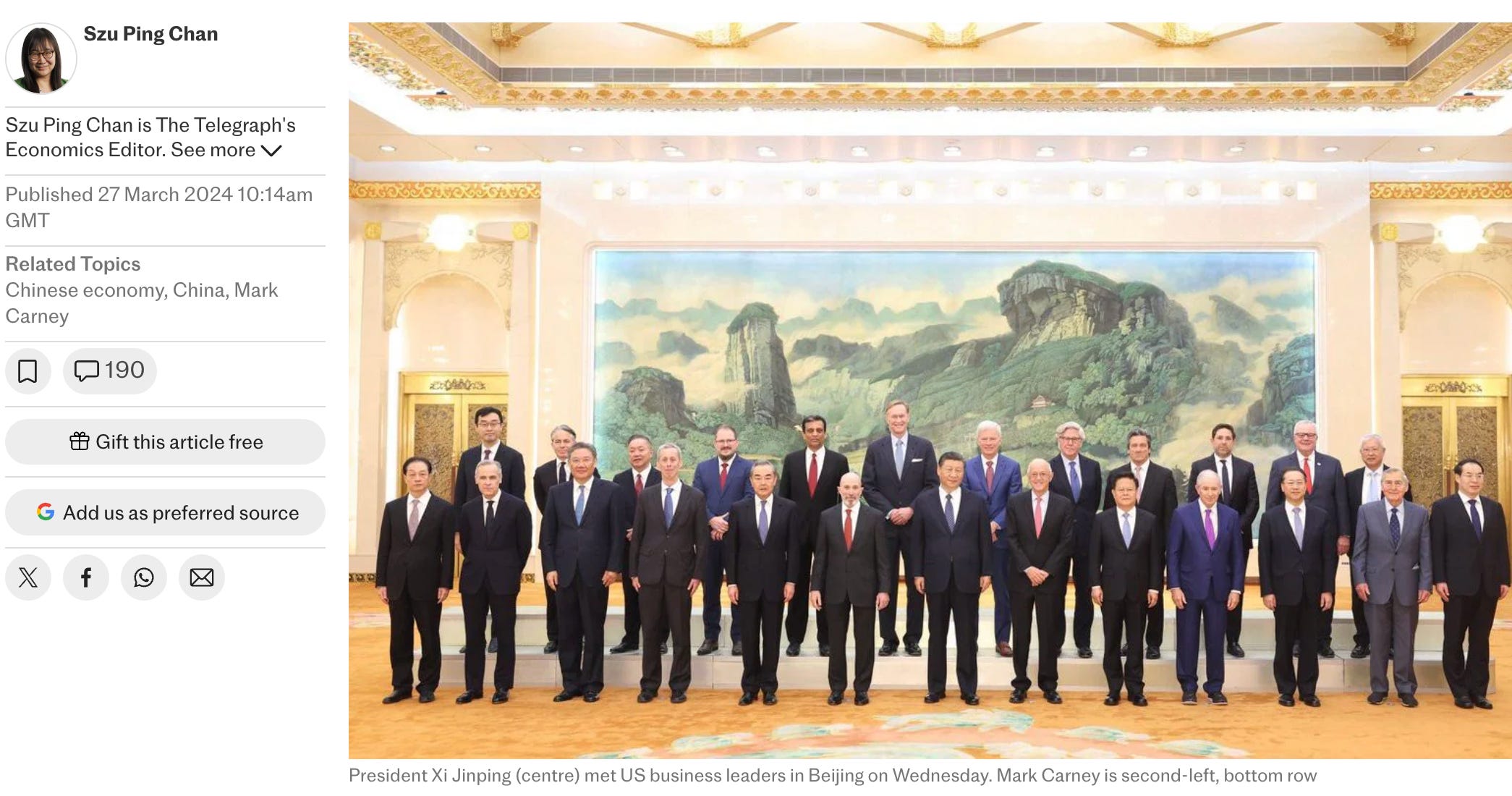
In September 2024, Mark Carney assumed a central role shaping Canada’s economic future as Chair of the government’s Task Force on Economic Growth. Weeks later, he met with a senior official from the People’s Bank of China. Shortly thereafter, Brookfield — an entity with which he has longstanding ties — secured a loan of roughly $250 million from the state-owned Bank of China.
There is no allegation of illegality here. But in national security work, legality is not the threshold. Exposure is. Influence is. Perception is. And when public authority and private financial interests intersect — particularly involving foreign state institutions — it raises questions that deserve clear answers.
Now turn to Newfoundland.
The Beaver Brook mine is not just another industrial site. As The Bureau has reported, it is North America’s most significant source of antimony — a mineral essential to ammunition, advanced weapons systems, and modern defense technologies. China owns it. And in 2023, it was shut down.
Since then, Beijing has tightened global supply through export controls, driving prices sharply higher while Western governments scramble to secure independent sources. The United States has responded with billions in strategic investment. Canada has not.
In policing, when a critical asset is controlled by a foreign state actor and rendered inactive in a way that benefits that actor strategically, we do not assume coincidence. We assess leverage.
The same dynamic is emerging in Canada’s Arctic.
Chinese state-linked enterprises hold significant mineral positions in Nunavut. At the same time, Ottawa is accelerating infrastructure projects — roads, ports, and corridors — that will define access to those resources for decades to come. Infrastructure is not neutral. It determines who operates, who profits, and ultimately, who holds influence on the ground.
If Canadian-funded infrastructure enhances the operational reach of foreign state enterprises — particularly those aligned with strategic competitors — we must ask whether we are strengthening sovereignty or quietly diluting it.
Layer onto this the growing body of evidence around foreign influence operations.
A recent international study identified hundreds of organizations in Canada connected to China’s United Front system — an apparatus designed to shape political and social environments abroad. Canada’s own Foreign Interference Commission has heard credible concerns about relationships between political actors and networks aligned with Beijing’s interests.
This is not about ethnicity or diaspora communities. It is about state-directed influence — deliberate, persistent, and strategic.
What is most troubling is not any single element, but the inconsistency across them.
Canada identifies China as a strategic challenge. Yet strategic minerals remain under foreign state control. Public funds support foreign state-linked enterprises. Domestic industries are bypassed in key procurements. National security considerations appear disconnected from economic policy.
In my experience, organized systems — whether criminal or state-based — do not need to overpower institutions. They exploit gaps. Inconsistencies. Misalignments between stated priorities and actual decisions.
Right now, Canada is presenting those gaps.
This is not a partisan issue. It is not about personalities. It is about coherence — about whether our economic, industrial, and national security policies align with the realities of an increasingly competitive and adversarial global environment.
The question is not whether risks exist. They do.
The question is whether we have the clarity — and the will — to address them.
Because influence, when executed effectively, does not need to be visible. It does not need to be aggressive. It simply needs to shape outcomes over time.
Canada is not being overtaken.
But we are, increasingly, being outmaneuvered.
Garry Clement is a former superintendent with the Royal Canadian Mounted Police, where he specialized in national security and organized crime investigations. He is the author of Under Cover: Fifty Years of Dirty Money, Organized Crime and the RCMP and Canada Under Siege: How Prince Edward Island Became a Forward Operating Base for the Chinese Communist Party.


Sadly, so very sadly, Canada is a warehouse, the elite have the keys, it's citizens go about thinking it's a real democratic country while paying high taxes for the living they eak out all the while putting up with floor crossers, money laundering, drug gangs, long health care wait times, corruption at all levels of government, I could go on, what a mess, what a sad mess
A multitude of Canadians see, sense and clearly understand how dangerously close Carney is bringing Canada to Beijing. We also have zero doubt that it’s intentional! Where to go, how to reverse course, seems to drift further and further from reach or reality!
Think of Hungary’s history…the brutal communist regime that overtook the easily influenced (exactly like many weak-minded Canadians) Hungarian population back then, the subsequent torture, the escapes to other democratic countries…like Canada that occurred. The LONG road back to the highly successful democracy Hungary now has today!
IS THIS CANADA’S FUTURE?? People who came here from brutal dictatorships say it’s exactly what happened in the countries they left behind!!