China Owns Canada's Only Antimony Mine — Holding Canada's Trump Card
Beaver Brook in Newfoundland could produce five percent of the world's antimony supply — a mineral critical to warfighting that Washington now calls a national security emergency. China shuttered it.
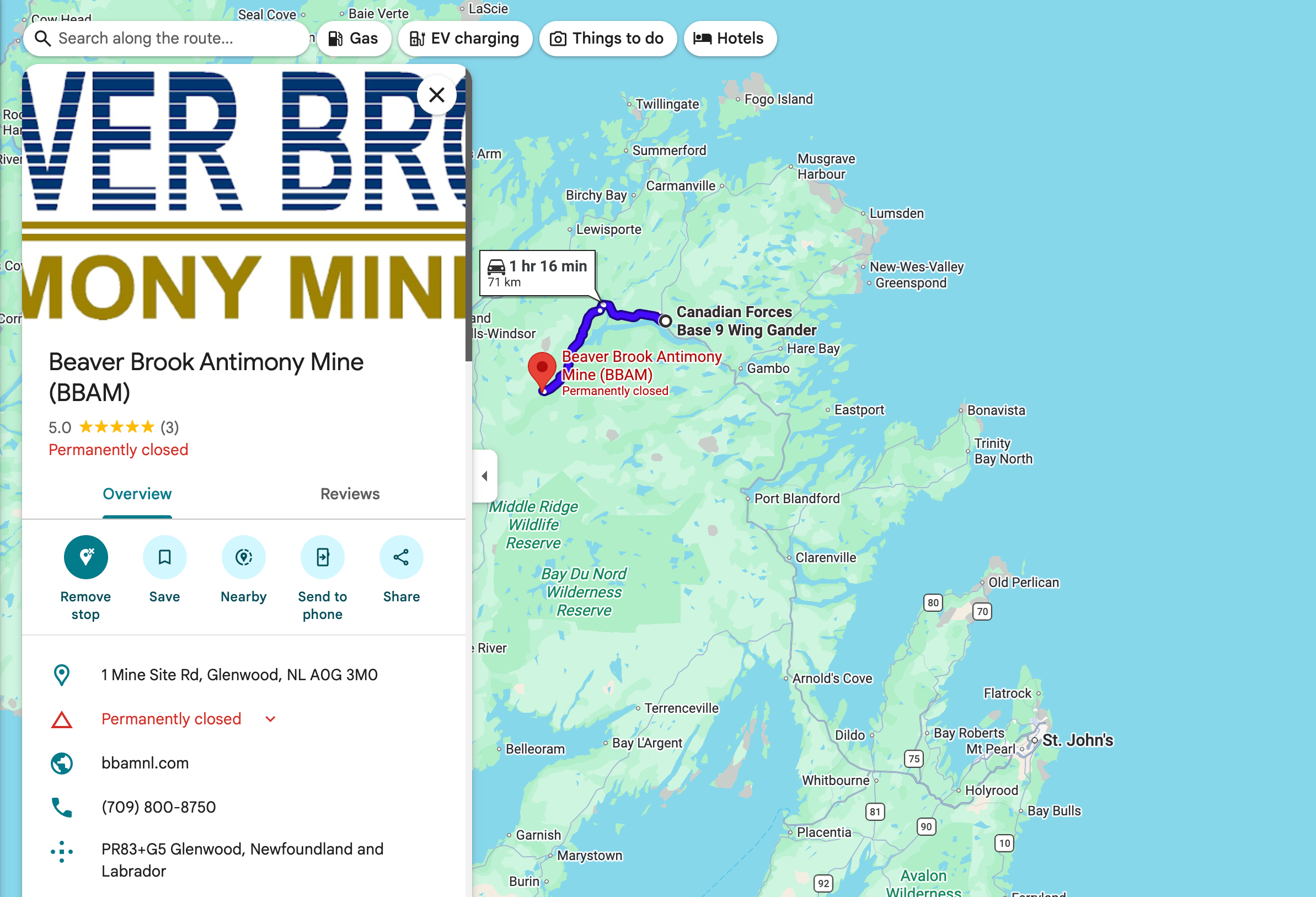
GLENWOOD — In the rugged interior of Newfoundland, an hour’s drive west from the Canadian Forces Base in Gander, sits a dormant mine with profound implications for the nation’s security and prosperity. Beaver Brook could be the largest North American producer of antimony — a critical mineral threaded through the entire spectrum of modern military hardware, from small arms and artillery shells to advanced missile seekers and night-vision goggles.
But China owns the mine and shut it down in early 2023 — one year before Beijing imposed export controls blocking antimony sales to U.S. military end users, driving prices from about US$5,900 per tonne to more than US$50,000.
Antimony forms in crystalline masses, often clustered in dark silver needles — nature's own suggestion of the gunmetal world it enters. It was little known before Washington recognized that Beijing had quietly secured a near-monopoly over the world’s critical mineral supply, antimony among them. The metal fires every conventional round, hardens military components, and provides the infrared edge that defines lethality in modern conflict. Armies could not sustain combat for even a single day without it — a reality that has driven urgent U.S. efforts to stockpile it, revive domestic processing, and cut reliance on China and Russia.
The Newfoundland mine was acquired in December 2009 by Hunan Nonferrous Metals Corporation, a Chinese state-linked producer, for $29.5 million. It went silent in 2013 — the year Xi Jinping secured his presidency — revived in 2019 under China Minmetals Rare Earth Group, employed roughly 100 workers, shipped concentrate to China, and was abruptly shuttered again in 2023. It has not produced since.
In a microcosm, The Bureau’s reporting on Beaver Brook surfaces a contest that is reshaping geopolitics in ways inconceivable only a few years ago — one waged not with weapons but through control of the materials that make weapons. The questions it raises for Canada are urgent.
Is Beijing deliberately keeping this strategic mine dormant to constrain global supply and freeze out Western competitors? Are Chinese party-state mining operatives in Canada blocking what could be Ottawa’s trump card in its stalled trade negotiations with Washington — an administration now spending billions and scouring the Western Hemisphere, from Greenland to Argentina, to secure non-China-dependent supply chains? Could Canada invoke national security powers to compel Beijing’s divestiture and reclaim the asset? And would it dare to — while Mark Carney moves Canada into deeper strategic alignment with Beijing, spanning electric vehicles and the critical mineral supply chains that sit at the heart of the new global security order?
Some in the industry have been watching Beaver Brook for exactly this reason.
Anthony Vaccaro, president of The Northern Miner, told the Central MinEx 2025 conference that the stakes for antimony were rising. “It’s an important mineral. We need it. We need to make sure our military is strong, but China is absolutely dominating it,” he said. “Prices have been surging on antimony and the Americans have woken up to it.”
He cited The Northern Miner’s own 2004 assessment — that at full production, Beaver Brook would rank as North America’s only primary antimony mine, producing about five percent of the world’s supply. The contrast between Ottawa and Washington’s response is telling.
Perpetua Resources is developing a lower-grade antimony deposit in Idaho on more than $80 million in Defense Department funding and a federal financing commitment of up to $2 billion. Canada’s better deposit sits idle in Chinese hands.
“That is what the U.S. government is looking to secure,” Vaccaro told the conference.
“Well, lo and behold, Newfoundland and Labrador has the biggest antimony potential mine in all of North America. Who owns it? Why isn’t it in production? The Chinese own it. We have this critical asset that’s Canadian, on care and maintenance by the Chinese.”
The minister most directly responsible for Canada’s critical minerals file is Tim Hodgson, appointed by Prime Minister Mark Carney as Minister of Energy and Natural Resources. His ministry oversees the federal critical minerals strategy, the sovereign minerals fund, and the Investment Canada Act framework governing foreign control of strategic assets.
The Bureau submitted questions to Ministers Hodgson, Anand, and Joly before publication. The questions have been acknowledged, but not answered before deadline for this story.
China Minmetals is not a commercial mining company in any sense Western regulators would recognize. It is one of China’s largest state-owned resource conglomerates — Communist Party leadership embedded, operations spanning mining, metals production, trading, and engineering across dozens of countries. By its own description, it is a “national team” and the “main force to ensure the security of resources.”
It is directly supervised by China’s State-owned Assets Supervision and Administration Commission. In practical terms, that places the company inside China’s industrial strategy — particularly in sectors considered essential to technology manufacturing, defense systems, and the global energy transition. In 2021, the company became a core shareholder in the formation of China Rare Earth Group, a state-directed merger designed to concentrate Beijing’s control over a strategically vital mineral industry.
Ottawa’s response to China Minmetals’ outsized strategic presence in Canada has been notably absent.
In November 2022, it ordered three Chinese companies to divest from Canadian critical mineral firms on national security grounds — Power Metals Corp., Lithium Chile, and Ultra Lithium, all minor lithium exploration plays.
Canada’s only primary antimony mine remained untouched. In November 2024, the government approved Zijin Mining Group’s acquisition of a Pan American Silver critical minerals asset, citing rigorous scrutiny and security undertakings. Fourteen months later, Zijin announced a C$5.5 billion all-cash takeover of Toronto-based Allied Gold Corporation.
The Bureau’s review of corporate records identified a Canada-based executive connected to China Minmetals — the enterprise that controls Beaver Brook — whose involvement in discussions about the mine’s future was flagged by a Canadian mining source. Independent review of the same executive’s profile disclosed a concurrent role at Zijin Mining Group, the firm now acquiring Allied Gold and the Pan American Silver asset.
The same pattern reaches into Canada’s Arctic.
Through MMG, China Minmetals controls the Izok Corridor Project in the Kitikmeot region of Nunavut — a 1,083-square-kilometer package of high-grade copper, zinc, lead, silver, and gold claims, among the most significant undeveloped mineral corridors in the North.
MMG has linked its development to the proposed Grays Bay Road and Port, which would open the first all-weather land route and deep-water Arctic port in that part of the country. Commercially, that unlocks the ore body. Strategically, it determines who builds Canada’s Arctic infrastructure.
The proposition carries immediate military concerns.
On March 12, 2026, Prime Minister Carney announced $35 billion in Arctic military and infrastructure spending — repackaging funds first earmarked by Justin Trudeau’s government in 2022 — and referred the Grays Bay Road and Port to his government’s Major Projects Office for fast-track approval. The same road MMG has identified as essential to unlocking the Izok Corridor. Canada’s sovereignty-asserting Arctic plan would, if executed, directly accelerate the strategic position of a Chinese state enterprise in Canada’s North. Carney’s plan also specifically designated 5 Wing Goose Bay in Labrador as a Deployed Operating Base — a forward platform for F-35s and allied NORAD training operations — deepening the military significance of a province that also hosts, an hour’s drive from 9 Wing Gander, the dormant Beaver Brook antimony mine in Chinese state hands.
The sovereignty concern in Canada’s Arctic was already on record in Ottawa six years ago. A 2019 House of Commons Standing Committee report warned that China had shown “considerable interest” in Arctic shipping routes, infrastructure, and resource access. Duane Smith of the Inuvialuit Regional Corporation delivered the plainest verdict: “We stand here on the edge of the continent waving our maple leaves at China, at Russia, at the U.S. and at any others who have designs on our Arctic.”
The Chinese academic literature is candid about why. A 2023 paper by researchers including Menglong Li of Jilin University frames China’s Arctic position with notable directness. Russia dominates the Northern Sea Route, it says, and Canada and Russia treat Arctic passages as internal waters.
China — though not an Arctic state — is a legitimate outside stakeholder whose role should grow, the paper argues.
The paper quotes Xi Jinping directly: "I hope that the international community will attach great importance to development issues, promote the establishment of global development partnerships, and achieve stronger, greener, and healthier global development. A sustainable Arctic is the only way out. The peace, stability, and sustainable development of the Arctic region will be beneficial to the whole world and accelerate the pace of economic globalization," the quote from Xi continues.
"In this era of great change, we should abandon the confinement of the Cold War mentality and strengthen cooperation between the East and the West. We should not distinguish by ideology but work hard for the common interests of all mankind. If human society can reach beneficial cooperation on the Arctic issue, it will become a template for resolving other disputes, and it will be a new chapter in history to sell part of the interests in exchange for the common development of all mankind."
Reading between the language of environmentalism and globalism and humanism, General Secretary Xi’s hardened CCP language and objectives can be easily discerned.
China Minmetals’ global reach has sometimes broached conflict.
Its subsidiary MMG — the same entity straddling the Nunavut deep-water port that Carney’s $35 billion Arctic plan has now fast-tracked — operates Las Bambas, one of the world’s largest copper mines, in Peru’s Apurimac region. Acquired in 2014 for $5.85 billion and in production since 2016, Las Bambas topped the Business and Human Rights Resource Centre’s global ranking of transition mineral conflicts in 2024, with more than 100 documented allegations of abuse. Indigenous communities report polluted water, blocked ancestral lands, and environmental assessments they say concealed risks to local aquifers. Lima declared states of emergency over unrest at the mine four times between 2015 and 2022. Three protesters were killed by gunfire in 2015. More than 300 people have been charged or jailed for opposing its operations, according to monitors including the United Nations Special Rapporteur on human rights defenders. MMG says it pursues dialogue and operates in compliance. The record tells a more complicated story.
In Brazil, MMG’s February 2025 acquisition of Anglo American’s Barro Alto and Niquelândia nickel mines for $500 million drew antitrust complaints from a Dutch-Turkish rival — whose $900 million bid was passed over — filed in Brasilia and Brussels. Critics warned the deal could hand China 52 to 62 percent of Brazil’s nickel output. The American Iron and Steel Institute asked the White House to intervene, arguing it would give Beijing direct influence over a metal critical to electric vehicle batteries and stainless steel. The European Commission opened a formal probe in November 2025 into MMG’s state ties. The transaction remained under scrutiny in early 2026.
Understanding how Beijing built its Western Hemisphere mining positions — and why governments from Ottawa to Washington were so slow to see it — requires going back further.
While Western industrial policy in the 1990s and 2000s operated on the assumption that trade made war obsolete — a variant of Fukuyama’s “End of History” thesis — Chinese strategic planners were reading their history differently. The lesson they drew from the past century of American dominance was not that economic integration creates peace. It was that whoever controls the physical inputs of modern industry controls the terms on which everyone else does business.
The Chinese Communist Party’s minerals strategy was, like most of its 5-, 25-, and 100-year plans, patient, systematic, and nearly invisible to Western publics until reversing it became expensive. China produces approximately 48 percent of the world’s mined antimony and refines the overwhelming majority of what is processed globally. For gallium — essential to semiconductors and communications equipment — China controls 98.8 percent of refined global output. For rare earth elements, which power the magnets in every electric vehicle, every wind turbine, and most advanced weapons systems, China accounts for roughly 60 percent of mining and over 90 percent of processing. The International Energy Agency has calculated that China dominates refining for 19 of the 20 key strategic minerals the energy transition and defense industry require.
Back to Newfoundland.
One year after China Minmetals shuttered North America’s most significant antimony mine, on August 14, 2024, Beijing announced that antimony exports would require a government license, effective the following month. In October, Chinese shipments fell 97 percent against the prior month. In December, Beijing escalated: it banned antimony exports to United States military users specifically — the first time China had directed a critical minerals restriction against a single country rather than the world at large. The price at Rotterdam doubled in two months, then doubled again.
In February 2025, China added tungsten to its export control list. In April, seven heavy rare earth elements were placed under licensing requirements globally. Then, in January 2026, China issued Announcement No. 1 of 2026, prohibiting all dual-use exports to Japan for military end users or any purpose that could enhance Japan’s military capabilities.
The trigger was Japanese Prime Minister Sanae Takaichi’s statement that a Chinese military attack on Taiwan could legally constitute a threat to Japan’s survival. On February 2, 2026, President Trump announced Project Vault: a strategic reserve for critical minerals backed by a $10 billion Export-Import Bank loan. Two days later, Secretary of State Marco Rubio convened 54 countries and the European Commission at the State Department for the first Critical Minerals Ministerial, launching FORGE — the Forum on Resource Geostrategic Engagement — as the successor to the Minerals Security Partnership. Eleven new bilateral frameworks were signed. The stated ambition: a preferential trading bloc for critical minerals, with minimum price floors designed to make Western production viable against Chinese state-subsidized output.
Canada attended the FORGE ministerial. It was not among the eleven countries that signed a new bilateral critical minerals framework with Washington.
The U.S. Defense Department has committed $245 million in antimony offtake to U.S. Antimony Corporation, the only antimony smelter in North America, based in Thompson Falls, Montana, currently running at a fraction of its mandated target.
Perpetua Resources, developing the Stibnite gold-antimony project in Idaho, has received more than $80 million in Defense Department funding.
“Perpetua never would’ve been able to build a mine here five or ten years ago,” Vaccaro told Central MinEx 2025. “It’s this federal funding. So critical.”
Vaccaro’s presentation ranged broadly — critical minerals, great-power competition, a world reorganizing around strategic resource control. But on Beaver Brook, he zeroed in on something specific: what he described as circulating chatter in Canadian mining and political circles about Beijing’s real intentions for the mine.
“I will tell you, there’s rumors that the Chinese use this — that Beaverbrook is on care and maintenance, but if the price of antimony stays high and other projects come on, they can turn the tap on, flood the market a little bit, drive the price back down, discourage others from entering,” he said.
“There’s rumors that that’s one of the games they’re playing. There’s certainly nothing stopping them currently from doing that. So I think this is going to be a very interesting asset to look at as possibly a microcosm for what’s going on on that big geopolitical scale.”
There is a harder lens through which to view Beaver Brook — the hardened geopolitical logic that sovereignty is expressed not only through the votes of citizens, but through jobs, productivity, presence, and utility. By that measure, a dormant mine in Chinese hands in the interior of Newfoundland is a statement of power, and not Ottawa’s.
Then there is polar projection — the map centered on the North Pole that NORAD has always used, the one that shows the world as it actually is rather than as Mercator flattened it. Russia and Canada face each other across the Arctic Ocean. Greenland bridges them. Newfoundland’s coast is the eastern hinge of North America’s Arctic exposure, closer to Moscow than to Vancouver.
The province no longer hosts permanent U.S. military bases — Fort Pepperrell, Argentia, and Ernest Harmon Air Station belong to another era. But 9 Wing Gander, roughly an hour’s drive from Beaver Brook, anchors search and rescue and continental air operations on the island. To the north, Five Wing Goose Bay in Labrador serves allied low-level training and NORAD-related activity. The province sits at the intersection of Arctic strategy and transatlantic defense — North America’s eastern gateway to the North Atlantic, close neighbor to Greenland across the Labrador Sea — at a moment when both are being urgently renegotiated.
The questions The Bureau put to Carney’s mining minister Tim Hodgson, a Goldman Sachs banking alumnus, were direct: Has the government assessed Beaver Brook as a strategic asset within North American defense-industrial supply chains? Has any national security review been conducted into Chinese state control of Canada’s only primary antimony mine? Does the 2023 rationale for not requiring Chinese divestiture — policy uncertainty — still apply, given Beijing’s subsequent ban on antimony exports to United States military users? Has Ottawa raised Beaver Brook with Washington as part of critical minerals cooperation? Has any mechanism been considered to restart production? The questions were acknowledged. They were not answered before deadline.
Ottawa’s inaction and China’s potentially intentional dormancy of one of the world’s most significant antimony deposits is not a question of market inertia or supply and demand.
It is a test of sovereignty — one that sharpens as Newfoundland’s geostrategic salience grows, its ports and radar installations forming a bulwark near American strategic assets in Greenland at a moment of intensifying Beijing activity in the Arctic, including through state-linked mining footholds like the Izok Corridor in Nunavut.
Meanwhile in Glenwood, where Beaver Brook workers have waited for work that did not return, life is slower than it might be. A Tim Hortons. A gas station. A Legion hall. Population roughly 700. Canada’s latent potential in microcosm.


Sam another stellar article with the depth and detail required for others to pick up from and give this topic the importance it deserves.
If our CCP friendly Liberals are not going to go through every Chinese owned asset in this country and put it through the same national security lens, then we'll have to pass that task on to the Americans who at least seem to want to keep the CCP out of their backyard.
Canazuela is no longer a sovereign nation, and has not been for many years. The situation is pathetic to say the least. Great info Sam.