A Federal Jury Has Convicted the Man Who Ran Beijing’s Secret Police Station Inside a Manhattan Chinatown Office Building
NEW YORK — A federal jury convicted Lu Jianwang, 64, on Wednesday of acting as an unauthorized agent of the Chinese government and obstructing justice by destroying evidence, finding that a community office on East Broadway in Manhattan’s Chinatown had functioned as a clandestine outpost of the Chinese Ministry of Public Security — part of a global surveillance network targeting overseas dissidents and critics of the Chinese Communist Party.
The split verdict found Lu guilty on one count of acting as an unauthorized agent of a foreign government and one count of obstruction of justice, while acquitting him on a third count of conspiracy to act as a foreign agent. Jurors deliberated for roughly eight hours before reaching their decision, sending notes to the judge during deliberations questioning the meaning of “conspiracy” in the conspiracy charge.
Lu faces up to 10 years in prison for acting as an illegal foreign agent and up to 20 years in prison for obstruction of justice. Sentencing has not yet been scheduled.
The verdict delivers the first American conviction in what investigators and prosecutors describe as a sprawling global infrastructure operated by Beijing to monitor, intimidate and silence Chinese nationals living abroad — a network that researchers have documented across North America, Europe and beyond.
According to prosecutors, Lu and co-defendant Chen Jinping established the Chinatown outpost in 2022 after Lu attended a ceremony in his native Fujian province where China’s Ministry of Public Security announced it was opening 30 such secret police stations around the world. The station was open for less than nine months — opening in mid-February 2022 and closing October 3, 2022. In September 2022, the non-governmental organization Safeguard Defenders published a report on the 30 overseas Chinese police service stations operating around the world; the FBI saw the report and took action.
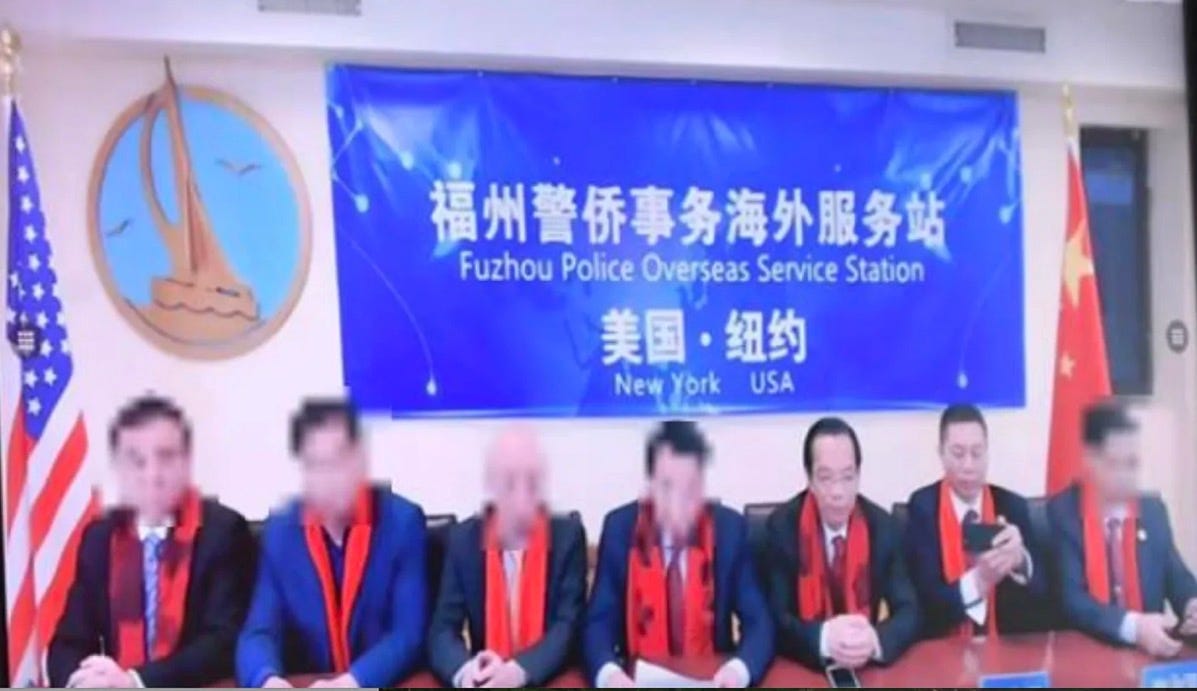
A banner displayed to jurors during the weeklong trial in Brooklyn federal court carried text that left little ambiguity about the site’s function: “Fuzhou Police Overseas Service Station, New York USA.”
At the center of the prosecution’s case were WeChat exchanges between Lu and Liu Rongyan, the Fuzhou Ministry of Public Security official who oversaw the Overseas 110 project. Those messages showed Lu being tasked in 2022 with locating Xu Jie, a Tiananmen Square student protester turned YouTuber living in California who had spent decades criticizing the Chinese government. According to court documents entered into evidence, Liu’s account sent Lu a message in Chinese: “Just help me confirm whether this person is there, that’s all. Thank you.” A follow-up read: “A friend is looking for him about a private matter. No need to contact him personally. Just confirm whether he is there.” Xu testified at trial about the harassment he had faced from Chinese law enforcement since 1989.
The FBI, spurred by the Safeguard Defenders report, raided the Chinatown outpost on October 3, 2022. The next day, prosecutors said, Lu admitted to FBI agents that he established the outpost, that he kept in touch with his handler via WeChat and that he had deleted those messages. Prosecutors argued the deletions, made after Lu learned the FBI was investigating, amounted to deliberate obstruction.
Lu’s ties to Chinese state security, according to court documents, traced back to 2015, when the Chinese consulate called on New York City hometown association leaders to bring their members to a counter-protest during Xi Jinping’s visit to Washington. Lu said local leaders each sent 15 members to counter Falun Gong practitioners demonstrating against Xi.
Among the most significant evidence presented was testimony from an FBI computer analyst who recovered data from Lu’s deleted files. What that data revealed went well beyond a single Manhattan storefront. The deleted files contained WeChat groups drawing members from overseas police-service stations across multiple countries, and plans for Chinese technicians to install a Huawei cloud system connecting the New York operation directly to the Fuzhou Public Security Bureau — within an overseas police-station architecture that also encompassed Toronto, Spain, France and the Netherlands.
The Bureau’s reporting on the case, which has tracked open-source records linking the similar Linda Sun and Lu prosecutions in New York, through Fujian community association networks, connects Lu to John Chan — a Brooklyn restaurateur and former human trafficker, heroin dealer and underground casino operator whose community events have intersected with an individual from New York’s Chinese Consulate identified in the Linda Sun trial as an alleged Chinese secret police operative.
That Ministry of State Security officer met with diaspora leaders in order to surveil communities that Beijing seeks to control abroad, the Linda Sun trial heard.
The Huawei cloud evidence was among the details that most directly undercut the defense’s driver’s-license narrative. A Ministry of Public Security that intended nothing more than pandemic-era paperwork services would evidently have no operational need for an encrypted cloud backbone linking New York to Fuzhou and coordinated nodes across three continents.
Eastern District of New York United States Attorney Joseph Nocella Jr. said in a statement after the verdict: “A police station operating in New York City at the direction of the Chinese government has been exposed, its sinister purpose disrupted, and its founder held accountable for blatantly disregarding the law and our country’s sovereignty.”
Lu’s defense lawyer John Carman dismissed the verdict’s significance, arguing the case had criminalized the ordinary conduct of a longtime American citizen with ties to his home community. Lu, he said, would appeal.
Lu listened to the proceedings via a translator. After the verdict was read, he spoke to supporters outside the courthouse in his native Fujianese dialect but declined to answer questions from reporters.
The case carries direct relevance beyond American borders. The same Safeguard Defenders report that triggered the FBI investigation documented overseas Chinese police service stations operating across multiple Western democracies, including in Canada. The network is linked to the United Front Work Department and its affiliated overseas Chinese community infrastructure — the same apparatus that Canadian security agencies and the Hogue Commission have examined in connection with foreign interference operations targeting diaspora communities, Canadian politicians and democratic institutions. There have been no charges in Canada. In the United Kingdom, however, a recent conviction found two citizens guilty of targeting diaspora citizens in Beijing security and repression operations.
Lu remains free on bail pending sentencing.


The Trump administration means business with spies operating within the USA.
However, here in Canada the TrudeauCarney Liberals don’t give a shit, because the Chinese Communist Party helped them get elected.
Here in B.C. we don’t know if the same thing went on, that resulted in the NDP beating out the Liberals a few elections ago.
We don’t know…..BECAUSE … the B.C. Prosecution Service refuses to release the RCMP report on the ….”NDP Fundraising Probe”.
You know…..they claim they “returned it to the RCMP”.
My request was in accordance to the Freedom of. information Act. Appears the BCPS doesn't give a shit about B.C. law… even though they come under the direction of theAttorneyGeneral ministry.
..
As previously requested Sam….please go after the RCMP report… they might be reluctant to lie to you?
Ohhh. forgot to mention….. the Office of Election B.C….are “unable to recall the event”… even though that office reported the fundraising irregularities to theNDP which resulted in
fundraising Probe”. It appears that office doesn’t give a shit about the law either?
Welcome to B.C..folks!