

By Brenda Shaffer
This week the UK Energy Secretary announced that the British government will remove its block on operations of the Jackdaw natural gas field, and that the gas produced there will reach British homes and businesses by the end of October. The decision took years, as UK governments and courts debated the merits of using the gas in light of Britain’s decision to adopt a net-zero economy and move away from fossil fuels.
It is astounding that the question was even posed, let alone debated. If you asked people on the street whether we should import gas at higher prices and with greater environmental impact from foreign countries or use local, cheaper, less polluting gas, it’s hard to imagine they would choose the former.
But the UK is not unique.
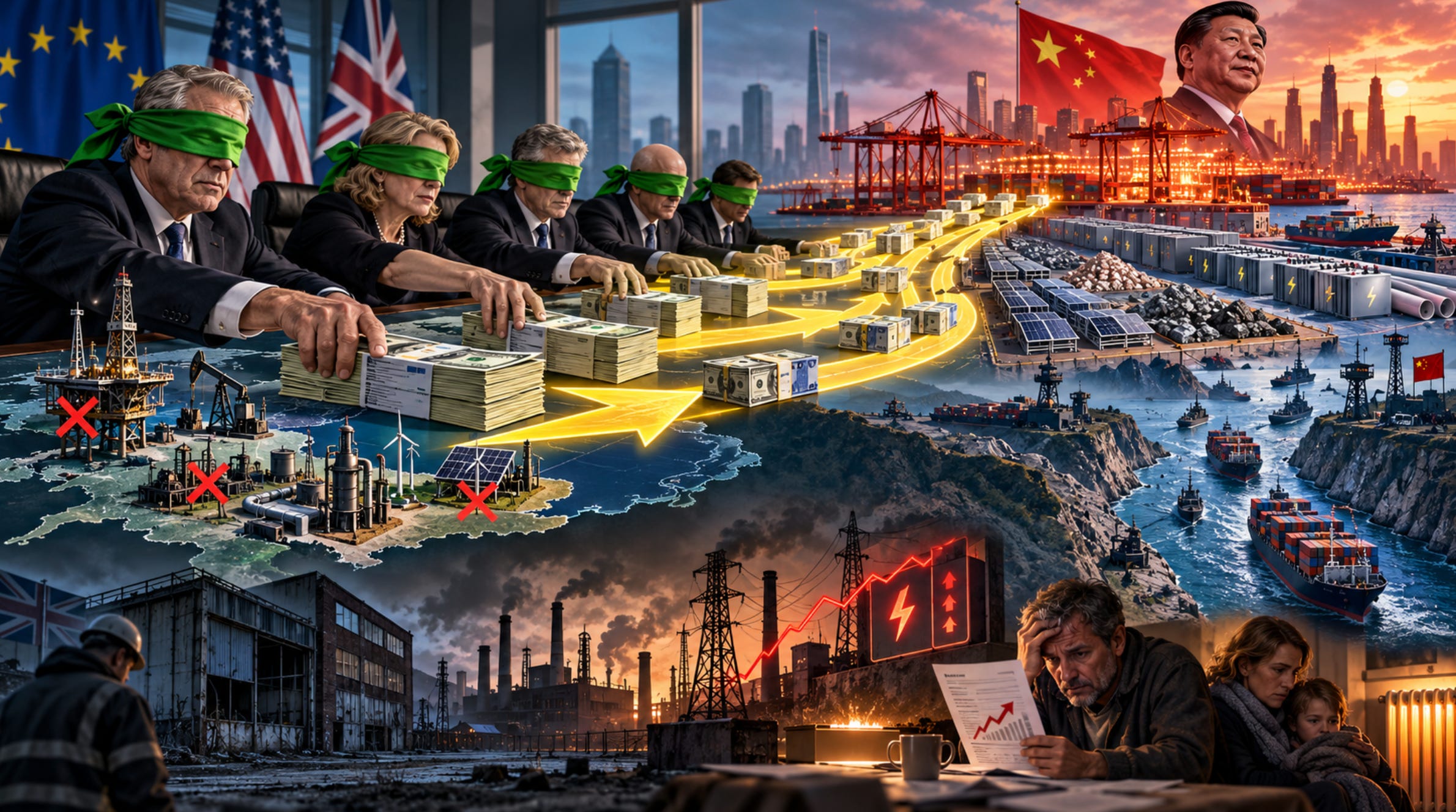
Over the last 15 years or so, most Western governments and international institutions have attempted to reduce production and access to fossil fuels as part of their climate policies. The logic is that limiting access to fossil fuels will force people to use renewable energy while reducing their nations’ carbon footprints.
As with other policies based on myths, it doesn’t work in the real world.
Fossil fuels provide 86 percent of global energy consumption, higher than in 1973, when the world started to seek alternative energy, and there is no scalable alternative available yet. Wind and solar are intermittent and geographically restricted; they provide 2–3 percent of global energy needs, and they depend on fossil fuels to deliver reliable power. Chopping away at our primary energy sources with no viable replacement is dangerously bad policy.
The West’s disinvestment in fossil fuels has had ruinous costs.
In 2025, discoveries of oil and natural gas fell to their lowest level in forty years. Investments in oil and gas development in 2025 totaled $540 billion, down nearly 40 percent from the previous decade. Despite the profits that could be made, many companies reduced investments due to government and public pressure to decarbonize.
Some actually believe that we are in the midst of an “energy transition” from fossil fuels to renewable energy despite having little evidence for the claim.
Some governments have gone beyond pressure. The UK and Italy have closed down their territories to exploration, and others, including the EU and Australia, have passed green-informed investment rules to prevent investments in fossil fuels.
The EU Green Taxonomy, which classifies commercial activities based on their alignment with the EU’s Green New Deal and its commitment to net zero, entered into legal force in July 2020. Unaligned investments and commercial activity now have difficulty accessing both public and private capital because banks, financial institutions, and insurers must all regularly report the percentage of their investments that are aligned with the Green Taxonomy. Many therefore refrain from investing in or insuring noncompliant projects, like new natural gas production.
Predictably, this and similar policies have raised energy costs. As Europe whines about affordability and blames Trump when it can’t get easy and cheap access to energy resources from the Middle East, remember: by prioritizing ideology over the economy (and common sense), they created their own crisis.
Canada stubbornly refuses to learn that lesson, and is currently developing a green taxonomy of its own.
Like the EU, Canada’s legislation aims to “drive investment into businesses and projects that lower carbon emissions in alignment with Canada’s net-zero by 2050 target.” The Canadian government has tasked the Canadian Taxonomy and Transition Planning Council, working together with the Canadian Climate Institute and Business Future Pathways, to develop taxonomy guidelines by the end of 2027.
The Carney government declared that Canada’s green taxonomy will be voluntary, envisioning that a non-governmental entity will monitor implementation. That means unelected groups will gain additional power over citizens, reducing democratic power.
The draft taxonomy does not envision certifying investments in new oil and natural gas production, though it deferred a decision on the status of short- to medium-term investments that extend existing natural gas production if they contribute significantly to greenhouse gas abatement.
The Carney government is attempting to attract foreign investment and improve Canada’s economy. Ironically, the current global energy crisis creates a huge opportunity for Canada’s energy sector as a non-Middle East oil and gas producer. A looming green taxonomy will deter some investors, although the Carney government believes that it will help Canada attract investments from green funds and European and Australian investors who need to fulfill their taxonomy quotas.
But government investment taxonomies have even larger implications than lowering domestic energy production. They enable increased government control over the economy, changing companies’ business models from innovation and production to chasing government funds.
That means government bureaucrats, not markets, pick the winning technologies to develop because they decide what aligns with the taxonomy.
Under this model, energy systems are no longer built based on efficiency and effectiveness but on government policy priorities. Companies must retain teams of “sustainable finance” experts, lawyers, and accountants to comply with the green taxonomy requirements. This creates a market advantage for larger firms, leading to market concentration.
In other words, everyone loses.
Prof. Brenda Shaffer is a faculty member in the Energy Academic Group at the U.S. Naval Postgraduate School and a nonresident senior fellow at the Atlantic Council’s Global Energy Center. An international energy and foreign-policy specialist, her research focuses on energy security, Iran, the Caspian region and the relationship between energy and geopolitics.
"That means government bureaucrats, not markets, pick the winning technologies to develop because they decide what aligns with the taxonomy"
The Elbows Up Regime is well underway with this plan. Bill C-5, and C-39 do just that.
Fossil fuels is a big misunderstanding, if not a bigger lie. Seriously, how many dinosaurs, plants and animals died to create this fossil myth. Why are these fuels found so deep in the earth’s crust? Thousands of feet and more.
Like it or not, natural gas and petroleum are earth’s renewable resource. Extreme heat and pressure deep down at the earth’s crust combine carbonate, iron and other elements to manufacture this resource. It then leaks upward through fissures and cracks in the earth into underground caverns.
Responsible management is the answer not foolish woke green thinking.
Nuclear is also a best alternative combined with responsible management.