


BROOKLYN, New York — In 2004, Nortel’s security adviser Brian Shields found that a computer in Shanghai had been reading an Ottawa executive’s email. As I reported for Global News in 2020, the intruder controlled the accounts of at least seven Nortel executives. On one day in April 2004, an address tied to the same Shanghai front company downloaded 779 documents using the chief executive’s credentials. “China is the source of all extractions we are aware of,” Shields wrote.
Nortel collapsed into bankruptcy in 2009. In the same years, Huawei rose to become the world’s dominant telecommunications-equipment supplier. Shields believed the two stories were connected. Huawei strongly denies benefiting from the hacking of Nortel. It has never been charged with any such wrongdoing in Canada, and it cites a 2014 University of Ottawa study that found no evidence it took Nortel’s intellectual property.
Nortel, which likely would now be among the world’s top companies had it survived into the next-generation wireless era its Ottawa-based engineers pioneered, is not part of the case now before a federal jury in Brooklyn.
But the question Shields raised in Ottawa runs through the most powerful accusations in the trial.
How did a Chinese company race from the back of the world’s telecommunications industry to the front so quickly, positioned to build so much of the world’s communications infrastructure? And what has that meant for citizens of countries such as Iran, where prosecutors allege that in 2009, the same year Nortel went under, Huawei equipment helped Iranian security forces track and detain protesters?
Huawei Technologies and three subsidiaries face 12 counts, including racketeering conspiracy, conspiracy to steal trade secrets, bank and wire fraud, money laundering and obstruction of justice. They have pleaded not guilty. The government rested on October 28 after 61 witnesses, and Huawei is now presenting its defense. It argues that its success rests on legitimate innovation.
A Justice Department lawyer, Taylor Stout, told jurors in September that the truth was exactly the opposite.
“Theft, lies, cover-up,” Stout said, opening the government’s case alleging the systematic theft of trade secrets and technology from American companies.
“There was no blueprint for crime,” answered Huawei’s lead lawyer, Brian Heberlig.
In The Bureau’s reporting and analysis of this trial, the most important evidence on whether such a blueprint existed surfaced in Huawei’s Texas-based subsidiary.
In July 2013, Huawei’s in-house lawyer in Plano, Texas, Charles de Chateauvieux, walked toward a corporate trainer named Heather Campbell in a quiet sixth-floor hallway and handed her an envelope without a word. Campbell, a former Marine trained as a Mandarin linguist, took six flights of stairs to her car and read what was inside.
It was, more or less, a sort of bounty notice, in the government’s telling.
The first document, now Government Exhibit 16336 and obtained by The Bureau, came from Huawei headquarters in China.
Titled “Management Criterion Of Competition Info Collection,” it set out “Hierarchical awards” for competitors’ information according to its “value and confidentiality.”
A rival’s product roadmap was worth 2,000 yuan, and its business documents and project prices 1,000. Its organizational chart, management decision chain and salaries brought 500.
The policy said information in the two highest ranks should, in principle, be encrypted and sent to a special mailbox. It was marked “Attn: Richard Yu,” then chief executive of Huawei’s consumer business. Today he sits on Huawei’s board as an executive director.
The second document showed how the American subsidiary reacted.
Two days after the policy arrived, Huawei Device USA’s management warned staff that such a program “may be normal and within the usual course of business” in some foreign countries and regions. “However, here in the U.S.A. we do not condone nor engage in such activities.”
“I sat and thought. I sat and thought,” Campbell told jurors. Then she went to the FBI. “My interpretation of that communication was it was requesting that employees commit theft and corporate espionage,” she testified. “That’s wrong.”
Huawei’s lawyers pressed her hard. She agreed she had no firsthand knowledge of how the memo was created. But she held her ground. “It was a directive to steal information,” she said.
On redirect, a prosecutor asked whether, in her remaining two and a half years at the company, she had seen any communication from China withdrawing the policy in the United States. “No,” she said.
Was she aware of it ever being withdrawn in China?
“No.”
Campbell’s envelope is one exhibit among many.
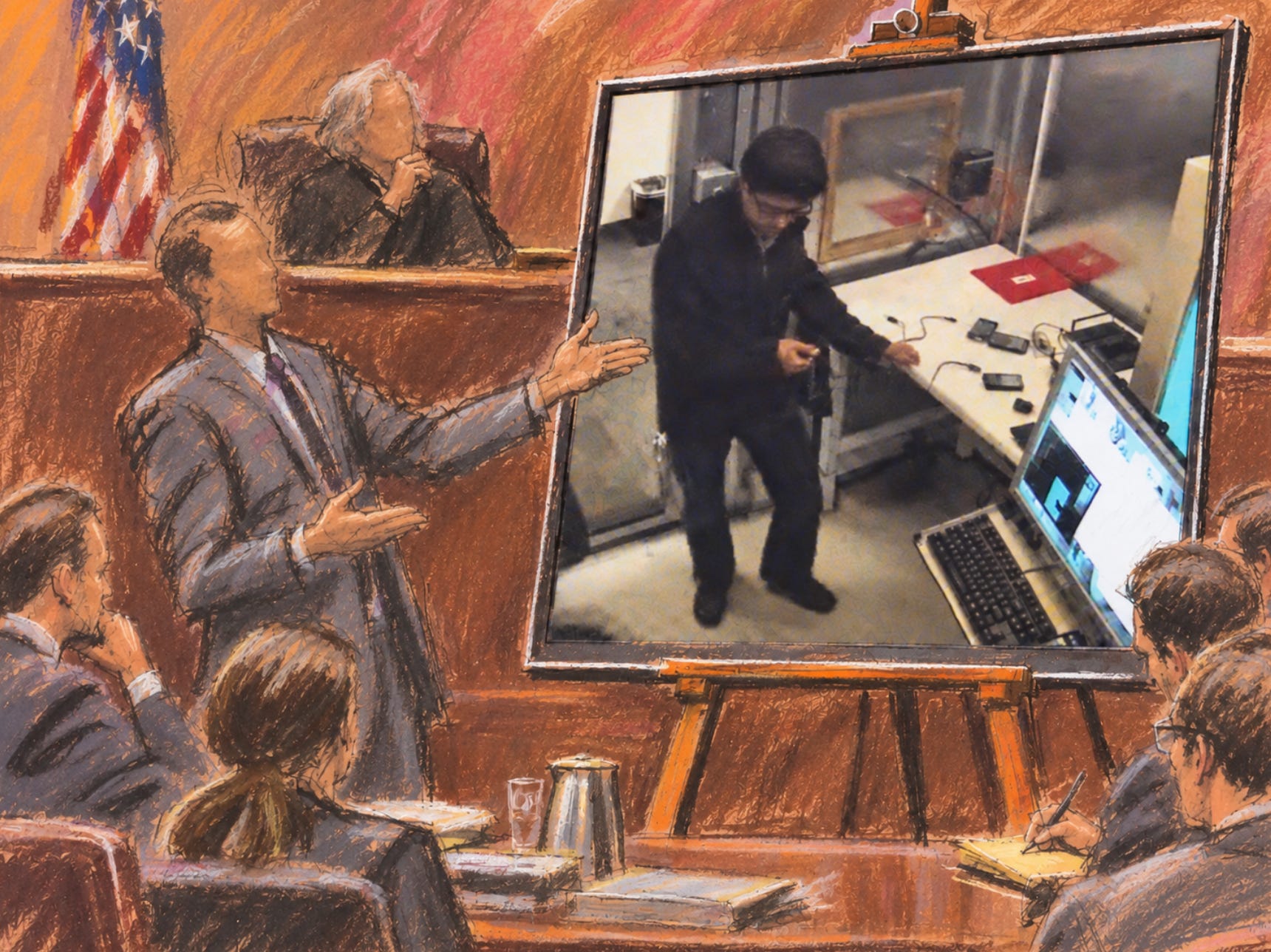
Jurors watched video of a Huawei employee zipping a component of T-Mobile’s smartphone-testing robot into a backpack inside a secured laboratory in Bellevue, Washington.
Internal emails acknowledged that “TMO would not want to share the details about the robot technology/documents,” the South China Morning Post reported. A former engineer at Huawei’s American research subsidiary testified that a colleague boasted of taking code used in Amazon’s cloud platform. The alleged victims in the trade-secret case include Cisco Systems, T-Mobile, Fujitsu, Quintel Technology and CNEX Labs.
The government charges that technology record and Huawei’s business in Iran as two arms of a single alleged enterprise.
The 2020 superseding indictment alleges that Huawei installed surveillance equipment in Iran “used to monitor, identify and detain protestors” during the 2009 demonstrations against the regime.
The government’s first witness, Parham Baheshti, testified that Huawei representatives pitched a capability for “analyzing the Iranian people and their behavior online,” according to Associated Press reporting. Taken as a whole, the case describes a company accused of taking from democratic competitors while supplying an authoritarian state.
The money has been traced too.
One FBI chart obtained by The Bureau begins with nearly $11.8 million paid by the Mobile Communications Company of Iran into Skycom, the Hong Kong company that ran Huawei’s business in Iran and which Meng Wanzhou admitted Huawei controlled.
The chart follows the money through JPMorgan Chase in New York to Huawei in China, then through Citibank in New York to Futurewei, Huawei’s American subsidiary, and finally $4.55 million to its payroll processor. Huawei has asked Judge Ann M. Donnelly to strike the chart and four others. It calls the tracing “simply a prejudicial summation point dressed up in the guise of neutral forensic tracing.”
Concerns from a number of Washington lawmakers about military forces they perceived behind Huawei may not reach the jury.
In 2010, eight Republican senators led by Arizona’s Jon Kyl warned four cabinet-level officials that Huawei’s bid to supply Sprint Nextel, a carrier serving the American military and law enforcement, posed “substantial risk.”
Their letter cited Huawei’s business in Iran, alleged links to the Islamic Revolutionary Guard Corps and what they called the company’s “direct ties” to China’s military.
A company allegedly acting at the military’s direction and with its funding, they wrote, could gain a critical position in American supply chains. That was the “most troubling” possibility.
As The Bureau reported from hundreds of pages of pretrial filings, that letter, reported by the Washington Times, became the subject of a fight over what the jury would see.
Prosecutors sought to introduce bank due-diligence files citing the Washington Times report and cataloguing alleged links between Huawei and China’s military and intelligence services.
They also sought to use videotaped testimony in which a veteran compliance executive was asked about “general concerns about Huawei’s ties to the Iranian military.” Prosecutors said the material showed how banks weighed the risk of keeping Huawei as a client. Huawei called it irrelevant, prejudicial and hearsay.
The case’s links to Tehran and Beijing also reached the security of the courtroom itself.
In an opinion unsealed October 21, Donnelly explained why she closed the courtroom for three Iranian witnesses with close family in Iran. Their knowledge of Huawei and Skycom operations in Iran was so distinctive, she found, that their testimony alone could identify them. She cited Tehran’s record of targeting critics on American soil, including a murder-for-hire plot in New York.
In a footnote, the judge recorded that prosecutors had also warned of a “serious risk” that the Chinese government might retaliate against the witnesses. She made no finding on that warning, and her ruling rested on the Iranian threat.
The Bureau’s readers have read a version of that warning before.
A classified Canadian Security Intelligence Service assessment dated June 10, 2019, and reviewed exclusively by The Bureau, is titled “PRC Strategy and Tactics to Influence the Meng Proceedings.”
It says units of China’s Ministry of State Security were tasked “from high levels” to respond to the arrest in Vancouver of Huawei’s chief financial officer.
Beijing, CSIS assessed, feared that Meng might cooperate with American authorities and disclose privileged information if extradited.
The campaign it described included the detention of Michael Kovrig and Michael Spavor, and trade restrictions aimed at Canadian executives with access to senior officials. “China picked Richardson,” CSIS wrote of the grain company it singled out. The assessment also described calibrated interference in the 2019 federal election.
“CSIS assesses that the PRC seeks to exert pressure on Canada’s political leaders by clandestinely interfering in Canadian democratic institutions in the run-up to the 2019 federal election,” the leaked intelligence document states.
“Multiple corroborated reports confirm that PRC missions in Canada are moderating their support for the Prime Minister and other Liberal candidates. Canada-based PRC officials believe the current government faces an uncertain election outcome.”
Uncorroborated single-source intelligence went further, reporting that Beijing might consider Meng’s “exfiltration or assassination” if that became the only alternative to significant national harm.
The Canadian assessment and the American warning about China’s potential threats to witnesses are separate records, seven years apart.
Neither has been tested before this jury, and the judge made no finding on China. In The Bureau’s assessment, though, the two pieces of documented information, in combination, are compelling.
In 2019, Canada’s intelligence service warned that Beijing saw a cooperating Huawei insider as a threat to Chinese national interests. In 2026, the United States government told a federal judge that witnesses in the same prosecution faced a serious risk of Chinese retaliation.
Meng signed her statement of facts in September 2021 and went home to China. Kovrig and Spavor were freed within hours. In Brooklyn, her admission that “Huawei controlled Skycom, and Skycom employees were really Huawei employees” was read aloud by a former FBI agent. Meng was not there to explain it, or to be cross-examined on it.
Huawei’s first witness, board member Yang Chaobin, testified that research spending has exceeded 20 percent of revenue in recent years.
He said 110,000 of Huawei’s roughly 210,000 employees work in research and development. Asked whether executives had a strategy to steal intellectual property, he said, “Absolutely not.”
Huawei’s lawyers say the trade-secret episodes were isolated misconduct, several already litigated as civil disputes, and that the FBI’s charts connect payments that are not connected.
Donnelly has told prosecutors the defense “is entitled to show that they did things that weren’t criminal things.” She told prospective jurors that “China and the Communist Party … are not on trial.”
The contest the trial reveals points to a set of facts and allegations much larger than the facts and arguments in front of the jury, and its pending verdict.
On one side are the democracies and the companies, from Cisco to the former Nortel, whose engineering built the world’s networks.
On the other is a Chinese champion accused of taking what it could not build fast enough, while selling to Tehran the tools prosecutors say were used to find the protesters in its streets.
Whoever builds those networks will hold the switches through which billions of people talk, bank and organize. That is what the people of Tehran learned in 2009.
The Bureau will continue to cover Huawei’s defense, the government’s closing arguments and the jury’s decision.
This could be among the most important criminal trials in recent American history, with consequences for billions of people.
Every person who buys a Huawei phone or watch, should know that he or she is supporting an entity that works for and answers to the Chinese Communist Party.
I remember NORTEL well. The largest telecommunications company on the planet Earth.
Those days are long gone.
The world has foolishly bent the knee to China since Richard Nixon’s visit in the 1970s.
Since then corporations happily sent their business capabilities to China to realize cheaper products and sell to the massive Chinese locals.
China owes the world for its economic development and pulling them out of poverty.