

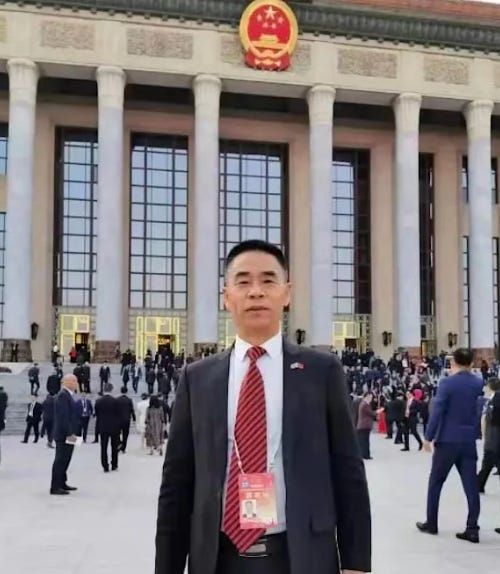
WASHINGTON — The United States has escalated its campaign against alleged Chinese-linked transnational criminal and corruption networks, publicly designating a prominent Chinese-Fijian businessman accused of bribing citizens of the Pacific island nation to advance the interests of the Chinese government, business and criminal actors.
The State Department announced that Zhao Fugang, director of the Overseas Chinese Service Center in Fiji, had engaged in significant corruption.
“Zhao abused his public position by paying bribes to Fijian citizens to advance China-based government, business, and criminal interests,” the department said.
The designation makes Zhao and his immediate family members generally ineligible to enter the United States.
The action places renewed scrutiny on a businessman whose activities have been examined for years by Australian intelligence and investigative journalists, amid allegations that Chinese Communist Party influence operations in the Pacific overlap with organized crime, political corruption and the cultivation of local elites.
It also fits a broader pattern of American enforcement actions targeting powerful figures operating across Southeast Asia and the Pacific—including Macau triad figure Wan Kuok Koi, known as Broken Tooth, and the Cambodia-based Prince Group, whose alleged criminal activities have attracted major U.S. sanctions.
According to reporting published Thursday by Australia’s ABC, Zhao has denied the allegations and demanded that Washington disclose the evidence against him.
The designation follows years of scrutiny of Zhao’s connections to Chinese officials, diaspora organizations and alleged criminal networks.
In 2024, Australia’s 60 Minutes identified Zhao as an alleged senior figure in a transnational criminal syndicate and reported his prominence in Chinese Communist Party United Front activities.
The Organized Crime and Corruption Reporting Project also reported allegations linking him to a syndicate involved in drug trafficking, money laundering and human trafficking.
OCCRP and its Australian reporting partners reported that the Australian Criminal Intelligence Commission had designated Zhao an Australian Priority Organisation Target in mid-2023.
In prior reporting and a podcast episode, The Bureau examined Beijing’s reach into the Pacific islands with Cleo Paskal, a Canadian journalist who has testified before the United States Congress and the U.S.-China Economic and Security Review Commission, and Chris Meyer, a former United States official and China analyst.
Paskal describes Beijing using mafia networks to subvert civilian institutions across Micronesia, the island spine between Hawaii and the first island chain of Japan, Taiwan and the Philippines, preparing the ground before any shot is fired over Taiwan.
Meyer connects the casino-based money laundering, underground banking and political influence networks documented in Wilful Blindness to patterns he has investigated in Saipan. In August 2020, U.S. authorities unsealed a 71-count indictment against three executives of Imperial Pacific International and its construction contractor, alleging racketeering conspiracy and other offences.
In prior reporting for The Bureau, Paskal examined Governor Arnold Palacios’s efforts to secure stronger federal investigations of corruption in the Northern Mariana Islands. In April 2025, he reportedly asked the territory’s congressional delegate to take his request to FBI Director Kash Patel. Palacios died on July 23, 2025, after a medical emergency and evacuation to Guam.
The cases are distinct, and Washington has not publicly established that the individuals or organizations operate as a single network.
But collectively, they illustrate an emerging focus of U.S. national security policy: China’s potential use of criminal enterprises, financial networks and politically connected intermediaries to extend influence in strategically important countries.
In a letter to the U.S. Embassy in Suva, Zhao said he had not paid bribes, abused a public position or engaged in corruption to advance Chinese interests. He also said he was not facing criminal proceedings in Fiji.
The political dimensions of the case are particularly significant in Fiji, where China has sought to expand its diplomatic, commercial and policing relationships.
Zhao has appeared alongside Chinese officials at events celebrating police cooperation between Beijing and Suva. His appointment as director of the Overseas Chinese Service Center was attended by senior Chinese and Fijian officials, including then-prime minister Frank Bainimarama.
China’s embassy previously rejected suggestions that Chinese diaspora organizations were engaged in improper activity, describing their work as legitimate and transparent.
Fiji’s current prime minister, Sitiveni Rabuka, said in 2024 that he did not know whether Zhao was operating on behalf of the Chinese government and stressed his rights as a Fijian citizen.
The latest American action, however, directly alleges that Zhao’s activities served a combination of Chinese governmental, commercial and criminal interests.
The U.S. Embassy in Suva described what it called an established pattern of criminals operating across the Pacific with connections to China, arguing that corruption leaves island governments vulnerable to foreign interference and organized crime.
The broader American enforcement record provides context for that assessment.
In December 2020, the Treasury Department sanctioned Wan Kuok Koi, the former Macau triad leader known as Broken Tooth, and organizations associated with him in Cambodia, Palau and China.
Treasury identified Wan as a leader of the 14K Triad and linked his activities to organized crime and corruption. U.S. officials also described his political connections to the Chinese Communist Party and his involvement in organizations that promoted Beijing’s interests abroad.
In subsequent congressional testimony, Treasury officials cited Wan’s activities as an example of how China-related actors could exploit economic vulnerabilities and corruption to cultivate political influence.
The Prince Group case has exposed another dimension of the same regional security problem.
On October 14, 2025, the United States and United Kingdom announced coordinated sanctions against the Cambodia-based conglomerate headed by Chen Zhi, with Treasury identifying 146 targets associated with an alleged transnational criminal organization.
American authorities accused the organization of operating industrial-scale online fraud compounds, laundering billions of dollars and exploiting trafficked workers.
Crucially for the Pacific, Treasury also identified the group’s expansion into Palau, where it said associates had pursued a long-term island lease and resort development.
One of those associates, Wang Guodan, was identified by Treasury as vice-president of Palau’s Overseas Chinese Federation.
Treasury alleged that Wang helped Prince Group establish commercial interests in Palau and had previously introduced Wan Kuok Koi to the country’s then-president in 2018.
Washington has continued expanding its Prince Group enforcement campaign.
In June 2026, Treasury sanctioned another nine individuals and 26 entities linked to the organization, targeting alleged leadership figures, investors in scam compounds and corporate fronts.
The department also moved against financial infrastructure associated with Huione Group, which American authorities identified as a major channel for laundering proceeds from online fraud and cryptocurrency-related crime.