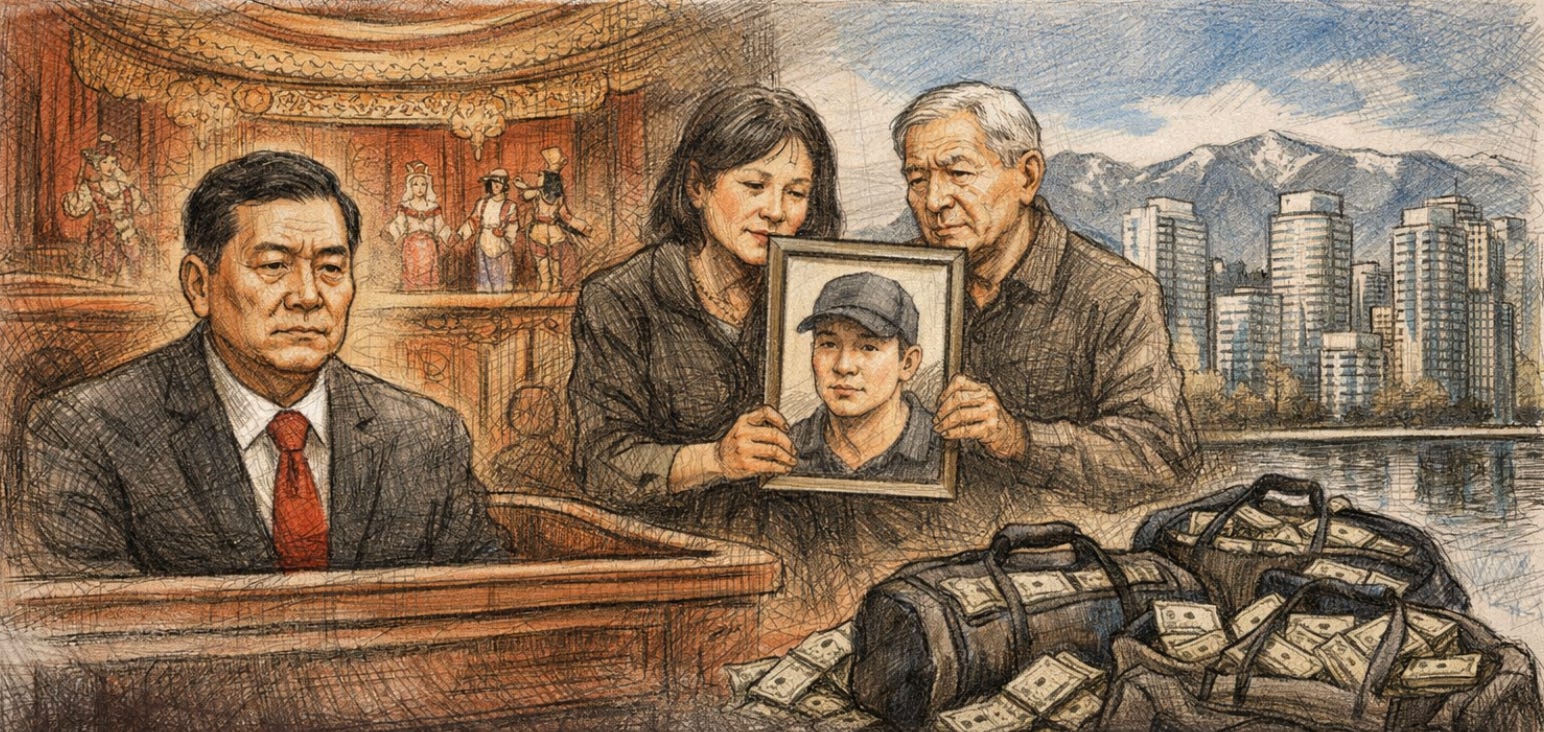
Vancouver Real Estate Saga Worthy of Beijing Opera: A Senior Party Official Accused of Massive Corruption, and His Opera Stagehand Son’s Canadian Fortune Traced After His Death
Analysis: A new B.C. ruling tracing tens of millions doesn’t turn into a source-of-funds trial—but it offers a rare blueprint for how offshore capital becomes Vancouver land.
BRITISH COLUMBIA — It begins, as so many Vancouver real estate stories do, with a fortune that defies the logic of lawful wealth creation—too sudden, too large, too well-traveled, and too entangled with the machinery of China’s one-party state to feel like ordinary success—and hints at the familial web that would later unravel across the Pacific, after duffle bags of Chinese currency were converted into Canadian dollars to fund condo developments in Vancouver.
In northeast China, a senior Chinese Communist Party official, Chunli Zhang—referred to in the British Columbia Supreme Court record as “Big Brother” or “Mr. Zhang Sr.”—was, Justice Gordon Funt found in December 2025, credibly accused in Chinese disciplinary findings of abusing his position on a stunning scale.
The Canadian judge noted the allegations cautiously, while observing that the record nevertheless portrayed wealth wildly disproportionate to Zhang Sr.’s reported government income. As investigators closed in, the ruling recorded, Chinese authorities seized cash equivalent to approximately CAD $22 million, along with thirty properties and five vehicles—an inventory, the judge wrote with understatement, that “speaks volumes.”
A Chinese court even jailed one of Chunli Zhang’s sons for admittedly owning properties purchased through his father’s corrupt wealth, the Canadian record shows.
By his own telling, Chunli Zhang was a senior and influential Communist Party member who cycled through government posts that gave him leverage over land, development, and approvals—beginning in 1996 and rising to Deputy Secretary of the Jixian District Committee in 2009.
From there the story crosses oceans and legal systems, moving through the familiar geography of modern Chinese capital flight.
The official “fled abroad,” the record said, and landed on an Interpol “wanted list … without being apprehended.”
Somewhere along the way, his son, identified in the ruling as “Mr. Zhang Jr.” or Tong Zhang, and associated parties moved at least $60 million into Vancouver-area real estate projects that would later fracture into a bitter courtroom dispute.
In Justice Funt’s reasons, contracts, promissory notes, and bags of cash are not treated as a source-of-funds inquiry, but they still underline the persistent public question behind so much of the region’s housing anguish: where did the money come from, and how did it surface in Vancouver, really?
Those questions were already in the open years before Justice Funt’s December 2025 decision.
In an opinion column published Dec. 3, 2020, Vancouver Sun columnist Douglas Todd described a civil claim in which Tong Zhang alleged that he had entrusted roughly $45 million to Hang Yin, a Vancouver-based developer and business partner in “almost a dozen properties in Richmond, Vancouver, Burnaby and Surrey,” and that Yin had “disappeared.”
The same lawsuit, Todd wrote, claimed that “even though Yin cannot be found, his wife and daughter have been conspirators in his elaborate fraud,” and that they lived in West Vancouver, “in a mansion with a view of English Bay.”
Todd noted the lawsuit’s depiction of how money and ownership were structured in the early phase of the relationship: that in 2015, Tong Zhang began transferring large sums out of China to Yin so Zhang could become a partner in numerous numbered companies buying Metro Vancouver residences and strata properties.
Todd also flagged a structural question that would hover over the litigation—and that would not be resolved in the run of British Columbia court cases that followed: “Zhang’s lawsuit does not stipulate how he was able to transfer tens of millions of dollars out of China beginning in 2015, given that the country’s leaders have officially allowed Chinese nationals to transfer overseas only $50,000 a year.”
There was also some mystery, Todd wrote, because “the actual identity of the plaintiff, Zhang, who also goes by the first name Tony, is hard to determine.”
The December 2025 ruling supplied a fuller frame.
By 2022, Tony Zhang was said to be deceased, and the case was being carried forward by other parties behind the suit—his estate and surviving family. Tried in Vancouver over months in spring and summer 2025, it turned on a simple claim.
Tong Zhang had entrusted millions brought from China to Hang Yin to fund British Columbia real estate projects in exchange for ownership interests, but his business partner, also known as “Uncle Yin,” commingled and diverted the funds.
Zhang’s estate asked the Canadian judge to help them recover the money and trace it into properties developed across Vancouver by Yin’s family.
The defendants countered with a different story: that the true investor was Zhang’s father, Chunli Zhang, not Tony Zhang himself, and that any British Columbia property rights belonged to the father—whom the defendants characterized as a corrupt Chinese Communist Party official who buried his fortune in Vancouver through his offspring.
Beijing Opera Set Designer Turned Real Estate Flipper Millionaire
The human thread running through the case affirms a positive tale of Canadian migration for Mr. Zhang Jr. and his wife, Danyang Yang, an opera singer with the Beijing Opera House Theatre. Zhang is described as a theatre employee who began speculating in real estate—including “flipping” properties—after moving from Shuangyashan to Beijing in 2004.
“Although Ms. Yang and Mr. Zhang Jr. had met briefly in 2007, their relationship started in the second half of 2011. They had come to know one another through opera rehearsals. Mr. Zhang Jr. was responsible for the stage layout, stage pop-ups, and design. They started to live together at Mr. Zhang Jr.’s home in early 2012.”
Their life in China, as the trial record captured it, was bounded by China’s one-child policy. But in Canada, Ms. Yang explained, things felt different.
During cross-examination, she testified—in what the judge called an “uncontrolled poignant voice”—about coming to Vancouver in 2014 to give birth to a second child:
“Yes, it’s true that the purpose of that trip was to give birth to my second child, because at the time I was employed by Beijing Opera House, right, and at that point, you know, China or the Chinese government did not allow couples to have second child. If I insisted to give birth to my second child, then I would receive a penalty from my employer and they would punish me, or even worse yet, they could, you know, do some extreme measures, such as terminate my pregnancy by force. At the time, we were thinking—I’m sorry—Canada is a very tolerant country. We thought it would be a wise idea to give birth to our second child and third child here.”
With plans to have their young children educated in Vancouver—and with Ms. Yang remarking that Canada is “a very tolerant country”—the judge found that she and Mr. Zhang Jr. viewed Canada not merely as a place to park Chinese-earned real estate profits, but as their intended domicile.
A Vancouver-born citizen priced out of the market may one day seek an answer in a different kind of forum.
But that is not the case before Justice Funt. His December 17, 2025 ruling begins with the Chinese court record.
Zhang Sr. Says Mexico Trip Proves He Is Not on Interpol List
“The parties’ witnesses have confirmed that Mr. Zhang Sr. was under investigation in China for embezzling funds, taking bribes, misappropriating public funds, and other corrupt practice,” Justice Funt wrote. “That is not in dispute.”
The court was shown a disciplinary document stating that Zhang was expelled from the Chinese Communist Party on October 15, 2019, for embezzling public funds.
It was also shown a later document, dated November 25, 2021, from the Jixi City Discipline Inspection Commission and Supervision Committee, which stated that Zhang abused his position and was accused of embezzling the equivalent of approximately CAD $44 million, accepting bribes of approximately CAD $57 million, misappropriating funds of approximately CAD $11 million, and distributing money and goods to seek improper benefits of approximately CAD $4 million.
That same Chinese document stated that authorities seized cash equivalent to approximately CAD $22 million, along with thirty properties and five vehicles, and recorded that Zhang had “fled abroad” and was on a “wanted list … without being apprehended.”
Justice Funt emphasized that there was no evidence Zhang had been convicted by a Chinese court of the alleged crimes, but said the scale of the seizures corroborated, at least in part, the findings and spoke to Zhang’s ability to invest. The record further noted witness evidence that more than 20 properties allegedly held in the names of Zhang’s two sons were seized in connection with the investigation.
“According to the Mishan Court Judgment, in 2021, Mr. Zhang Jr.’s brother—Tian Zhang—was tried before the Mishan Court for the crime of concealing and disguising criminal proceeds belonging to Mr. Zhang Sr. by putting them in his name,” Justice Funt’s reasons for ruling acknowledge. “According to the Mishan Court Judgment, Tian Zhang was represented by counsel in that trial, confessed to the crimes described above, and was found guilty and sentenced to a suspended sentence of three years imprisonment and five-years of probation.”
Funt writes that witnesses were also shown a photograph of an International Criminal Police Organization “Red Notice” seeking Zhang’s arrest for corruption and acceptance of bribes.
Zhang claimed, however, that the Chinese government issued him a criminal clearance certificate in 2021—though it was not produced at trial—which he said showed he was not on any Interpol list. Zhang also pointed to his travel to Mexico in May 2024 as evidence he was not subject to an Interpol notice, but the judgment cautioned that this was not determinative, because enforcement of Red Notices can vary by country and may not always result in detention or denial of entry.
Without determining the truth of the matter, Justice Funt found Zhang Sr. “evasive” on the questions.
Funt also described a separate Chinese court finding—by the People’s Court of Mishan City, Heilongjiang Province—that Zhang Sr. sought to conceal properties allegedly obtained as bribes by placing them in the names of relatives, including his Vancouver real estate investor son, Mr. Zhang Jr., Mr. Zhang Jr.’s brother, and Mr. Zhang Jr.’s spouse.
Beijing Toll-Booth Venture and the Shadow Ledger
With the accusations in China established, the financial bridge into Vancouver is where Hang Yin—Tony Zhang’s Vancouver-based business counterpart and the central defendant—enters the record.
This is also where the evidence begins to read like a familiar chapter from broader examinations of British Columbia’s real estate industry in recent years: large sums moving through offshore hubs, and multi-million-dollar promissory notes functioning as a kind of shadow ledger in Chinese diaspora financial networks—one that tends to surface only when relationships collapse and disputes reach a British Columbia courtroom.
For example, in reviewing share structures and companies tied to a $37 million development in Richmond—an ethnically diverse, heavily Chinese diaspora municipality bordering Vancouver—the judge wrote that “many of the promissory notes itemize the deposits reflecting the basis for the particular promissory note—for example, a $15,218,600 promissory note issued by ‘108 B.C. Ltd.’ shows as one of many deposits supporting the promissory note ‘Incoming Wire … (Hong Kong) 23-Sep-16 500,485.00.’”
The relationship between the senior Party official, Mr. Zhang Sr., and Hang Yin had deepened years earlier in China, filings say, in business circles tied to a Beijing toll-booth venture—an arrangement that, on the Canadian record, was treated as legitimate, even as broken trust and competing narratives about how these deals were secured later hardened around it.
Ultimately, the Canadian judge held that the record did not support tying Mr. Zhang Jr.’s Vancouver wealth to his father’s alleged corruption, emphasizing instead the plausibility of rapid, outsized gains in China’s property boom.
A potential point of contention—echoing questions raised in the Vancouver Sun’s December 2020 column about China’s strict capital controls—is that the judgment accepts the transfer narrative largely as presented, without a detailed accounting of how tens of millions moved from China to Canada, or the deeper source-of-wealth questions that shadow those flows.
“I had evidence of Mr. Zhang Jr. keeping large amounts of cash in his master bedroom; such accords with wealth,” the Canadian judge reasoned, while finding it merely “opportunistic speculation by the defendants, at this time, that the cash came from corrupt activities asserted to have been undertaken by Mr. Zhang Sr.”
The judgment also records evidence that Mr. Zhang Jr.’s driver, Mr. Peng, delivered “duffle bags of cash” to Mr. Yin or his representative, after which Mr. Yin “would then cause the cash to be exchanged for Canadian dollars,” alongside promissory-note attachments listing many “Incoming Wires.”
Justice Funt acknowledged, “I confess to some disquiet in envisioning duffle bags of cash,” while also noting the defense “did not submit that large cash transactions in China would be illegal.”
At the same time, he emphasized that the lawyers and accountants involved in the transactions had professional obligations “to satisfy themselves” they were not assisting with funds tied to criminal activity—and that he had “no evidence or assertion” those professionals failed to meet those duties.
In the midst of 300 pages of fact finding and law, the judge also saw fit to give assurance to Mr. Zhang Jr.’s children.
“I will further add, because Mr. Zhang Jr. has died and one or more of his three young children may wish to read these reasons in the future, that there was no suggestion, or evidence whatsoever, that their father was engaged in the drug trade or some other criminal activities.”
Justice Funt emphasized the absence of corroboration for the Yin family’s allegation that Hang Yin secured his Beijing toll-booth business—and cemented the family-business relationship that followed between the Yin and Zhang families in China and Canada—through a significant bribe. Citing the court testimony, Justice Funt wrote that Yin testified:
“I called Chunli Zhang during the spring festival. I said, ‘It’s spring festival. Thank you, big brother, for your help.’ I said, ‘I’ll go to visit you, pay a visit.’ What I meant was to give him some gift money. At the time, Chunli Zhang was very friendly, and he said, ‘No, that’s not necessary.’ And I said, ‘You know, it’s New Year’s time, and it’s just a token of my appreciation.’
“And later, he agreed for me to go to his office. After I arrived at his office, I left 100,000 RMB, (about CAD $19,000) and then I left. And I said, ‘I want to thank you.’”
Yet there was no financial record, no email, no WeChat message, no recording—nothing independent to support Yin’s claim that he paid an illicit reward connected to the toll-booth approvals, Funt ruled.
The judge also noted that “it is not shown that Mr. Zhang Sr. was soliciting a bribe or otherwise seeking or expected illegal compensation.”
Justice Funt concluded that Yin’s story did not align with “the preponderance of the probabilities,” and then inferred a theory: even if Yin had bribed Zhang Sr., it was “improbable” he would later accept Zhang Sr.’s funds for Canadian property investments, because he would fear being financially linked to corruption in which he had participated.
Disentangling the Web
Justice Funt then does what Canadian courts are often forced to do in cases built on informal cross-border capital flows: he tries to follow the money through the Canadian corporate vehicles and mortgages, and maps how Zhang Jr.’s claimed investment capital was converted into land, project equity, and—at key moments—into leverage that benefited the Yin family’s side ventures.
On developments on Vancouver’s West 41st Avenue, the reasons set out that 1011066 B.C. Ltd. bought five properties in 2015 for an aggregate of $19,181,479, and that Zhang Jr.’s side alleged he provided 60 million RMB—about $11 million Canadian—as his 40 percent stake. The defendants conceded a roughly equivalent contribution but insisted the investor was Zhang Sr.; Funt rejected that and found Zhang Jr. was the investor.
When three properties were sold together in June 2017 for $25,225,000, the court records a significant profit—$11,186,625—and finds Zhang Jr. received no direct or indirect credit for it.
The reasons take a similar approach with a Surrey coffee shop property. After 107 Holdco Ltd. bought a Surrey commercial site in 2016, a $1,925,000 BlueShore mortgage was later placed on that asset. Funt finds the borrowed funds were not used for the stated purpose, and instead traces large portions outward to a “Ms. Liu.”
“Ms. Liu, without any qualms, on August 7, 2017, used $900,000 from the BlueShore Mortgage to help fund the purchase of the fourth property for the Royal Oak Project, despite knowing that Mr. Zhang Jr. or Mr. Zhang Sr. had invested in the Surrey Coffee Shop Property,” the Canadian judge ruled. “Similarly, on August 18, 2020, Ms. Liu, through the Jin Ocean Mortgage, stripped approximately $4,500,000 from 101 Ltd. for her personal purposes, which included approximately $900,000 for Ms. Yin’s home.”
Next, “Ms. Yin, with willful blindness, facilitated, including committing to personally guarantee, the $1,925,000 BlueShore Mortgage, of which $900,000 was used by her mother for her mother’s investment in the Royal Oak Project.”
On another property deal—one of the few places where the parties’ relationship was fixed by a clean legal instrument according to the judgment—Funt treats a March 4, 2019 bare trust declaration as legitimate. Generally, a bare trust is one in which the trustee holds legal title and acts only on the instructions of the beneficiary.
In this case, it identifies Zhang Jr. as the “Owner” and Yin as the “Nominee,” and it confirms Yin held title as bare trustee for Zhang Jr.’s benefit. On that record, the judge finds Yin breached fiduciary obligations by failing to disclose that he had already mortgaged the property for his own purposes.
In a nutshell, the ruling concludes that Tony Zhang’s family is entitled to recover most of the funds he allegedly moved out of China—because the court accepts, based on the evidence, that even a Beijing opera stage manager could generate extraordinary gains by flipping property in a buoyant market, amplified by leverage.
He cites testimony from a “Ms. Shuyan Zhang” that the Chinese real estate market “included pre-sale tickets with the possibility of making ‘a lot of money’ in quick order.”
“Twenty percent leverage also makes it possible to greatly increase one’s principal when the real estate market is buoyant,” Funt posits, in his findings. “As a simple example, say Mr. X purchases Blackacre for $1,000 in 2004. He puts $200 down, so he must borrow $800. In 2006, Mr. X sells Blackacre for $2,000. After using $800 to pay off the loan, Mr. X is left with $1,200. Mr. X, then uses his $1,200 to put 20 percent down and purchases Whiteacre for $6,000, borrowing $4,800. In 2008, Mr. X sells Whiteacre for $12,000. After paying back the $4,800 loan, Mr. X’s principal is now $7,200. This is 36 times his initially invested principal of $200.”
“In sum,” Funt concludes, “the foregoing supports a finding that the Chinese real estate market at the relevant time afforded the possibility of making significant profits quickly.”
A broader, higher-level comment outside the courts—one likely to resonate with many Vancouver residents—came, arguably, from a source for The Bureau: a veteran lawyer who has testified before provincial examinations of real estate investment typologies and who referred to the case as “a perfect example of what helped fuel the crazy Vancouver real estate market.”
And in Justice Funt’s own words, the mechanics of that market logic are laid out on the record, based on the evidence he accepted: that a Beijing Opera stagehand who purportedly grew massively wealthy through real estate pre-sales and flips in China and, together with a Chinese immigrant businessman in Vancouver, contributed tens of millions in contested funds to Vancouver’s skyrocketing real estate market about a decade ago—funds that were then used to leverage other purchases through collateralized mortgage loans.
In his own words:
“It is apparent that Mr. Zhang Jr. trusted Mr. Yin. Mr. Zhang Jr. caused to be delivered the requisite investment funds in cash (RMB) to Mr. Yin (or his representative) with the cash then converted by Mr. Yin into Canadian funds for use in real estate development (investment) in the Greater Vancouver area.”


One can not even make this stuff up!
Are you fucking kidding me? If I ever have to have anything decided in a court I want this judge. He melded China law with Canadian law as he saw it disregarding most of the evidence that was blatantly obvious right in front of his face. Unreal! If there is bribery afoot it wouldn’t surprise me at all. You can’t make this up. I’m stunned here. Lmao.