


OTTAWA — Days before a parliamentary committee decides whether to investigate the Carney government’s multibillion-dollar Vancouver condo bailout, the market-intelligence unit of Bob Rennie, the Carney fundraiser at the center of the controversy, has published data suggesting Ottawa and Victoria would be catching a falling knife with public money — or, in the view of critics, halting a correction that would benefit generations of young homebuyers, before Vancouver’s market is allowed to approach standard measures of affordability.
The report is the July 2026 edition of the Rennie Advance, the market summary produced by the intelligence division of the Rennie group of companies — the real estate firm founded by Bob Rennie, the marketer the industry calls its condo king, whose February fundraiser for Mark Carney and documented proximity to the bailout’s policy chiefs, Premier David Eby and Prime Minister Mark Carney, sit at the heart of The Bureau‘s reporting and Pierre Poilievre’s request for the ethics committee probe that will be debated Tuesday. The report, current as of July 2 and prepared by the firm’s economists and analysts, is standard industry fare: sales, listings, prices.
The numbers, first, confirm the collapse the bailout answers. Condo sales in the Vancouver region came in at 1,400 in June — 26 percent below the ten-year June average, the deepest deficit of any housing type the firm tracks. Through the first half of 2026 there were 16,894 sales across all home types, the fewest first-half sales in the firm’s data going back to 2005. Active condo listings stood at 9,439, some 54 percent above their ten-year average — the largest structural overhang in the market. And prices are falling into the rescue: the median Greater Vancouver condo sold for $663,000 in June, down five percent from a year earlier and down another three percent in a single month; in the Fraser Valley, the median condo fell nine percent on the year, to $475,000. The government’s June 18 plan proposes to buy more than 2,200 unsold condominiums out of a market still repricing downward month by month.
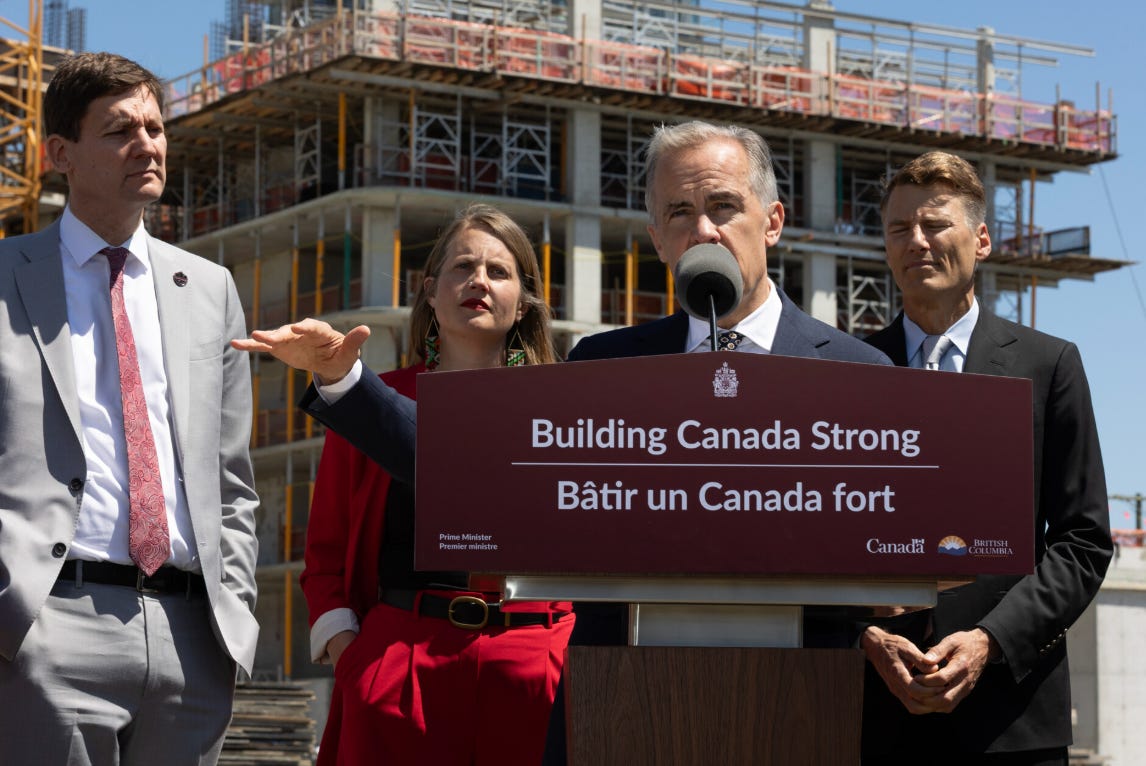
And the units the bailout targets may sit well above that median. Andy Yan, the Simon Fraser University urban planner, has calculated that a third of Metro Vancouver’s unowned condos are priced above $1 million — and the announcement itself was staged in South Vancouver’s River District, beside towers where empty two-bedroom units are marketed at close to $1.1 million, in the Richmond corridor where the glut is heaviest and where, as The Bureau has reported, offshore demand shaped the market for decades. The governments have not disclosed which units will be bought or at what price. At least one developer represented at Rennie’s February fundraiser for Carney — Thind — has since entered creditor protection over its Vancouver projects. The correction now underway has not come close to restoring the link between local incomes and local prices. The bailout, by design, stands in the way of that natural alignment.
That arithmetic is now the center of a full-scale Conservative campaign.
On Friday, Poilievre posted a formal petition — “Scrap the Carney Condo Bailout” — elevating the fight to a standing policy plank, in the mold of the party’s long-running war on the carbon tax, a campaign that ran until Carney himself co-opted the demand. “Carney’s condo bailout going ahead,” Poilievre wrote. “Forcing young homebuyers to bid against their own tax dollars to bail out the Liberal Club of donor developers.” His prescription matched the market diagnosis in Rennie’s own report: “Get out of the way. Let the free market work, with developers dropping the price until people can afford them.”
The petition itself, hosted on the party’s site, frames the objection in formal clauses: that the plan would spend taxpayer dollars on more than 2,200 unsold condominiums “benefiting developers, banks, and investors without adding a single new home to Canada’s housing supply”; that taxpayers “should not be forced to subsidize vacant condos that British Columbians cannot afford at current prices.”