


WASHINGTON — The Trump administration has imposed sweeping new sanctions on 46 individuals and companies connected to Mexico’s Sinaloa Cartel, targeting an alleged criminal infrastructure that extends from senior cartel leadership and border trafficking operations into legitimate businesses and elite Mexican political circles, as the Pentagon simultaneously expands its military campaign against drug-trafficking organizations across Latin America.
Announced Tuesday by Treasury Secretary Scott Bessent, the sanctions target 21 individuals and 25 entities, including Ismael Zambada Sicairos, known as “Mayito Flaco,” and members of the Sinaloa Cartel’s Los Mayos faction. Alongside cartel leaders, those sanctioned include politician Carlos Alberto Torres Torres, the ex-husband of Baja California Governor Marina del Pilar Ávila, a senior figure in Mexican President Claudia Sheinbaum’s governing Morena party.
“Carlos Torres uses his political influence to facilitate cartel activities and protect the Sinaloa Cartel from government and law enforcement intervention in Baja California,” the sanctions say.
The action also strikes Tijuana-based cell leaders, money launderers and politicians whom U.S. authorities accuse of enabling cartel operations near the American border.
The scale resembles Bessent’s sweeping new “financial D-Day” plan to isolate Iranian economic proxies and money laundering channels. According to Treasury, the administration has undertaken more than 30 sanctions actions against over 400 individuals and entities associated with criminal networks since the beginning of 2025, employing a strategy intended to dismantle entire trafficking platforms, rather than merely isolating hands-on narco-traffickers.
The financial offensive is unfolding alongside an increasingly militarized American campaign in the hemisphere.
In a story published Tuesday evening, The Wall Street Journal reported that the Pentagon is expanding operations from maritime strikes against suspected trafficking vessels into land-based missions, deploying sophisticated surveillance drones, mapping cartel infrastructure and sending American special forces to participate in raids alongside Latin American security forces.
General Francis Donovan, the four-star Marine commanding U.S. Southern Command, confirmed that land strikes remain among the options under consideration.
“Do I see land strikes as options? Yes. We want all options at the table,” Donovan told the Journal.
The latest sanctions focus on Baja California, where Treasury alleges that the Sinaloa Cartel has penetrated the political and policing establishment.
According to OFAC, Mayito Flaco, a dual U.S.-Mexican national born in Anaheim, California, assumed leadership of Los Mayos following the July 2024 arrest of his father, Ismael Zambada García, known as El Mayo. The arrest triggered a violent internal struggle between Los Mayos and the rival Los Chapitos faction.
Treasury identifies the brothers Alfonso and René Arzate García, known respectively as Aquiles and La Rana, as longstanding controllers of the Tijuana trafficking plaza. Their organization allegedly oversees fentanyl production and transportation into the United States, leveraging violence, political influence and corruption to maintain territorial control.
The sanctions also expose an alleged financial apparatus involving currency exchanges on both sides of the U.S.–Mexico border.
OFAC identifies Galerías Centro Cambiario, operating as Magic Casa de Cambio, as a Tijuana currency exchange used to collect proceeds from American drug sales through cooperating exchanges in Southern California and so-called “mirror transactions” at linked financial institutions in Mexico.
This form of underground banking resembles the “Vancouver Model” of Chinese transnational money laundering exposed by The Bureau in Canada. Secretly partnered banks or currency exchanges in different countries accept drug cash deposits in one country while a corresponding partner releases funds to the depositor in another. Transactions flow in both directions, allowing the partners to reconcile their balances without moving the original bulk cash deposits across borders.
According to Treasury, the Tijuana exchange’s previous owner, Omar Guadalupe Ayon Díaz, had been arrested for laundering more than $45 million for the Sinaloa Cartel before his murder in October 2023.
Other designated businesses span the hotel, real estate, private equity, entertainment, security, transportation, restaurant and fuel sectors.
More significantly, Treasury’s investigation identifies an alleged corruption network reaching into the political establishment of Baja California.
Carlos Alberto Torres Torres, the former husband of the state’s governor, is accused by Treasury of using his political influence to protect the Sinaloa Cartel and facilitate the activities of Juan José Ponce Félix, known as El Ruso, who commands the Los Rusos faction around Mexicali.
Treasury says the State Department revoked Torres’s U.S. visa in May 2025 because of his cartel affiliation.
The allegations extend to former Mexicali public security director Pedro Ariel Mendívil García, whom Treasury accuses of accepting bribes from El Ruso in exchange for allowing the cartel to exercise control over municipal police and use them to facilitate trafficking and enforcement operations.
Torres’s brother, Luis Alfonso Torres Torres, allegedly handled bribes and laundered proceeds through businesses and political campaigns. Another former government official, Rafael Buenrostro Martín, is accused of exchanging political favours for payments from a senior cartel figure.
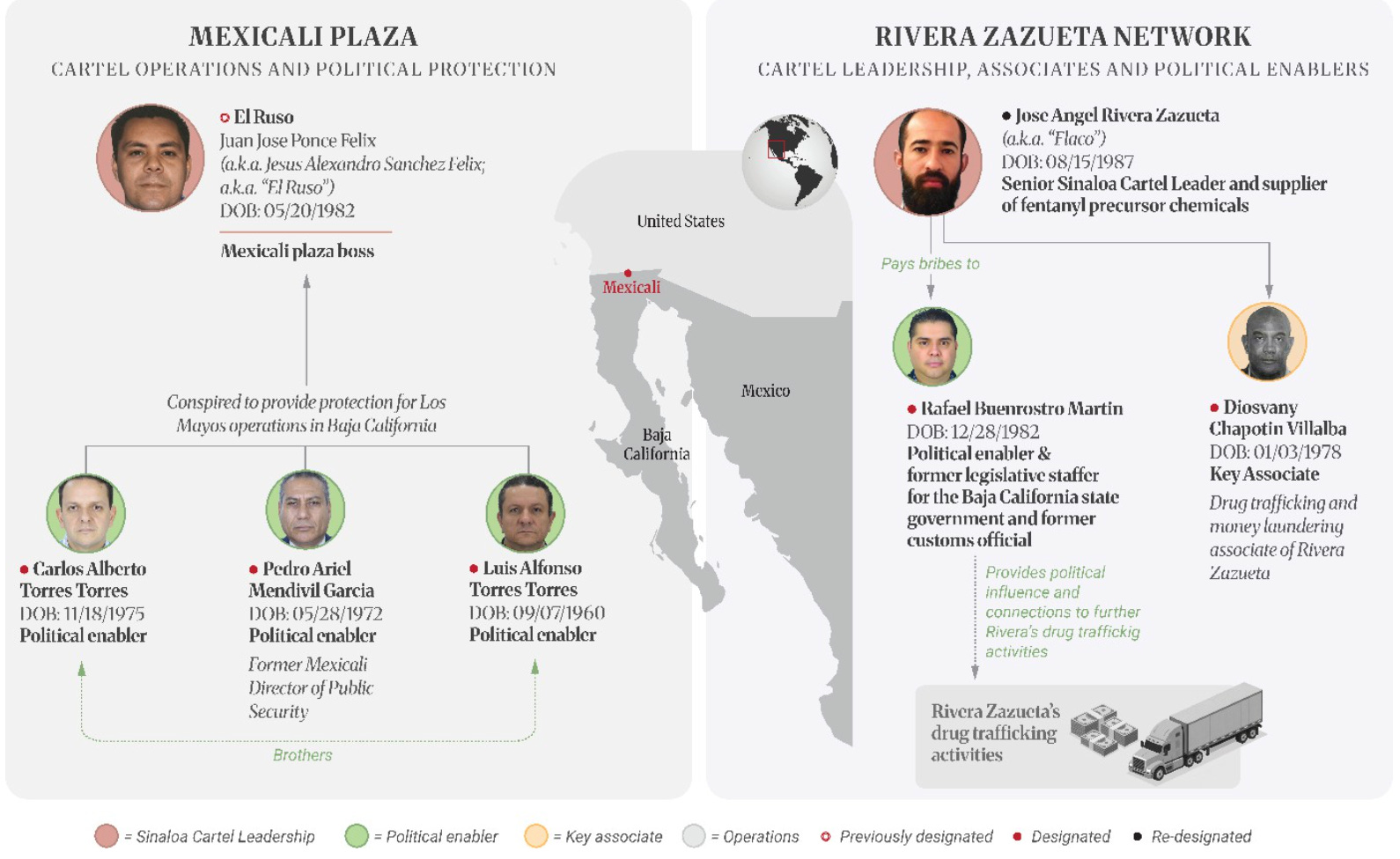
These are U.S. Treasury allegations underlying administrative sanctions, not criminal convictions against all those named. But the moves from Bessent underline a new reality for American homeland security under President Trump: countering cartel networks now sits within the Pentagon’s foremost mission, alongside securing American military and commercial access to strategic territory from Greenland to the Panama Canal.
Their scope also provides context for recent remarks by Secretary of State Marco Rubio concerning cartel penetration of the Mexican state.
During a September 9 press appearance in Ecuador, Rubio described Mexico as an especially serious security challenge because of its size and the power of its criminal organizations.
He said vast areas of Mexican territory were no longer effectively governed by the state, but controlled by organizations Washington now designates as narcoterrorists.
He said Washington preferred cooperation with Mexico but made clear that the United States regarded the organizations as a direct national security threat requiring further action.
The Pentagon’s developing military posture suggests the administration is preparing capabilities for a broader range of responses.
According to the Wall Street Journal, Southern Command is considering transferring MQ-9 Reaper drones from Africa into Central and South America. The aircraft, previously central to American counterterrorism campaigns, can collect electronic intelligence, detect heat signatures, conduct persistent surveillance and carry out precision strikes.
Donovan described the objective as imposing systemic pressure on trafficking organizations by identifying the infrastructure behind their operations, including laboratories, jungle staging areas and locations used to manufacture semi-submersible trafficking vessels.
The Journal also reported that senior officers from five major American commands—Northern Command, Southern Command, European Command, Africa Command and Special Operations Command—met in Washington last week to discuss a coordinated global campaign against cartel networks.
The military expansion is already visible on the ground.
Last week, approximately 50 American military personnel joined more than 300 Ecuadorian police officers in raids around Guayaquil and other locations targeting an alleged trafficking network associated with Mexico’s Jalisco New Generation Cartel, according to the Journal.
More than 30 people were arrested. In a separate operation in Manabí province, Ecuadorian forces working in coordination with Southern Command killed a local gang leader reportedly connected to the same Mexican organization.
The expanding operations have also been accompanied by an effort to establish a regional coalition capable of applying coordinated economic and security pressure.
On September 22, Trump met with representatives of 14 Latin American and Caribbean governments participating alongside Washington in the Shield of the Americas initiative. He urged them to adopt joint sanctions against 24 designated trafficking and criminal organizations.
The participating governments include Argentina, Bolivia, Chile, Colombia, Costa Rica, the Dominican Republic, Ecuador, El Salvador, Guyana, Honduras, Panama, Paraguay, Peru and Trinidad and Tobago.
Mexico and Brazil are notably absent from the coalition, underscoring the diplomatic complications surrounding Washington’s regional strategy.
Canada is also absent.
While traditionally viewed as outside the principal Latin American cartel threat environment, the footprint of these transnational networks in Canada is growing. The Bureau asked a spokesperson for Canada’s fentanyl czar, Kevin Brosseau, whether Ottawa intended to join the Shield of the Americas initiative and whether Canada shared Washington’s developing military force posture against cartels and fentanyl trafficking. The response did not address either question.
The northern border is also moving higher on Washington’s national security agenda.
A range of senior U.S. officials, from White House border czar Tom Homan to FBI Director Kash Patel, have pledged greater attention to threats involving fentanyl production, cartel trafficking, human smuggling and suspected terrorists entering the United States through Canada.
In a September 26 interview with The Epoch Times, Homan said the administration intended to shift additional resources north following its intensified enforcement campaign along the Mexican border.
“The next two years, I’m really concentrating on the northern border,” Homan said, pointing to additional personnel, drones, surveillance technology, aircraft and infrastructure. He also argued that dangerous individuals could exploit Canadian immigration pathways to enter Canada before attempting to cross illegally into the United States, and identified drug trafficking through Indigenous border territories as another enforcement concern.
Patel has similarly described the northern border as an emerging operational priority. Testifying before Congress in May, he said the FBI had established a new Homeland Security Task Force in Alaska and was working with Canadian partners to target drug-production capabilities that trafficking organizations had shifted northward, including networks moving narcotics into Alaska and the continental United States through tribal lands.
“Because the drug traffickers got smart with the securitization of the southern border and moved it up there,” Patel told lawmakers.
The concerns intersect with previous investigations by The Bureau into cartel-linked trafficking networks operating around Quebec’s border with New York State, including the activities of Canadian-Colombian trafficker and former U.S. cooperating witness Jon Acebedo-García, who was subsequently murdered in Medellín in January 2025 in a killing allegedly ordered by Canadian cartel figure Ryan Wedding.
As The Bureau previously reported, Acebedo-García had been imprisoned for fentanyl trafficking in Quebec and was linked through American court records to a large-scale narcotics-smuggling organization exploiting the Akwesasne Mohawk borderlands between Quebec, Ontario and New York. In one documented 2009 incident, American police intercepted a vehicle carrying 23,000 MDMA pills after Acebedo-García and an associate returned from the reservation.
In July 2026, American authorities arrested three Akwesasne residents in another alleged international narcotics-smuggling operation, with investigators from both the Akwesasne Mohawk Police Service and St. Regis Mohawk Tribal Police participating in the case.
For Washington, the developing northern-border posture raises a question extending beyond the latest Mexican sanctions: whether the administration’s increasingly integrated campaign against cartel financing, logistics and trafficking infrastructure will ultimately encompass criminal networks operating through Canada as well as Latin America.
Bessent’s latest sanctions also follow a consequential August operation against a cocaine-trafficking network based in Ecuador.
On August 20, OFAC sanctioned 15 Ecuador-based targets and identified 10 vessels as blocked property, alleging that a network of ostensibly legitimate fishing businesses was covertly transporting thousands of kilograms of cocaine each month.
The vessels, operating near Manta, allegedly transferred cocaine to smaller, high-speed boats moving north through the Eastern Pacific. Treasury identified links to Ecuador’s Los Choneros and Los Lobos gangs and their Mexican trafficking partners, including the Sinaloa and Jalisco cartels.
The United States has meanwhile established a dedicated military coordination structure on its own southern border.
Joint Interagency Task Force–Counter Cartel, operating under U.S. Northern Command, was established to coordinate military, intelligence and law-enforcement capabilities against organizations threatening the United States from Mexico.
In a September 4 operational update, Northern Command reported that more than 8,000 American military personnel were deployed along approximately 1,954 miles of the southern border. It also reported that Joint Task Force–Southern Border had defeated more than 300 unauthorized drones associated with illicit activity during 2026, including 11 cartel-linked systems intercepted using an Army high-energy laser weapon introduced into border operations in August.