


LOS ANGELES – Federal prosecutors unsealed three indictments Tuesday charging 37 defendants tied to India-based transnational crime syndicates, alleging for the first time in a court filing that imprisoned gang leader Lawrence Bishnoi and his Canadian lieutenant Satinderjeet Singh, known as “Goldy Brar,” ordered the June 18, 2023 assassination of Hardeep Singh Nijjar outside a Sikh temple in Surrey, British Columbia — a killing that ruptured relations between Ottawa and New Delhi and became one of the most consequential national security cases in modern Canadian history.
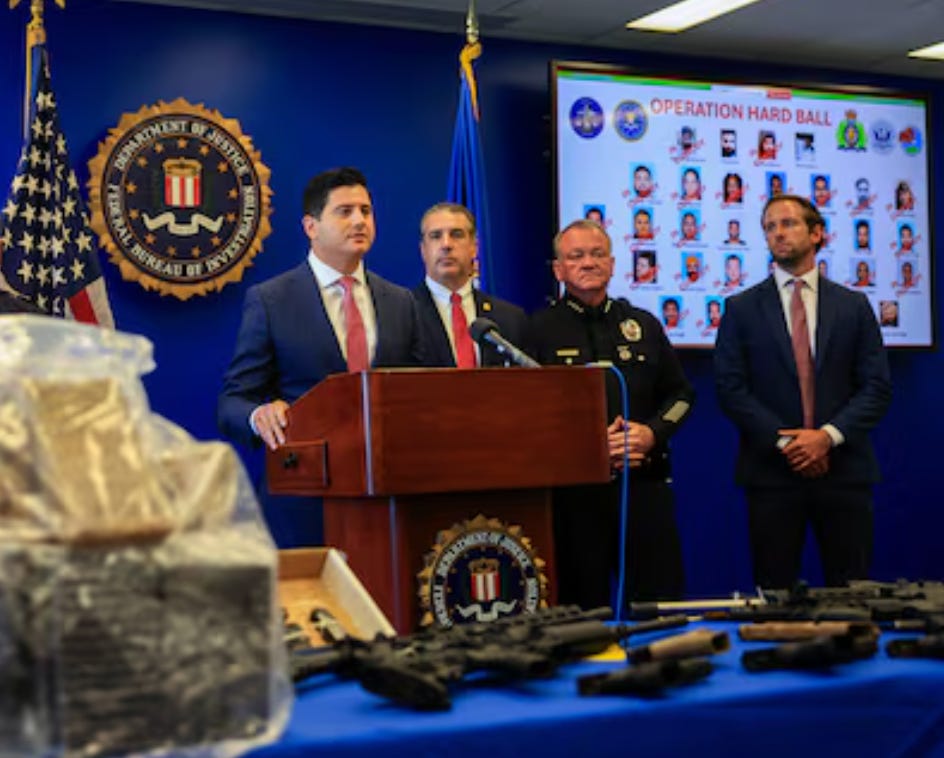
The charges, announced jointly by the United States Department of Justice, the FBI and the RCMP under a years-long investigation code-named Operation Hard Ball, describe three distinct but overlapping criminal enterprises — led by Bishnoi, his imprisoned associate-turned-rival Jaggu Bhagwanpuria, and Vancouver-based logistics broker Ravinder Singh Dhanda — that together ran murder-for-hire plots, extortion rackets targeting the Indian diaspora, and bulk cocaine and methamphetamine pipelines moving hundreds of kilograms weekly from southern California stash hubs across the U.S.-Canada border.
Twenty-four defendants were arrested Tuesday in a synchronized sweep across three continents, including 11 in California, one in Indiana, one in Georgia, three in Canada and one in Spain. Seven defendants were already in custody, and law enforcement is hunting 10 fugitives — seven in the United States, two in India and one in Europe. Investigators seized approximately 1,000 kilograms of cocaine, one kilogram of heroin, $40,000 in cash and a dozen firearms, executing 23 search warrants in the Sacramento area and 11 more in greater Los Angeles.
The nine-count indictment against the Bishnoi enterprise, returned by a federal grand jury on July 1, portrays the 33-year-old from India’s Punjab state as a self-styled university student leader who tired of politics and turned himself and his followers to crime. In public, according to the indictment, Bishnoi projected an image of himself as a “patriot,” “nationalist,” and deeply religious individual through social media posts and interviews with news organizations, and used this public image to recruit members and associates to his crime syndicate in India, the United States, and elsewhere. In private, prosecutors allege, he presided over a sweeping criminal enterprise spanning multiple continents — using contraband cellphones and voice-over internet protocol devices smuggled into his jail cell to personally direct political assassinations, murders, shootings, extortions, kidnappings, drug trafficking, and human smuggling committed by his members worldwide.
To manage day-to-day operations, the indictment alleges, Bishnoi delegated control to trusted lieutenants and regional leaders: Brar, 32, of Punjab, the North American leader of the enterprise; Rohit Godara, 37, of Rajasthan, the European leader; and Sukhraj Singh Kang, 58, of Punjab. Both Brar and Godara effectively spoke for Bishnoi and helped direct acts of violence committed by the gang’s members in the United States, Canada, and elsewhere, according to the charging document.
The indictment identifies Nijjar only by his initials, “H.S.N.,” describing a prominent political and religious leader from India’s Punjab state who was living in Canada when two gunmen shot and killed him as he left the Sikh temple. The filing is notable as much for what it does not allege as for what it does: it makes no reference to the theory advanced by former prime minister Justin Trudeau in September 2023 that agents of the Indian government directed the killing. Prosecutors have instead built the case around Bishnoi’s criminal organization — a syndicate the Canadian government designated a terrorist entity in September 2025.
