

OTTAWA — Two days before the Carney government tables a budget expected to carry a $63.3 billion deficit, a new study by the accounting firm EY Canada has estimated the nation is bleeding billions in tobacco tax revenue to black market factories sitting on Indigenous lands in Ontario and Quebec.
The study cites a particular Ontario Provincial Police (OPP) investigation that The Bureau’s sources have connected to transnational narcotics networks that bring together Mexican cartels and Canada-based hybrid mafias believed to be central to the country’s fentanyl production and international trafficking.
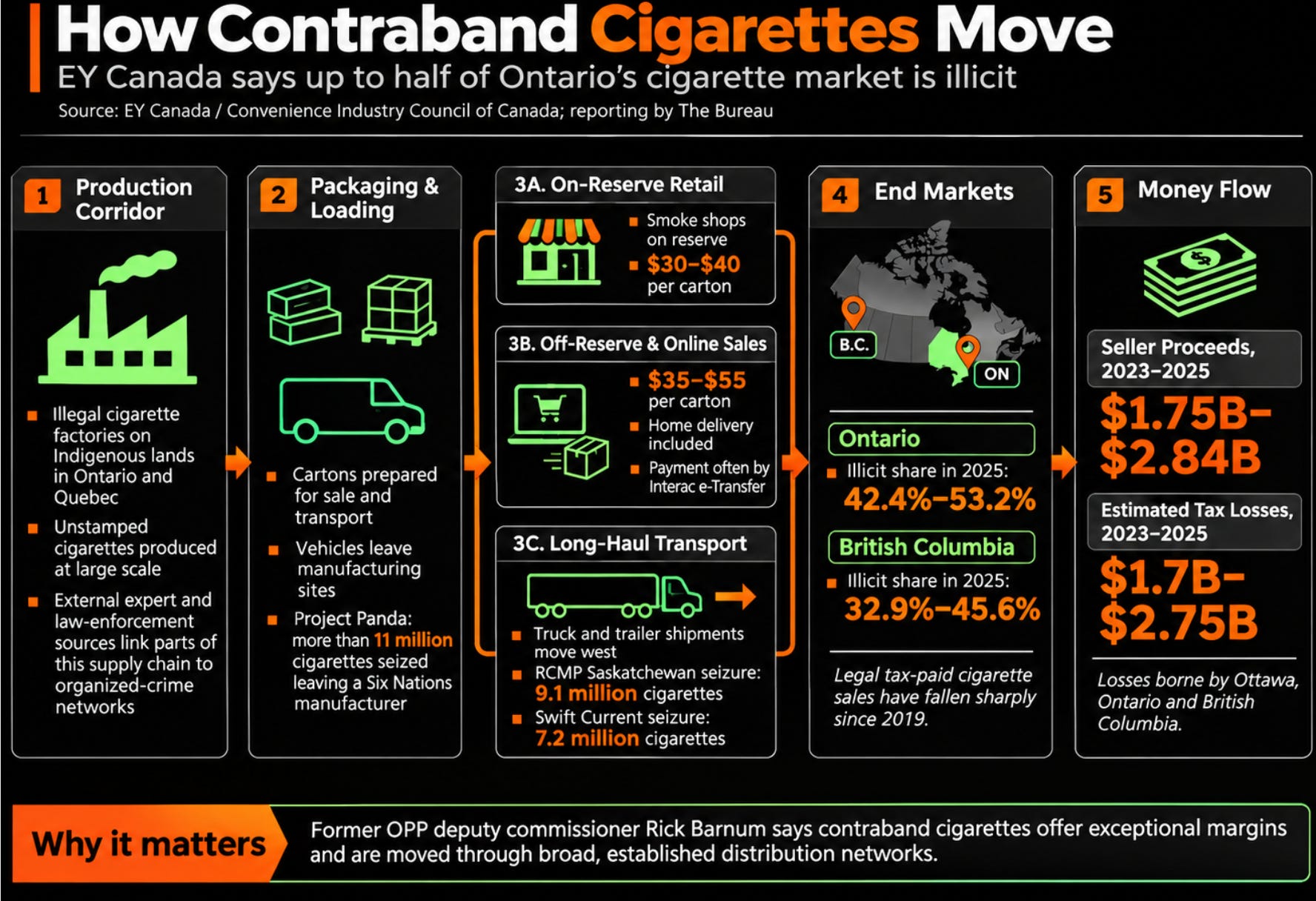
Up to one in two cigarettes sold in Ontario last year was contraband, the study found, and nearly one in two in British Columbia. Between 2023 and 2025, EY estimated, illegal sales cost Ottawa and the two provinces between $1.7 billion and $2.75 billion in tobacco tax and excise duty. Over the same period, the people selling those cigarettes took in between $1.75 billion and $2.84 billion.
The report was released Monday by the Convenience Industry Council of Canada. It is the fourth EY has prepared for the council, and it puts Ontario’s illicit share at between 42.4 and 53.2 percent of the market in 2025. British Columbia’s illegal market grew every year, from between 21.1 and 36 percent in 2023 to between 32.9 and 45.6 percent in 2025. Legal, tax-paid cigarette sales have fallen 46.4 percent in Ontario and 58.7 percent in British Columbia since 2019.
Ontario lost an estimated $690 million to $1.08 billion in provincial tobacco tax over the three years, according to the report. Ottawa lost a further $671 million to $1.05 billion in excise duty on cigarettes in Ontario alone.
British Columbia’s provincial losses ran as high as $400 million. The council noted that the findings land as Ontario projects a $16.9 billion deficit.
EY said the role of organized crime is “beyond the scope of this report.”
To illustrate where the supply comes from, however, the report cites Project Panda, an investigation that began in February 2025.
The OPP Organized Crime Enforcement Bureau ran it with the support of Six Nations Police. Officers searched vehicles leaving a contraband manufacturer on Six Nations of the Grand River. According to the report, they seized more than 11 million cigarettes worth an estimated $2.8 million, more than 616 kilograms of illegal cannabis products, 15 firearms and skids of packaging material. EY also cites the OPP’s chief superintendent for organized crime, who said the factory was operated by a non-Indigenous criminal network whose members do not live on the territory.
The Bureau has identified Project Panda as an investigation believed to link into the same networks Winnipeg police probed a year later in Project Puma, the largest drug seizure in Manitoba’s history.
Announced in May, Puma closed a two-year investigation with 33 arrests. Police seized 339 kilograms of methamphetamine, 175 kilograms of cocaine, 11.25 kilograms of fentanyl, about $825,000 in cash, 14 firearms and 1.35 million contraband cigarettes. Police allege the umbrella organization imported drugs from the United States in commercial transport vehicles and warehoused them in Alberta and Ontario. They also allege it had ties to the Hells Angels, the Wolfpack Alliance and a Mexican cartel. The Bureau’s law enforcement sources refer to these criminal networks as the systems within which former Olympian Ryan Wedding operated as a significant broker for Latin American cartel drug suppliers.
More broadly, experts including former Canadian military intelligence and law enforcement analyst Scott McGregor conclude that Wedding, who has denied the charges he faces at his upcoming trial in Los Angeles, is one of numerous facilitators in Canada for criminal networks based in Latin America and the Middle East, with upstream ties to China-based criminal networks.
EY’s own seizure record traces a road running west from that illegal production corridor in Ontario.
On January 20, Royal Canadian Mounted Police (RCMP) officers in Saskatchewan stopped a truck and trailer carrying about 9.1 million unstamped cigarettes. The driver was a Brampton resident who, police said, was under court-ordered conditions to remain in Ontario on tobacco-related charges. A month later, RCMP officers near Swift Current seized 7.2 million cigarettes and arrested two more men from Brampton.
A carton of 200 contraband cigarettes costs $30 to $40 at an on-reserve smoke shop and about $35 to $55 off reserve or online, with home delivery included and payment by Interac e-Transfer, EY reports. A legal carton cost about $159 in Ontario and $192 in British Columbia last year. Some online sellers say they operate from First Nations territory. Others, EY writes, are likely run by organized criminal groups off reserve.
Rick Barnum, the former OPP deputy commissioner who oversaw investigations and organized crime, told CHCH News on Monday how the trade was treated during his time in command.
Contraband tobacco “was always something we would sort of work on in the fringe,” he said. The council says the RCMP’s Contraband Tobacco Task Force has had its base budget frozen at $3 million a year since 2008. It is asking Ottawa to give the new Financial Crimes Agency a mandate to pursue the proceeds, and to require federally regulated banks and payment processors to close sellers’ accounts. In Ontario, council president Anne Kothawala said, roughly 100 busts a year produce criminal convictions in only about a quarter of cases. Convenience stores check identification and collect the tax, she said. “Organized crime does none of that, and right now it’s winning.”
Barnum, who now works with an industry group that tracks contraband tobacco, laid out the economics for The Bureau in May. “There’s no better commodity right now for organized crime to make their money than contraband cigarettes,” he said. He put the margin at roughly 400 percent and said a single tractor-trailer moved at the wholesale level clears about a million dollars. “And I don’t know anybody that’s gone to prison for it.”
The clearest line to Canada’s fentanyl traffickers remains Operation Mygale, a 2016 Quebec case.
In it, a motorcycle gang that had moved into contraband tobacco was found converting cigarette profits into cocaine, methamphetamine and fentanyl. Barnum sees the same composition in Winnipeg’s Project Puma and in the other large cases of the past year, in Alberta and on the East Coast.
“Now that the cartels are in so many communities across the country, (contraband) cigarettes are in every community,” he said. “It just makes sense to me that if the network’s built, they just use that. Now that’s sort of all melting into one.”
Reduce “Sin Taxes”, Tabasco, Alcohol to 10%, including federal provincial. That will eliminate the contraband market.
Let’s move forward.
I have 2 thoughts on the subject.
Governments should not be profiting from dangerous products like cigarettes, alcohol, weed etc etc. On the other hand how can government pay for the resultant health damage caused by the addiction?
God help us if the government legalizes fentanyl….like they did weed….. the result being the poor miserable wretches we see bent over living on our streets. However, if they taxed it, might be enough tax revenue from the sale of the shit to pay off the out of control debt that Carney and his liberals have caused! But then again……. seeing that government hands out this shit to the “poor miserable wretches we see bent over on our streets” ….we are back to square one……..being a bankrupt nation.
Question is…….are the Indigenous leaders aware of this illegal activity going on…..”on their land”? However, ….. if they are…. there is nothing the government can do to shut it down!, ..especially so if the indigenous elders are somehow profiting from the illegal “business”?
I hate to say this…… but Canada is a very troubled nation. And to think young men and women gave their precious young lives during WW2….. fot “this”? Will be a very sad day for me… as usual….. on Nov 11.
However Sam…… thanks for your courageous fight for Canada!