


WASHINGTON – An official declaration from President Donald Trump has informed Congress that fentanyl is still being produced in clandestine Canadian labs and that Chinese gangs are operating along the northern border of the United States, while the People’s Republic of China “continues to be the world’s largest producer of many of the precursor chemicals used to illicitly produce fentanyl, methamphetamine, and other deadly synthetic drugs.”
In the President’s legally mandated annual report on global drug trafficking, Trump singled out Ottawa in a consequential determination that names China, Mexico and Colombia among 23 major drug transit or illicit drug producing countries.
The determination suggests the People's Republic of China is tied to the problem of Chinese gangs operating on Canada's border with the United States, where approximately 447,000 people died of overdoses involving synthetic opioids from 2015 to 2024, according to the Centers for Disease Control and Prevention.
Canada is not on the list of 23 designated states, but the official determination ties it to China’s fentanyl production and puts it beside Mexico as a neighbor that must “do far more to stop the flows of deadly drugs into our country.”
“Canada needs to take meaningful action to dismantle drug labs, strengthen supply chain security, and degrade criminal networks and Chinese gangs operating along our northern border,” the determination says. It adds: “Fentanyl continues to be illicitly produced in clandestine Canadian labs, and precursor chemicals and synthetic drugs continue to enter the United States through Canada.”
The document does not quantify the flows.
Senior experts interviewed by The Bureau have indicated that far more fentanyl made from Chinese chemicals has crossed into the United States from Mexico than from Canada.
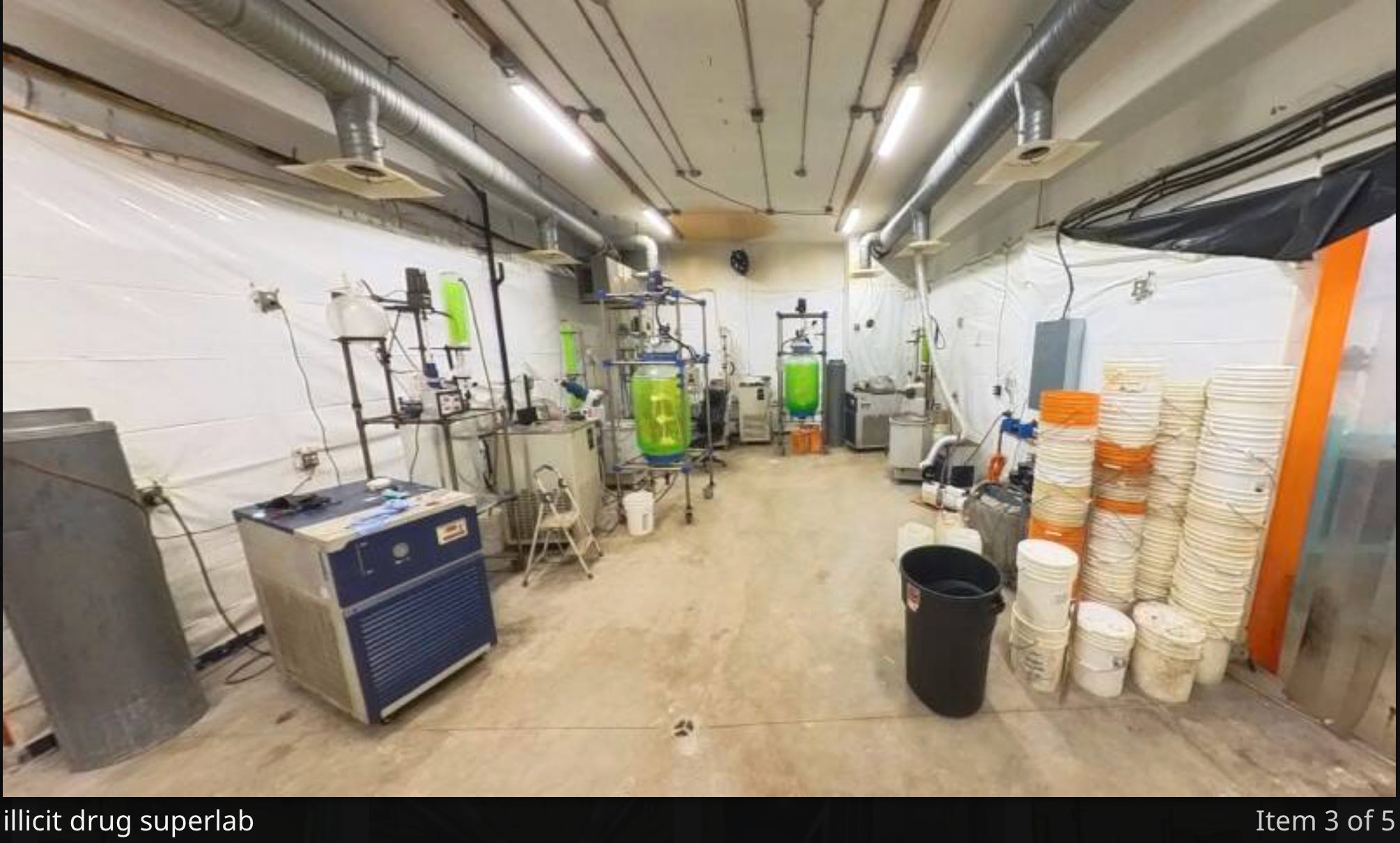
But the experts, including Derek Maltz, former acting administrator of the Drug Enforcement Administration, have said that Chinese fentanyl precursor shipments through the Port of Vancouver, and production in clandestine labs such as the so-called “superlab” in Falkland, British Columbia, have grown sharply in recent years. Recent testimony from Federal Bureau of Investigation Director Kash Patel and DEA Administrator Terrance Cole confirms that their agencies increasingly see Canadian production as a threat to the United States.
The new document is formally titled the Presidential Determination on Major Drug Transit or Major Illicit Drug Producing Countries for Fiscal Year 2027. It was published by the U.S. State Department on Wednesday.
The Royal Canadian Mounted Police and Public Safety Canada have not immediately responded to questions from The Bureau about President Trump’s statements on fentanyl production in Canada, Chinese gangs operating along the northern border, and the need for meaningful action by Canadian authorities.
The determination is a statutory finding filed with Congress and part of the official record available to American agencies.
Being listed, on its own, carries no penalty for any of the 23 countries named. The findings on Canada, Mexico and China, however, come as Ottawa and Mexico City face trade and tariff disputes with Washington. The Bureau learned from a senior U.S. Treasury source that beyond Treasury Secretary Scott Bessent’s widely reported sanction threats against entities that financially assist Iran, the department is examining fentanyl flows and weighing powerful regulatory actions against institutions and economies found to launder or facilitate them.
The determination is the type of presidential finding that could help build the case for such actions, and could also inform U.S. law enforcement and national security priorities.
For Canada, this year’s language is sharper than last year’s.
In the determination submitted in September 2025, the President credited Canada with appointing a fentanyl czar and proposing legislation to expand law enforcement inspection powers, while saying “more action is needed to stop fentanyl and other drugs from crossing our border and to arrest drug criminals exploiting Canadian territory.” This year’s document credits Ottawa with nothing, and it adds the reference to Chinese gangs.
The determination does not mention any specific Canadian case.
It arrived one week after The Bureau reported that no one has been charged with producing, financing or directing the fentanyl and methamphetamine laboratory in Falkland, British Columbia. The RCMP raided the site in October 2024 and called it the largest synthetic-drug laboratory seizure in Canadian history. Police said the property held enough finished fentanyl and precursors to produce 95 million lethal doses.
A U.S. official who spoke to The Bureau on condition of anonymity said the case began in China, and that the RCMP’s refusal to work with U.S. law enforcement on the case caused significant concern across counternarcotics agencies that reached all the way to the White House.
In late 2022, the official said, the Newark office of the DEA alerted the RCMP to precursor shipments from China bound for a chemical importer in Port Coquitlam, and the RCMP refused to pursue the leads into 2023. In October 2023, the U.S. Treasury sanctioned the Vancouver-area chemical importer as part of a China-based illicit-drug precursor network. The company has denied wrongdoing and any connection to illicit fentanyl laboratory activity in British Columbia.
The investigation’s only result came on September 2, with the conviction of a lower level distributor, from the perspective of U.S. officials interviewed by The Bureau. Gaganpreet Singh Randhawa, 32, of Surrey, pleaded guilty in British Columbia Supreme Court to attempting to export 310 kilograms of methamphetamine to the Philippines, along with drug and firearms offenses. The agreed statement of facts did not mention Falkland.
The Bureau’s U.S. source, along with sources cited by the Vancouver Sun, has linked the Falkland laboratory to the Wolfpack Alliance and to James Riach, a British Columbia gangster imprisoned in the Philippines.
The Bureau‘s sources describe the Wolfpack Alliance as a transnational, cartel-like network of British Columbia drug traffickers, Hells Angels figures, and senior operators with links to Iranian state-linked criminal networks and Mexican cartel leaders.
The RCMP has not publicly identified the intended market for the fentanyl found at Falkland. The American official with knowledge of the Falkland lab investigation told The Bureau the scale of the precursor supply coming into Vancouver in recent years, pointed south.
“At the levels of precursors that we’ve seen coming into Canada, it would consume the Canadian population ten times over,” he said.
The Presidential document places China at the start of the supply chain.
“The PRC continues to be the world’s largest producer of many of the precursor chemicals used to illicitly produce fentanyl, methamphetamine, and other deadly synthetic drugs,” it says.
Trump writes that he raised the issue directly with Xi Jinping, and that last year, at his request, Beijing began requiring its companies to obtain licenses before exporting designated precursor chemicals to North America. The determination says traffickers have adapted: “criminals continue to find ways around these controls through the use of unregulated precursor chemicals.”
Mexico, which appeared on the list again, was not designated as failing and faces no restriction on assistance.
The determination credits President Claudia Sheinbaum’s government with seizing more drugs, dismantling clandestine laboratories and sending more police and military resources to the shared border. It says United States-Mexican cooperation helped eliminate cartel bosses including “El Mencho.” It also says Mexico must act against “the narcoterrorist organizations that dominate vast areas of its territory.” It warns that “Mexico’s current investments in its security forces are insufficient to sustain and expand its campaigns against narcoterrorists, their finances, and their criminal networks,” and it calls for prosecuting “the many corrupt public officials that have aided and abetted the cartels.”
The full list of major drug transit or illicit drug producing countries is Afghanistan, The Bahamas, Belize, Bolivia, Burma, China, Colombia, Costa Rica, the Dominican Republic, Ecuador, El Salvador, Guatemala, Haiti, Honduras, India, Jamaica, Laos, Mexico, Nicaragua, Pakistan, Panama, Peru and Venezuela. The determination notes that a country’s inclusion “is not necessarily a reflection of its government’s current counterdrug efforts,” and that geography, commerce and economics can make a country a transit or production point even when its government is aggressive against traffickers.
Four countries were designated as having “failed demonstrably” over the past 12 months: Afghanistan, Bolivia, Burma and Colombia.
Venezuela, which was designated as failing last year, has been removed from that category. The determination credits cooperation with the interim government of Delcy Rodríguez after what it describes as the arrest and removal of Nicolás Maduro, and cites the elimination of Tren de Aragua leader Niño Guerrero. Colombia’s designation, the document says, “remains in place solely due to” the previous government. It suggests the status could be lifted if President Abelardo de la Espriella makes progress on coca eradication.
American concern about Chinese criminal networks in British Columbia goes back years. Project E-Pirate was an RCMP investigation into Silver International, an alleged China-connected underground money-laundering bank in Richmond. Canadian police believed the wider network connected Chinese synthetic-narcotics traffickers and Latin American cartel figures with drug traffickers across British Columbia and Alberta, cash pools in Mexico and Peru, and hundreds of bank accounts in China.
According to a Canadian case study published by the Financial Action Task Force, Silver International was part of a network estimated to launder more than C$1 billion annually.
The prosecution collapsed.
Port Coquitlam Mayor Brad West told The Bureau last year that in 2023, then Secretary of State Antony Blinken warned him about Chinese fentanyl and money-laundering networks in Canada. “He confirmed the connection between the Chinese Communist Party, the triads, and the Mexican cartels, telling me these groups are working together—and it’s Canada where they’re finding a safe operating base,” West said. West said Blinken also told him “U.S. intelligence and law enforcement are withholding some evidence because they don’t believe we’ll act on it.”
If only Canada's PM cared as much about this prevailing issue in Canada as much as President Trump does. Thank you Sam.