Threading the Needle: How Japan's Historic Prime Minister Could Turn Trump's Hormuz Demand Into a Pacific Masterstroke
Op-Ed: As the United States hunts for allies in the Middle East and Beijing tightens its grip on Taiwan, Sanae Takaichi arrives at the White House holding more cards than the headlines suggest.
TOKYO/WASHINGTON — Millions watched one year ago as the Oval Office became a boxing ring, a live-televised summit between Donald Trump and Volodymyr Zelensky dissolving into open confrontation before the world’s cameras. Tomorrow, a meeting of equal strategic consequence will unfold in that same room, one whose reverberations will touch Beijing’s war planners and their designs on Taiwan.
What happens between Trump and Japanese Prime Minister Sanae Takaichi will echo through the Strait of Hormuz and the Taiwan Strait — the two most critical maritime passages on earth, carrying oil, silicon chips, and an extraordinary share of global shipping tonnage — and force an answer to the question that has haunted the postwar order: what is Japan, still bound by a constitution written by its American conquerors, prepared to become?
Takaichi arrives under enormous pressure. The United States and Israel have struck deep into Iran’s military architecture, bunker-busting munitions destroying hardened missile sites along the Strait of Hormuz, Israeli strikes killing Intelligence Minister Esmail Khatib, senior national security official Ali Larijani, and former Basij commander General Gholam Reza Soleiman in successive days. More than 1,200 people have been killed in Iran alone.
The regime has responded with the one asymmetrical weapon always available to it. Closing the strait.
For Japan, that is not a distant crisis. The country imports roughly 90 percent of its energy from the Middle East, the lion’s share of it through those now-blocked waters. The closure has spiked inflation, hammered the yen, and threatened to derail Takaichi’s ambitious $134 billion domestic investment program before it has fully launched. Trump has publicly demanded that Japan send warships to help reopen the chokepoint.
Japan’s pacifist constitution, Article 9, written by American occupiers in 1947 and never amended, strictly limits what military operations the country can undertake abroad. Japanese public opinion does not support force projection. No significant United States ally has yet heeded Trump’s demands. One person described to the Financial Times as familiar with Takaichi’s thinking said this week: “Her ability to charm the guy is not the problem. The problem is substance.”
But here is what that framing misses.
Takaichi has agency. She is not simply a leader caught in a trap. She is a leader on the precipice of the most sweeping transformation of Japan’s national security posture since the postwar era began, and the Hormuz crisis, for all its acute danger, also hands her a rare instrument of leverage.
On March 13, the same day Japan’s lower house passed a record $58 billion defense budget, the Takaichi cabinet approved legislation to establish a National Intelligence Council, a new command architecture for intelligence policy chaired by the prime minister herself.
The United States, in 1945, had dismantled Japan’s intelligence apparatus along with its military. Takaichi is rebuilding both, with Washington’s blessing.
Ironically, Beijing has made the case for her. When she declared last November that a Chinese move on Taiwan would rise to a survival-threatening situation for Japan, a legal precondition for Tokyo to activate collective self-defense measures, Beijing’s response was performative and egregious. On November 8, Xue Jian, China’s consul general in Osaka, posted on X that “the dirty neck that sticks itself in must be cut off.” The post was later deleted.
At the Munich Security Conference in February, China’s top diplomat Wang Yi abandoned his scripted remarks to denounce Japan as “a militaristic nation” and invoke Pearl Harbor. The slur landed badly. It accelerated, rather than arrested, the momentum behind Takaichi’s agenda.
The Bureau has no intelligence on what Takaichi will say when she sits across from Trump tomorrow. But we have gathered this: nothing about that meeting will be accidental.
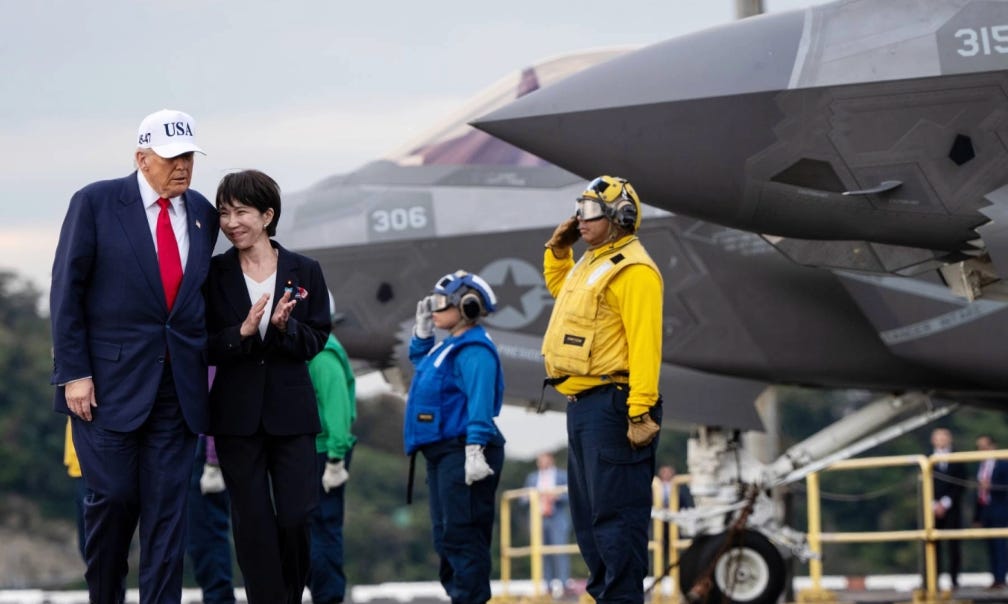
Japan’s government will have planned it with a precision that extends to word selection, physical choreography, and a studied understanding of Trump’s psychology that few other governments have matched. The Zelensky catastrophe, watched, rewatched, and analyzed in foreign ministries from London to Seoul, will have been treated in Tokyo as operational intelligence. Takaichi has already done the groundwork, forging a visible personal rapport with Trump on the deck of a United States aircraft carrier last October.
Some analysts believe Takaichi enters the Oval Office tomorrow holding more cards than the headlines suggest.
Desmond Shum, the investor and author whose book Red Roulette gave the world an intimate portrait of elite power in Beijing, writing on social media ahead of Thursday’s summit, argued that Takaichi will arrive at the White House prepared to at least hint at a Japanese maritime role around Hormuz.
His reasoning tracks the long arc of Liberal Democratic Party strategy: for decades, he wrote, Japan’s conservative establishment has worked to “normalize Japan’s security role and loosen the postwar constitutional straitjacke.”
And a Hormuz mission, whatever label Tokyo gives it, would be another incremental step in that direction. On the naval balance and military spending, Shum's math is persuasive — Japan already fields 36 destroyers against Britain's eight frigates and six destroyers, and has reached its two percent of gross domestic product defense target two years ahead of schedule. As for Beijing's inevitable denunciations, Shum is dismissive. That alarm, he wrote, "has been pulled so many times no one would give it a second glance."
The needle Takaichi must thread is real, but it is achievable.
Japanese officials have floated a "research and survey" deployment to the Middle East — the precise legal mechanism Takaichi's mentor Shinzo Abe used in 2020 — that would provide practical maritime presence while stopping short of combat operations in the strait itself. It would give Trump a visible allied commitment, give Takaichi domestic political cover, and, critically, give Japan something it has sought for decades. Undeniable, high-profile proof of its indispensability to Washington at the precise moment Tokyo is pressing Washington for backing against Beijing's pressure campaign over Taiwan.
That is the full-circle quality of this moment that history could record.
The United States wrote Japan's pacifist constitution. It is now the United States — presiding over a western alliance that Beijing seeks to fracture and ultimately lead — that needs Japan to set that constitution aside. And it is Japan, led by a prime minister with a supermajority mandate, a rebuilt intelligence architecture, a record defense budget, and a personal rapport with the American president, that holds the pen.


Fascinating geopolitical perspective
I really appreciate The Bureau, thanks for the Great Work