“They Can Cut All the Flowers, but They Cannot Stop the Spring”: Five Years After Cuba's 11J
U.S. Ambassador Mike Waltz confronted the Cuban delegation with the human cost of the regime’s repression.
By Michael Lima
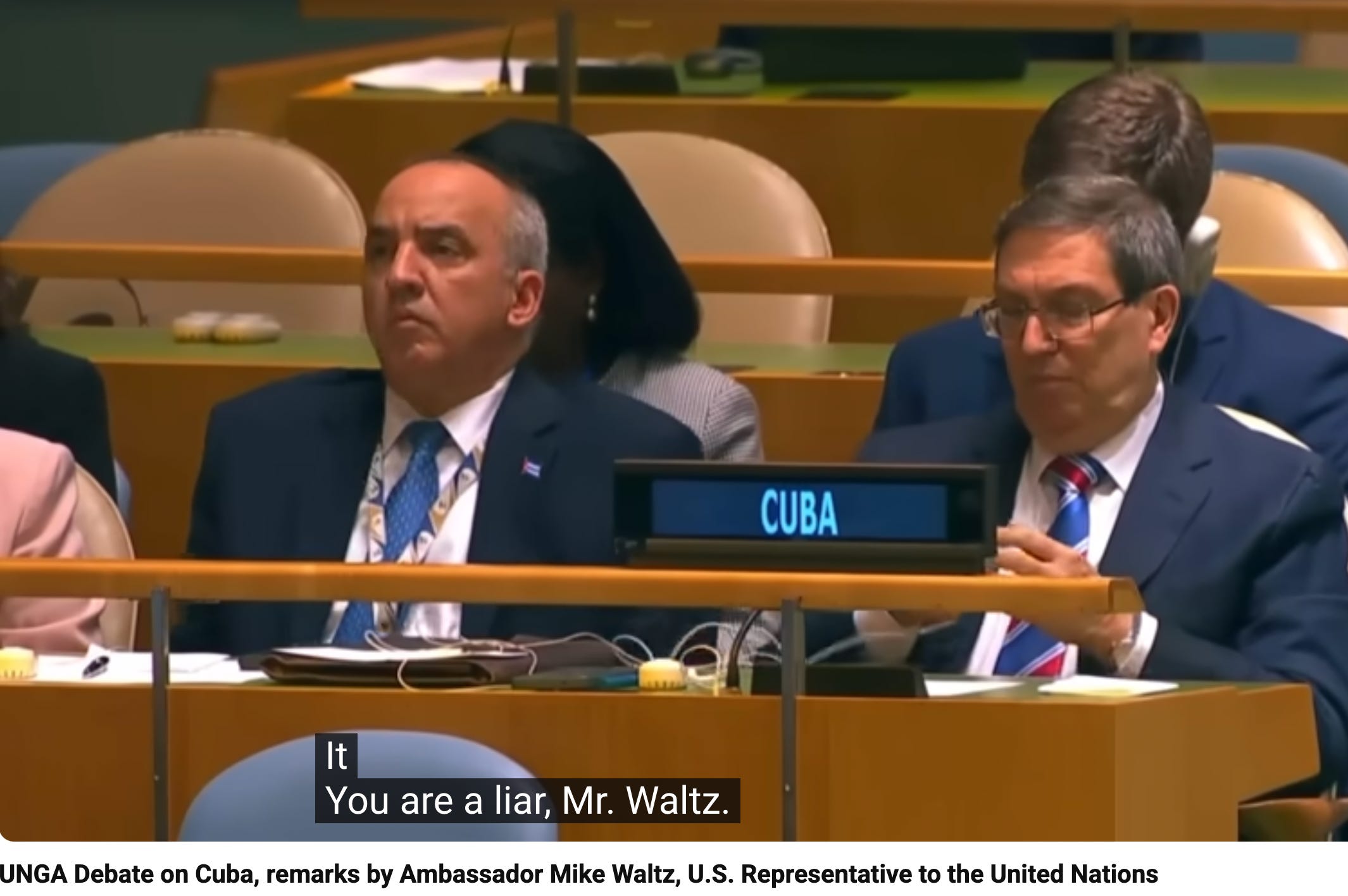
NEW YORK — This week at the United Nations, U.S. Ambassador Mike Waltz confronted the Cuban delegation with the human cost of the regime’s repression. Holding photographs of political prisoners tied to Cuba’s democracy movement, he honored artists Luis Manuel Otero Alcántara and Maykel Castillo “Osorbo,” poet Duanis Dabel León, and brothers Jorge and Martín Perdomo.
León and the Perdomo brothers were imprisoned for taking part in the historic July 11, 2021, demonstrations, while Osorbo had already been jailed before the uprising.
The response was revealing.
Foreign Minister Bruno Rodríguez repeatedly pounded the table in a rage and demanded a point of order, attempting to disrupt the presentation and prevent uncomfortable truths from being heard. In Cuba, those same truths are routinely silenced through censorship, imprisonment, and forced exile.
Five years later, July 11, commonly known in Cuba as 11J, remains the clearest proof that Cuba’s future belongs not to the ruling family, military conglomerates, or the regime’s heirs, but to the Cuban people.
This July 11 marks five years since the 2021 pro-democracy protests, among the largest and most socially broad-based demonstrations in Cuba’s recent history. Hundreds of thousands of Cubans took to the streets across the country demanding freedom, shouting “Down with communism,” “Fatherland and Life,” and “Freedom.” The sovereign spoke in the streets.
In the eastern Cuban town of Palma Soriano, a crowd called Ramiro Valdés, the recently deceased founder of State Security and the regime’s equivalent of the KGB, a murderer, signaling that many Cubans had begun to overcome fear. In less than 24 hours, more than six decades of myths carefully cultivated by the regime about its supposed popular support collapsed. The Cuban people disproved the dictatorship’s apologists, who had long argued that the absence of mass protests reflected acceptance of the system rather than the effects of repression and fear.
The demonstrations also showed that pro-democracy leadership can renew itself despite imprisonment and forced exile. Artists and activists associated with the San Isidro Movement, together with opposition organizations such as the Patriotic Union of Cuba, helped inspire the first demonstrators in San Antonio de los Baños, where the nationwide wave began. As the phrase often attributed to Pablo Neruda puts it, “They can cut all the flowers, but they cannot stop the spring.” The regime could imprison or exile individual leaders, but it could not extinguish a democratic aspiration rooted in society.
July 11 marked a turning point in Cuba’s nonviolent resistance. Since then, independent observatories and human-rights organizations have documented thousands of individual and collective protests. Civic resistance did not end with 11J. It became more visible, more widespread, and more deeply rooted in neighborhoods across the country.
That was extraordinary in a system designed to suppress independent thought from childhood through political indoctrination in schools, enforced conformity, and pervasive surveillance. In Cuba, dissent can lead to expulsion from school or the workplace, harassment, and prosecution through a judicial system routinely used to criminalize peaceful opposition.
The regime’s response to 11J was mass repression. Miguel Díaz-Canel called on regime supporters to carry out the “combat order,” widely understood as a directive to confront demonstrators. Thousands were detained, prosecuted, and sentenced in proceedings that lacked basic due-process guarantees.
As the protests unfolded, authorities restricted internet access, limiting Cubans’ ability to communicate, organize, and document abuses through a telecommunications system strengthened by Chinese technology. Arrests, surveillance, intimidation, and selective restrictions on activists and independent journalists continued in the days that followed.
Cuba’s Special National Brigade, commonly known as the Black Berets, also played a visible role in suppressing demonstrations. Reporting by ADN Cuba has documented earlier training for Cuban Black Berets by China’s People’s Armed Police in crowd control and the management of large-scale disturbances, illustrating how cooperation among authoritarian governments can reinforce repression.
A mass exodus followed as many Cubans feared that police would identify them through camera footage and neighborhood surveillance networks. Families were separated by imprisonment and exile, while political prisoners and their relatives faced a continuing humanitarian crisis.
The case of Saylí Navarro and her father, Félix Navarro, captures that cost. Saylí, a pro-democracy advocate and prisoner of conscience, reportedly sleeps on the floor because prison mattresses are infested with bedbugs. Her father, the 73-year-old leader of the Pedro Luis Boitel Party for Democracy, has hypertension, diabetes, and respiratory difficulties and has reported physical and verbal abuse in prison. Father and daughter received sentences of eight and nine years for asking about the whereabouts of fellow activists who disappeared during the July 11 protests.
International pressure on Cuba’s ruling system has grown. The United States initially imposed targeted sanctions on officials responsible for repression and, since 2025, has expanded pressure against entities tied to Cuba’s military and intelligence apparatus, including GAESA, the military-controlled conglomerate that dominates key sectors of the economy. The aim is to deny resources to a system that uses state-controlled wealth to sustain repression at home and authoritarian alliances abroad.
The regime’s international support has also begun to erode. In its most recent resolution on Cuba, adopted by 283 votes to 199, the European Parliament condemned the regime’s “brutal and relentless repression,” called for the immediate and unconditional release of political prisoners, urged targeted sanctions against those responsible, including Díaz-Canel and GAESA leaders, and called for the suspension of the EU-Cuba Political Dialogue and Cooperation Agreement.
Yet much remains to be done. Canada and other democratic governments have not imposed individual sanctions on the principal perpetrators of repression in Cuba, weakening the coordinated international response needed to maximize the impact of such measures. Targeted sanctions are most effective when democratic governments act together.
The European Parliament’s action and others world-wide, also reflects the growing influence of pro-democracy advocacy across the Cuban diaspora and within democratic institutions. Although the regime maintains an extensive diplomatic presence abroad, its credibility, political influence, and ability to mobilize international support are increasingly challenged by Cuban activists, families of political prisoners, human rights organizations, and democratic allies.
At a time when some media outlets elevate close relatives of Raúl Castro as figures of political significance, they risk overlooking a fundamental truth. These are unelected individuals tied to a system that has perpetuated poverty, repression, and the denial of basic freedoms. The sovereign and central protagonist of this story is the Cuban people.
Five years after 11J, the conditions that gave rise to the uprising have only worsened. Prolonged blackouts, uncollected garbage, a collapsed health care system, and widespread shortages of food and medicine have left much of the country resembling a failed state. Above all, millions of Cubans continue to reject a socialist political and economic system they increasingly view as the principal cause of the nation’s decline. Those who filled the streets on July 11, 2021, did not chant against U.S. sanctions. They demanded freedom, denounced the dictatorship, and held their own rulers responsible for Cuba’s crisis.
Yet 11J left behind something the regime has been unable to extinguish: a culture of non-violent resistance. Over the past five years, thousands of collective and individual acts of protest have unfolded across the island, from pot-banging demonstrations and cries of “Freedom” to sit-ins, graffiti, and countless other expressions of civic defiance. Brutal repression has prevented this growing resistance from coalescing into another nationwide uprising, but it has not erased the conditions that produced 11J, nor the possibility that they may do so again.
If that moment comes, democratic nations must stand with the Cuban people. They must condemn repression clearly, defend Cubans’ right to protest peacefully, and impose meaningful consequences on those responsible for violence, arbitrary detention, and human-rights abuses.
Michael Lima is a researcher and the director of Democratic Spaces, an NGO dedicated to fostering solidarity in Canada with human rights defenders and civil society in Cuba. He holds a Master’s degree in Latin American History from the University of Toronto.


As Cuban people fight for freedom other countries around the globe are ushering in communism. Canada being one of them. A stark contrast for sure. Let’s hope Cuba can gain freedom soon and show the world how democracy works again. Cuba can be the jewel of the Caribbean of they do this right. It could be the new Hong Kong in all seriousness but they won’t be owned by anyone which means the prosperity they could unleash is what could make them the jewel of the Caribbean. I read an article in Pirate Wires some time ago on how it could be made into a Hong Kong. It was of course if the U.S. took control of it which isn’t out of the question yet.