

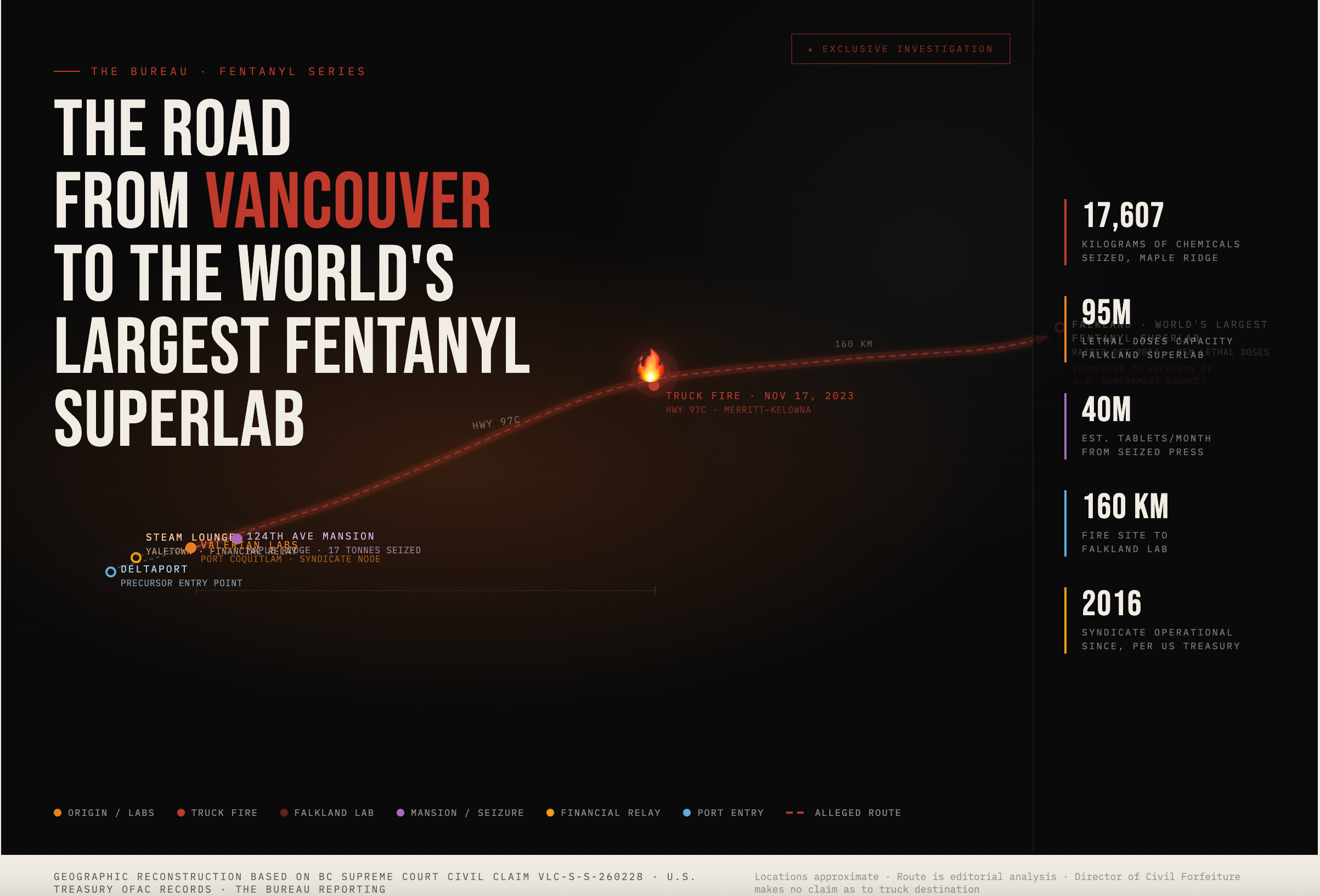
VANCOUVER — In November 2023, a 26-foot rental truck caught fire on Highway 97C in British Columbia’s remote Nicola Valley, roughly midway between Merritt and West Kelowna. The truck was carrying a large cargo of hazardous chemicals — ethanol, formamide, lead acetate, mercuric acetate — which ignited, sending towers of black smoke over a stretch of open grassland and folded blue hills, on a road that runs northeast to Falkland.
The driver was Peyman Sheirzad, an employee of Valerian Labs in Port Coquitlam. According to a civil forfeiture claim now before BC Supreme Court, he had rented the truck under the direction of Iranian-Canadian businessman Bahman Djebelibak — publicly known as Bobby Shah. The chemicals, investigators determined, had originated from the Valerian Labs offices.
The Director of Civil Forfeiture makes no claim about where the truck was going. But a map tells its own story. Highway 97C through the Nicola Valley is one of the primary routes connecting the Lower Mainland to the BC Interior. Falkland — where the RCMP dismantled what it called the largest and most sophisticated drug superlab in Canadian history eleven months later, in October 2024 — lies roughly 160 kilometres up that same corridor, northeast of where Sheirzad’s truck went up in flames.
Together with the inventory found in the December 2024 raid of Shah's Maple Ridge mansion, the truck fire appears to provide the first documentary evidence in any Canadian court record supporting what senior U.S. government sources told The Bureau over the past year: that Shah's network, the Canada-based node of a Chinese fentanyl syndicate, was connected to the supply chain feeding the Falkland superlab. Those same sources describe Falkland as the largest fentanyl lab ever discovered anywhere in the world — not only in Canada. The RCMP has not confirmed or denied that assessment.
The lawsuit filed by BC's Director of Civil Forfeiture also alleges something the Carney government has not acknowledged publicly: that a China-based criminal syndicate — active since at least 2016, supplying fentanyl precursors to Mexican cartels and finished fentanyl to American streets through the dark web and postal system — is the upstream criminal architecture above Bobby Shah's network. It is the first time that allegation has appeared in a Canadian court record. Ottawa has minimized or denied it. Shah has consistently maintained he is a legitimate chemical businessman. He has not yet filed a response to the Director's January 2026 claim.
In December 2024 — weeks after the Falkland bust, which is not referenced anywhere in the civil claim — RCMP executed a search warrant at Shah’s Maple Ridge mansion. Officers found what the civil claim describes as approximately 17,607 kilograms of solid chemicals and 44,207 litres of liquid chemicals — collectively, roughly the weight of two fully loaded transport trucks, and enough volume to fill a residential swimming pool nearly three times over.
Among the items seized was a 50-ton hydraulic press — the kind of industrial equipment used to compress synthetic narcotics like fentanyl and MDMA into the small, hard counterfeit pills sold on North American streets. Running conservatively, The Bureau estimates a press of this class can produce roughly 40 million tablets per month. At the fentanyl concentrations the DEA typically finds in counterfeit M30 pills — the small blue tablets the Sinaloa Cartel pioneered as the dominant street form of the drug across North America — that output could represent tens of millions of potentially lethal doses every thirty days.
The RCMP, in announcing the Falkland superlab raid, stated that facility had a total capacity of 95 million potentially lethal doses. At the conservative monthly output rate of the press found in Shah's Maple Ridge mansion, that benchmark could be reached in under three months of continuous operation — from a house in the suburbs of Vancouver.
Whether the mansion was a production site, a precursor supply hub, or both is a question the civil claim does not resolve — and one that Ottawa has not answered.
A direct comparison between the Maple Ridge mansion and the Falkland lab is not possible on the available evidence. The Maple Ridge figure is a rate calculation based on press class and chemical inventory — inputs for fentanyl, MDMA, methamphetamine, cocaine and heroin production stacked in the same building as the machine that would process them. What the civil claim establishes is that the industrial capacity to approach Canada's largest known superlab was sitting in a suburban home.
The Syndicate
On October 3, 2023, the U.S. Treasury’s Office of Foreign Assets Control designated Shah, Valerian Labs Inc., and Valerian Labs Distribution Corp. as part of a sweep targeting 28 individuals and entities connected to what Washington described as a China-based criminal organization — referred to in the civil claim as “the Syndicate.”
According to U.S. authorities, the Syndicate had, since at least 2016, manufactured and distributed large quantities of illicit drugs, opioid additives, and precursor chemicals used in the production of fentanyl and methamphetamine, while laundering the proceeds internationally. It supplied drug traffickers across the United States, dark web vendors, virtual currency money launderers, and Mexico-based criminal organizations. Its members operated companies through which synthetic narcotics and precursor chemicals were openly advertised online, alongside methods designed to evade detection: counterfeit postage labels, false invoices, falsified customs documentation, concealment packaging, and US-based re-shippers. Funds moved through cryptocurrency, bank wires, and third-party payment processors including AliPay.
Shah and Valerian Labs, U.S. investigators determined, were purchasing and importing opioid additives and precursor chemicals — including methylamine hydrochloride, used to produce methamphetamine and MDMA — directly from Syndicate members. Shah was identified as a major customer of Jinhu Minsheng Pharmaceutical Machinery, itself a designated Syndicate member. Valerian Labs Distribution Corp. had attempted to procure 2,000 litres of chloroform, 800 litres of dichloromethane, and 200 kilograms of iodine. The Canadian node was not a freelancer. It was integrated — a purchaser and importer within a supply chain running from Chinese chemical manufacturers to Mexican cartels to American streets.
When Global News reached Shah after the Treasury designation, he denied drug trade involvement but confirmed the purchases. His only mistake, he wrote in a text message, was that he “didn’t just procure” but kept the chemicals as commodities on his inventory, according to Global’s report.
According to the BC Director's filings, Shah's criminal record predates his chemical empire by years: credit card forgery, theft, unauthorized use of computer services, counterfeit currency, possession of property obtained by crime. By 2018, those frauds had given way to something with industrial ambitions. Valerian Labs — formerly Hollywood Vape Labs — had obtained Health Canada licensing as a precursor chemical supplier, occupied offices at 1971 Broadway Street in Port Coquitlam, and assembled a product catalogue of over 200 substances. To Canadian regulators, it was a licensed chemical vendor. To U.S. authorities, it was a Chinese fentanyl trafficking node, on Canadian soil.
In March 2018, RCMP raided both Valerian Labs and the Maple Ridge mansion, seizing a Land Rover, a Porsche, a hydraulic press covered in drug residue, gold and silver jewellery, blank cheques, bank cards in others’ names, and a five-gallon drum of sodium borohydride. In 2021, BC Provincial Court Judge David St. Pierre found the searches had violated Bobby Shah’s Charter rights. The Director’s case collapsed. Shah retained the property.
In January 2022, Ramina Shah — his wife, a realtor who documented the family’s lifestyle extensively on social media — was stabbed to death in a Coquitlam parkade. The Integrated Homicide Investigation Team has characterized the investigation as ongoing.
The Director’s earlier Charter loss is not referenced anywhere in the January 2026 claim. That timeline should interest the Carney government, already under pressure from Washington to address vulnerabilities in Canada’s counter-narcotics laws. The 2018 raid found a hydraulic press covered in drug residue, a controlled precursor chemical, and proceeds of crime in a mansion the couple could not afford on declared incomes under $30,000. The case was thrown out on a search warrant technicality. It took eight years, a U.S. Treasury designation, and a second civil forfeiture action to get the RCMP back to the same front door.
The Treasury designation came in October 2023.
What Ottawa has not shared with Canadians, U.S. sources say, is that the DEA’s Newark office had already delivered the case to Canadian authorities through the U.S. Embassy in Ottawa in late 2022 — nearly two years before the Treasury designation — warning specifically of precursor shipments tied to Valerian Labs. Canadian police, those officials say, not only declined to cooperate but delayed launching their own probe until after Washington imposed sanctions.