


TORONTO — In the first days of June, Ontario’s highest court quietly affirmed the release of Deepak Paradkar, a Toronto-area criminal lawyer accused by United States prosecutors of serving as a senior operative inside Ryan Wedding’s billion-dollar drug organization — the man who, the indictment alleges, introduced the former Canadian Olympian to the “trusted couriers” who carried cartel cocaine and methamphetamine into Canada through the arteries of the commercial trucking industry.
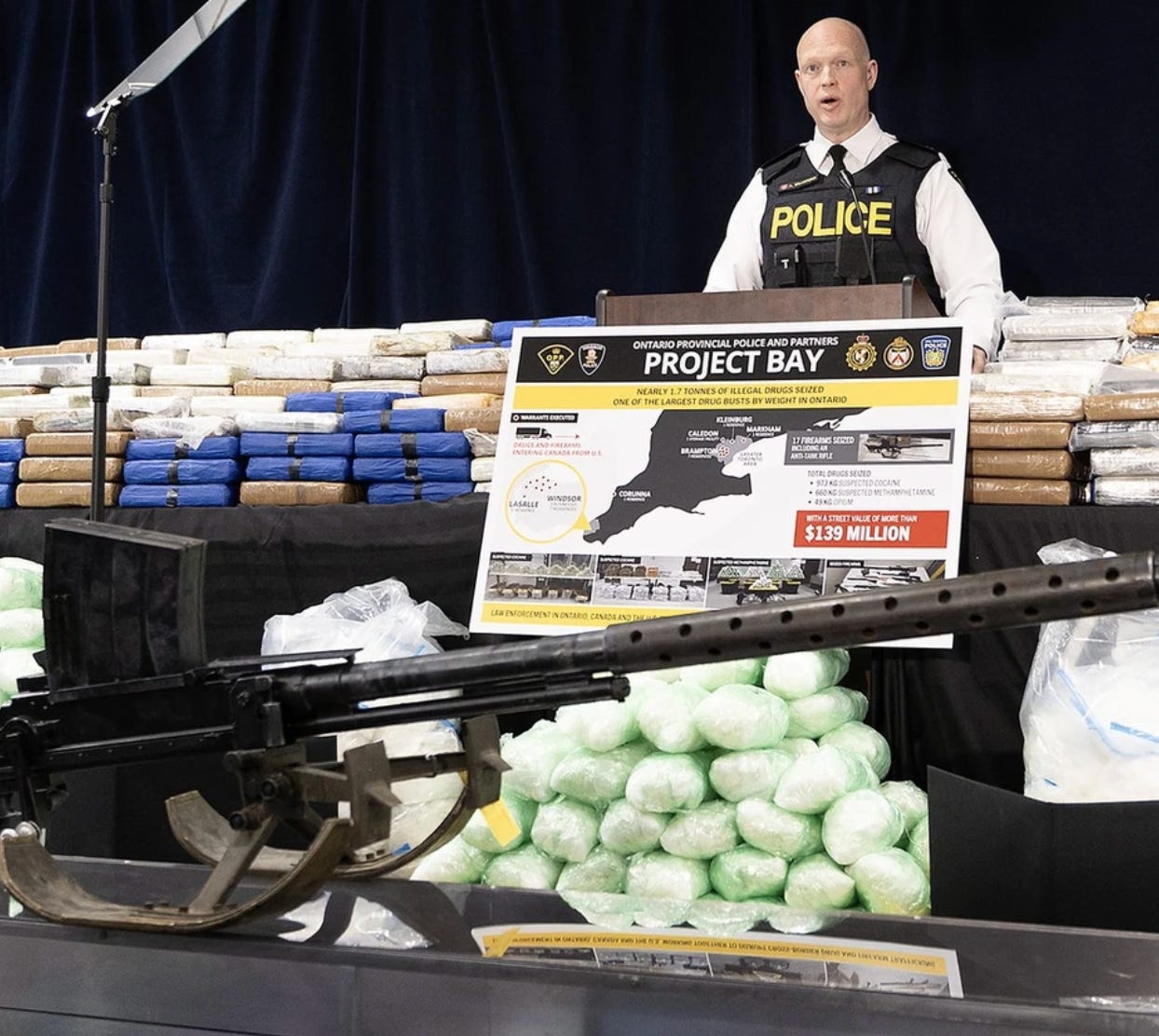
Seven weeks later, in Windsor, bordering Detroit, at the far end of Highway 401, police announced one of the largest drug seizures by weight in Ontario’s history — and described, at the center of it, the same corrupted long-haul trucking system.
The investigation, the Ontario Provincial Police and Canada Border Services Agency said, “revealed the use of a broker-style model within the commercial transportation sector,” one that “leveraged established connections to facilitate the cross-border movement of illegal drugs, including the arrangement of drivers to knowingly transport illicit commodities within legitimate supply chains.”
That sentence, in itself, is at once shocking, affirming and troubling, considering The Bureau’s exclusive reporting last year, sourced to a senior U.S. investigator, that the Royal Canadian Mounted Police stonewalled American requests in 2019 to target that same trucking industry, in cartel haulage cases involving Ryan Wedding and the Sinaloa and Jalisco New Generation cartels.
In that story — “RCMP Rejected U.S. Bid to Target Cartel–Indo-Canadian Trucking Routes as Cocaine and Meth Surged North” — the senior U.S. investigator said: “This is the biggest threat facing Canada, because it’s just open borders.”
“We’ve been talking to RCMP for years about this, but nobody really wants to take it head on as a North American project,” the source said in the September 2025 story. “Six years ago, we went to the RCMP and said, ‘Hey, we really need to work this together.’ They said, ‘No, there’s no appetite.’”
The new Ontario Provincial Police case and the prior cases allegedly involving Ryan Wedding and Deepak Paradkar are not, on the public record, connected. None of the nineteen accused named by police in the new investigation, called Project Bay, appears in the American indictments against Wedding’s network — nor in the earlier Ontario files that track the same criminal patterns: Project Brisa, announced in 2023 as the largest drug bust in Toronto police history, Project Pelican in Peel Region, and others.
Most of the names on the new charging list, though, come from the same Punjabi diaspora in which Wedding’s network allegedly found its haulers.
What connects the cases is pattern and architecture — the alleged penetration of legitimate transportation by mafia brokers — and the highways and bridges it runs on. The same Ontario border crossings, and several of the same Ontario towns, where Wedding’s organization dominated the importation of cartel cocaine and methamphetamine into Canada, according to U.S. prosecutors and The Bureau’s senior U.S. sources.
The Paradkar bail decision drew a cycle of daily coverage from the Canadian press when it was rendered in December, and again when the appeal court ruled. What that coverage largely passed over is the ruling itself — the most detailed judicial narrative yet placed on the Canadian public record of how the Wedding organization is alleged to have worked.
Paradkar, 62, a criminal lawyer of nearly thirty years’ standing, was charged in California on October 28, 2025, and arrested three weeks later in what the court record calls “the urgent circumstances of a nation-wide takedown.” The indictment, as summarized by Justice van Rensburg of the Court of Appeal for Ontario, describes the Wedding organization as “a billion-dollar enterprise and the largest supplier of cocaine to Canada,” moving product from Colombia to Mexico, across the border into the United States, “where it was stored before being conveyed by Canadian drug transportation networks to final destinations, mostly in Canada.”
Within that enterprise, prosecutors allege, the lawyer performed functions no ordinary member could: introducing Wedding to trusted couriers for the transport of drugs; investigating the seizure of shipments bound for Canada or the United States; paying defense lawyers in both countries to find out whether arrested members of the organization were cooperating with police; speaking with arrested individuals himself to make the same assessment; and obtaining prosecution disclosure the organization could not otherwise access, so it could monitor cooperation and gauge the risk to shipments still moving. He was compensated, the indictment alleges, “with cash drops and expensive watches.”
The most serious allegation is that Paradkar advised Wedding and another member of the organization to murder a confidential source who was assisting American authorities — counsel, prosecutors allege, offered so that Wedding would avoid extradition from Mexico. The source was shot dead in Medellín, Colombia, on January 31, 2025. The Bureau has identified the victim as a Quebec-based convicted fentanyl trafficker, turned FBI informant, Jonathan Acebedo-García.
A cooperating witness — identified in The Bureau’s prior reporting and other media accounts as Wedding’s second-in-command, Andrew Clark, and described in the ruling only as a man who trafficked drugs with Wedding and assisted him in committing multiple murders — is expected to testify that Paradkar said the indictment “would most certainly be dismissed” if the source were killed.
The government asked the appeal court to admit fresh evidence, to address what the original judge called “peculiarities” in the cooperating witness’s claim that Acebedo-García had admitted to one of Wedding’s subordinates that he was cooperating with the FBI.
The appeal court agreed to allow fresh evidence, which Paradkar had opposed — and what the new American materials add is striking. According to the Revised Record of the Case, Wedding directed an alleged hitman, Atna Ohna, to delete everything from the phone used to confirm the informant’s cooperation except the message string with the dead man — and to hand the device to Paradkar, who believed the texts could be used as evidence in Wedding’s defense. After the killing, the cooperating witness is expected to testify, Paradkar “reaffirmed his belief, in conversations with Wedding and the CW, that the FBI’s case was no longer viable.”
And there is the encrypted chat that the bail judge, Justice Peter Bawden of the Superior Court of Justice, called the strongest evidence in the case: messages among Wedding, his second-in-command Andrew Clark, and Paradkar concerning two couriers arrested in Arkansas while transporting drugs for the organization. “The chat also indicates,” the appeal court wrote, “that Mr. Paradkar knew the DTO was considering killing the couriers.”
Justice Bawden released Paradkar anyway, finding the lawyer had “narrowly met his onus”: a 62-year-old diabetic with a serious cardiac history and no criminal record, presumed innocent, facing a case that was strong but “certainly defendable,” whose safety in jail could not be assured — and whose former associates, the judge concluded, “were more likely to kill Mr. Paradkar than assist him.”
He went home to house arrest under the supervision of his wife, five million dollars pledged against the family’s properties, a GPS monitor, a prohibition on electronic devices, and a home security system with twenty cameras. The appeal court found no legal error in any of it, and the release stands. Canada will now seek his committal for extradition on a single narrowed count: conspiracy to commit murder. Wedding was taken into United States custody in January; his trial is set for December in Los Angeles.
That is the court file.
The supply chain it describes, by every indicator The Bureau has documented for years — durable leadership, deep leverage inside Canadian infrastructure, operatives who have walked away from serious charges before — a cartel pipeline Wedding directed into Canada for immensely powerful criminal systems embedded into the Mexican state, remains embedded in Canada’s borders and transportation systems. On July 23, its signature method — brokers and trucks — surfaced again.