


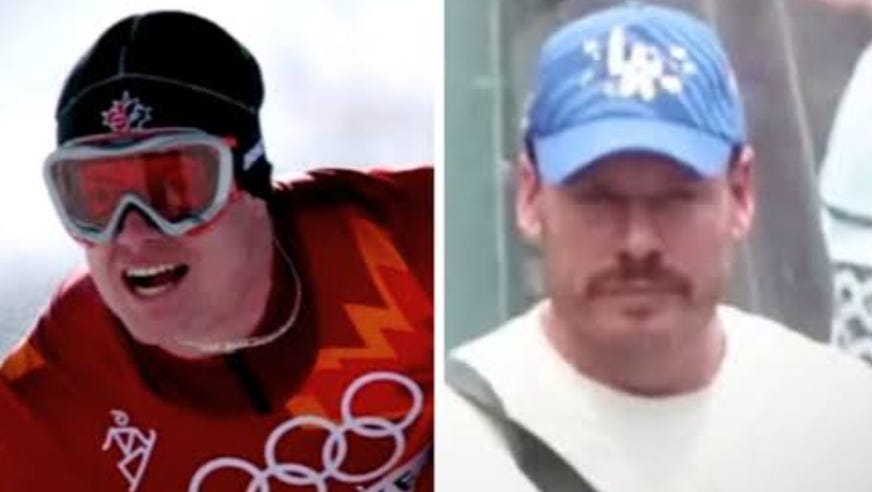
VANCOUVER — In June 2008, the FBI agents watching Ryan Wedding in Los Angeles came close to letting him fly home.
Six years after racing in Salt Lake City, the former Olympic snowboarder from British Columbia had come south with a Vancouver associate to buy 24 kilograms of cocaine. Nothing went to plan. His drug money, packed into a box at his Coquitlam condo and moved through a Persian currency exchange in Vancouver, arrived in California short. For three days his crew drifted between hookah lounges in Westwood and a train station beside Angel Stadium in Anaheim, in meetings that swung from idle to tense.
The FBI had not been looking for him. Its agents had come to the case through a money laundering investigation in Vancouver, one that led them into the underground banking and trucking networks, built by Iranian and South Asian diaspora groups, that carried the city’s drug economy along the rails of its legal one. Wedding was a chance discovery, a relatively minor player riding those rails.
His broker, a Russian-speaking Canadian named Michael Krapchan, kept telling different stories to different people. So the agents, speaking through a paid informant who posed as a cocaine supplier, told the Canadians to give up and go home.
“We just said fly home, this is crazy,” retired FBI special agent Brett Kalina, who led the case, told The Bureau. “You guys aren’t prepared to do this. This is not the proper way you do business.”
Wedding refused to quit. Kalina came to see that as the first sign of a stubborn arrogance, a belief that he could outsmart everyone around him, which showed in Wedding’s words and actions “from the first second.” Within days Wedding was in federal custody in San Diego. Seventeen months later, facing recordings of his own voice and two co-conspirators ready to testify, he insisted on a trial.
“No sane person that wasn’t as arrogant as Ryan Wedding would have gone to trial, knowing full well we had recordings of him discussing [the deal],” Kalina said.
In November 2009, a jury convicted him of conspiracy to distribute cocaine. He served nearly four years in American prisons. Years later, American prosecutors would accuse him of running one of the largest cocaine trafficking organizations supplying Canada, and American officials would set his name beside Pablo Escobar’s and Joaquín “El Chapo” Guzmán’s. Wedding, arrested in Mexico City in January 2026, has pleaded not guilty to the new charges against him in Los Angeles.
What emerged from The Bureau’s interview with Kalina is revealing, though it will not surprise readers of my book Wilful Blindness. From the start, the American focus was on international money laundering, and on Vancouver’s place in a multipurpose criminal economy where anything from weapons to foreign interference services to drugs could move clandestinely through seemingly legitimate business fronts.
Kalina’s San Diego squad worked international organized crime, and its agents had traveled to Vancouver several times looking at other targets. The investigation, he said, “started out as a money laundering investigation.” Krapchan was looking for someone in San Diego to launder large amounts of money.
“There’s very few ways that you would want to launder the kind of money that they were talking about without having some drugs involved,” Kalina said, “unless you’re talking about massive espionage and weaponry at a level that these guys were not at.”
Money, he added, is “so much easier for us to work with than narcotics,” in large part for safety reasons.
The FBI’s source was no kingpin. He had a language skill and connections to people in the Vancouver area, Kalina said, and he presented himself as a courier, never as a man with a warehouse of cocaine by the Mexican border. “That’s not us,” Kalina said of the FBI team’s pitch to the Vancouver narcos, through a source they deployed. “But we can be a conduit.”
About a week before the Canadians flew south, Krapchan told the source he was bringing his people down, and that this time they wanted kilos. The agents assumed he meant subjects they were already watching. They did not know who was coming until the travelers stepped off the plane in Los Angeles and agents caught a look at a luggage tag bearing Wedding’s name. Flight records showed who had booked together and sat together, and from there, Kalina said, “it was pretty easy to identify the two.”
The second man was Hassan Shirani, a Persian-Canadian from Vancouver who would later plead guilty and testify against Wedding.
In his testimony, Shirani described how the deal had come together. Wedding had already lost about $300,000 Canadian on an earlier attempt to buy cocaine in Los Angeles, Shirani said, when the man who was supposed to make the purchase ran off with the money. Wedding wanted another supplier. Shirani offered something rarer, a way to move product north. Through a Vancouver martial arts gym he met Krapchan and another man, Elmar Akhundov, who said they had a San Diego supplier but had never done business with him “because they never had transportation.”
