

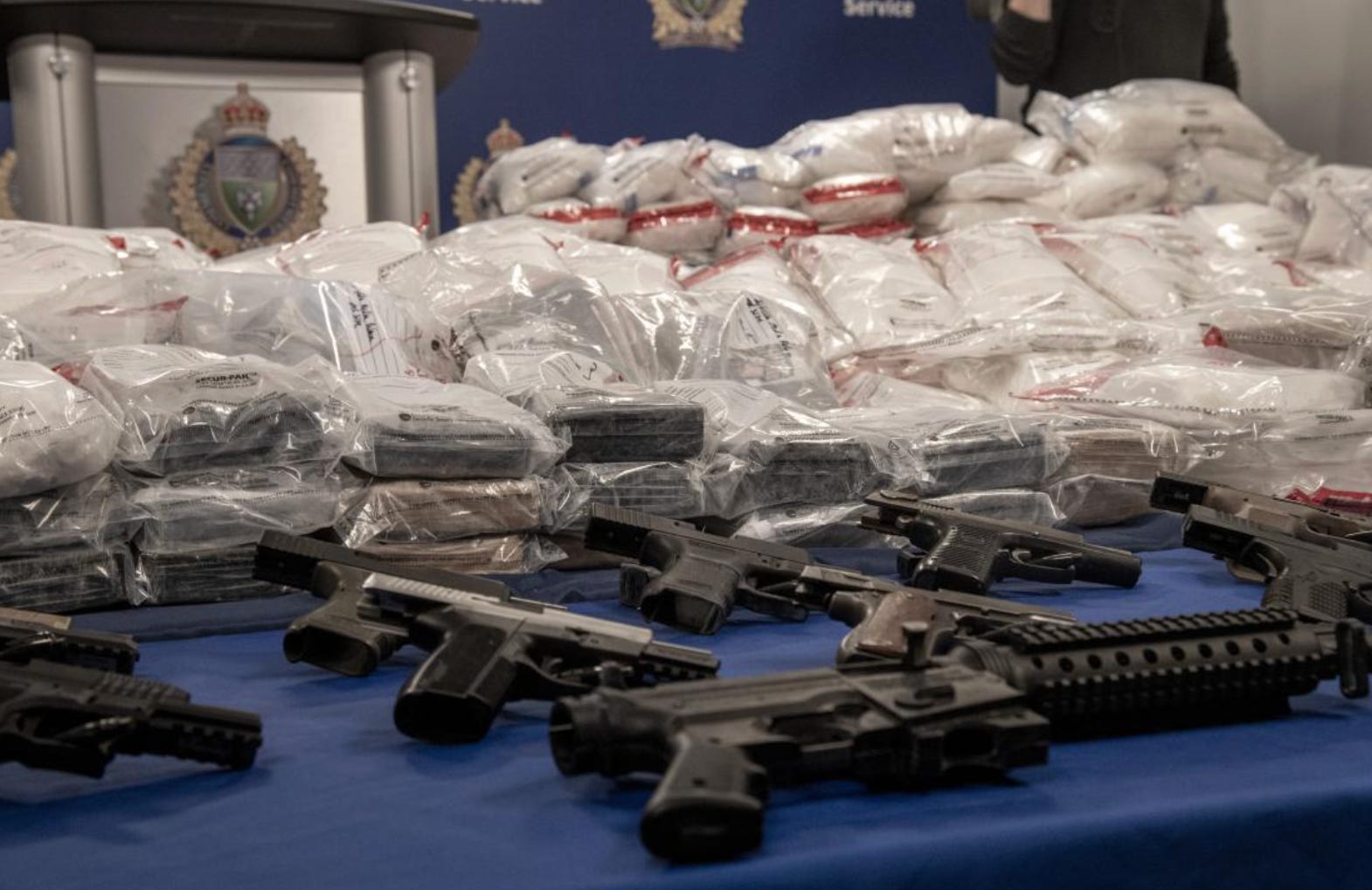
OTTAWA — When Winnipeg police laid out the largest drug seizure in Manitoba history last week — more than 525 kilograms of cocaine, methamphetamine and fentanyl, 14 firearms, and $825,000 in cash — the bricks of narcotics and the row of guns drew the cameras. A quieter item in the evidence locker did not: 1.35 million contraband cigarettes.
To a former senior Ontario Provincial Police (OPP) organized crime investigator who has spent decades tracing the illicit tobacco trade, that detail was perhaps the most revealing thing in the multi-agency probe. Illegal cigarettes, he told The Bureau, are the connective tissue of the networks that flood hard drugs from China and Mexico into Canadian communities. If tobacco produced on Indigenous lands fueling fentanyl production does not register with citizens, he says, the one billion in tax dollars lost every year in Ontario alone should at least raise eyebrows.
And the trade is significantly influenced, in his assessment, not only by Hells Angels traffickers identified in the two-year Project Puma probe, but by an entity operating from a Six Nations base whose wealth and reach may supersede any comparable figures living in Canada or the United States.
“Probably the most successful organized crime figurehead, maybe in North America,” Rick Barnum said. “Billions and billions of dollars, never being at risk really of arrest,” with luxury properties “all over the world,” sports cars, planes and yachts.
Barnum, former Deputy Commissioner of the OPP Organized Crime command, now works for an industry group that tracks the increasing proliferation of contraband tobacco manufactured on Indigenous lands in Canada, mostly the Mohawk lands in Ontario between Hamilton and Buffalo.
According to Barnum and industry groups, whose findings are backed by police investigations, multiple Ernst & Young reports and a report last year from former U.S. national security official David Luna, illegal tobacco has become a massive, low-risk profit center for transnational mafias tied to Canada’s growing fentanyl production trade — a protected-jurisdiction revenue stream funding organized crime networks with connections to Mexico and China across Canada.
Asked directly how the Indigenous tobacco entities tied to Project Puma compared with Ryan Wedding — the former Canadian Olympic snowboarder turned cartel proxy whose legacy network The Bureau assesses to be at the center of Project Puma — Rick Barnum did not hesitate.
The Indigenous players could “buy” numerous Hells Angels clubs across North America and “could buy a Ryan Wedding too,” Barnum said. The wealth being generated from Mohawk lands, to the benefit of a relative few, he said, “makes Wedding look like a lower-level figure.”
There is a blueprint showing how Canada is exploited.