


OTTAWA — For The Bureau’s 2025 Holiday Special, I sat down once again with Jason James for a long-form, two-hour conversation—our second holiday edition—to answer his questions about the elite networks surrounding Prime Minister Mark Carney and the China connections that have quietly defined his ascent.
Perhaps presciently, during the federal election campaign The Bureau published a network-mapping model outlining the key figures orbiting Carney, including Dominic Barton, Jin Liqun, Mark Wiseman, and Evan Solomon. Months later, that exercise looks well founded. Wiseman has now been appointed Carney’s ambassador to the United States—a critical position as Canada tries to steer a course between the world’s two rival superpowers. And Solomon, the former CBC host once caught up in an art-dealing scandal involving Carney, is now Minister of Artificial Intelligence—another portfolio that sits squarely between U.S. and Chinese competition over advanced technology, critical minerals, and energy security.
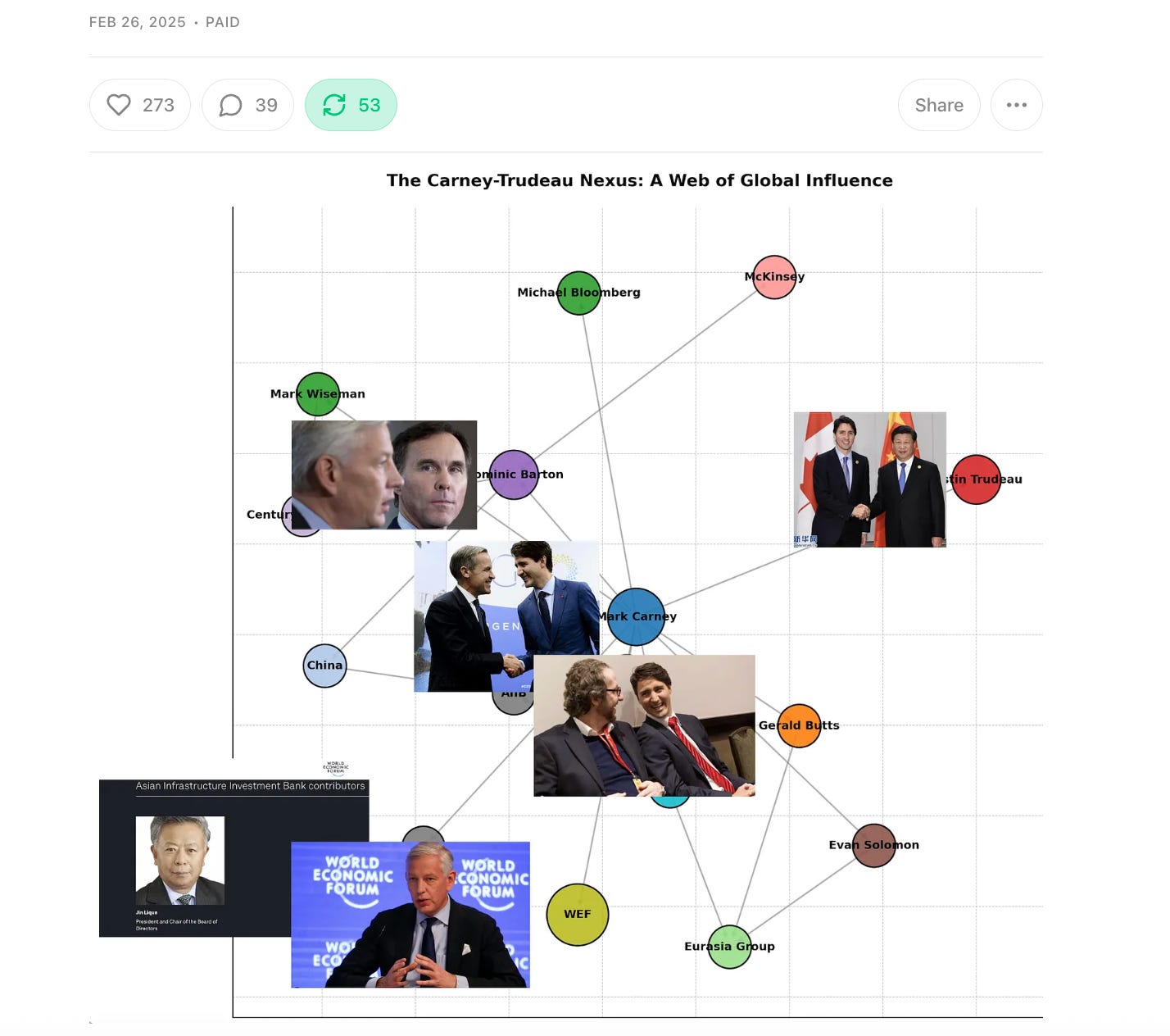
In the episode, I tell Jason that the pattern isn’t coincidental. It reflects the same constellation of influence The Bureau mapped before Carney ever took office: long-standing relationships of trust shaped through finance, global governance, and shared ambition—often paired with a marked propensity to favour deeper trade and engagement with Beijing, an authoritarian regime built on the subjugation of hundreds of millions of Chinese nationals. That context is central to how I assess Carney’s rise, including analysis I have previously provided in testimony at a Parliamentary ethics hearing.
A review of corporate records showed that Brookfield—the influential Canadian investment fund from which Carney stepped away to replace Justin Trudeau as Canada’s leader—maintains many billions in politically sensitive investments with Chinese state-linked real estate and energy companies, alongside a substantial offshore banking presence. One major venture included a $750 million entry into high-end Shanghai commercial property in 2013 with a Hong Kong tycoon affiliated with the Chinese People’s Political Consultative Conference—an entity U.S. intelligence and national-security analysts have described as central to Beijing’s united front ecosystem.
As that market later deteriorated—vacancies rising in Shanghai and credit conditions tightening—Brookfield secured hundreds of millions of dollars in loans from the Bank of China to refinance its Shanghai commercial holdings. The Bureau’s reporting has also noted the broader continuity: a decade earlier, Carney, as Governor of the Bank of England, publicly advanced policies designed to expand China’s financial footprint, including support for renminbi clearing in London. In a 2013 speech, UK at the Heart of Renewed Globalisation, Carney said: “The Bank of England [has] signed an agreement with the People’s Bank of China … Helping the internationalisation of the Renminbi is a global good.”
In this episode, Jason adds a finding about Mark Carney’s promotion of Beijing’s Belt and Road plan—another massive boost, I argue, to President Xi Jinping’s global ambitions.


