The Canadian Who Spent Over 1,000 Days in Chinese Prison Warns Ottawa Is Walking Into Beijing’s Trade Trap
OTTAWA — Michael Kovrig, the former Canadian diplomat who knows what Beijing’s leverage looks like from the inside, has warned Parliament that Mark Carney’s Beijing trade pivot is leading Canada toward a trap it may not be able to escape.
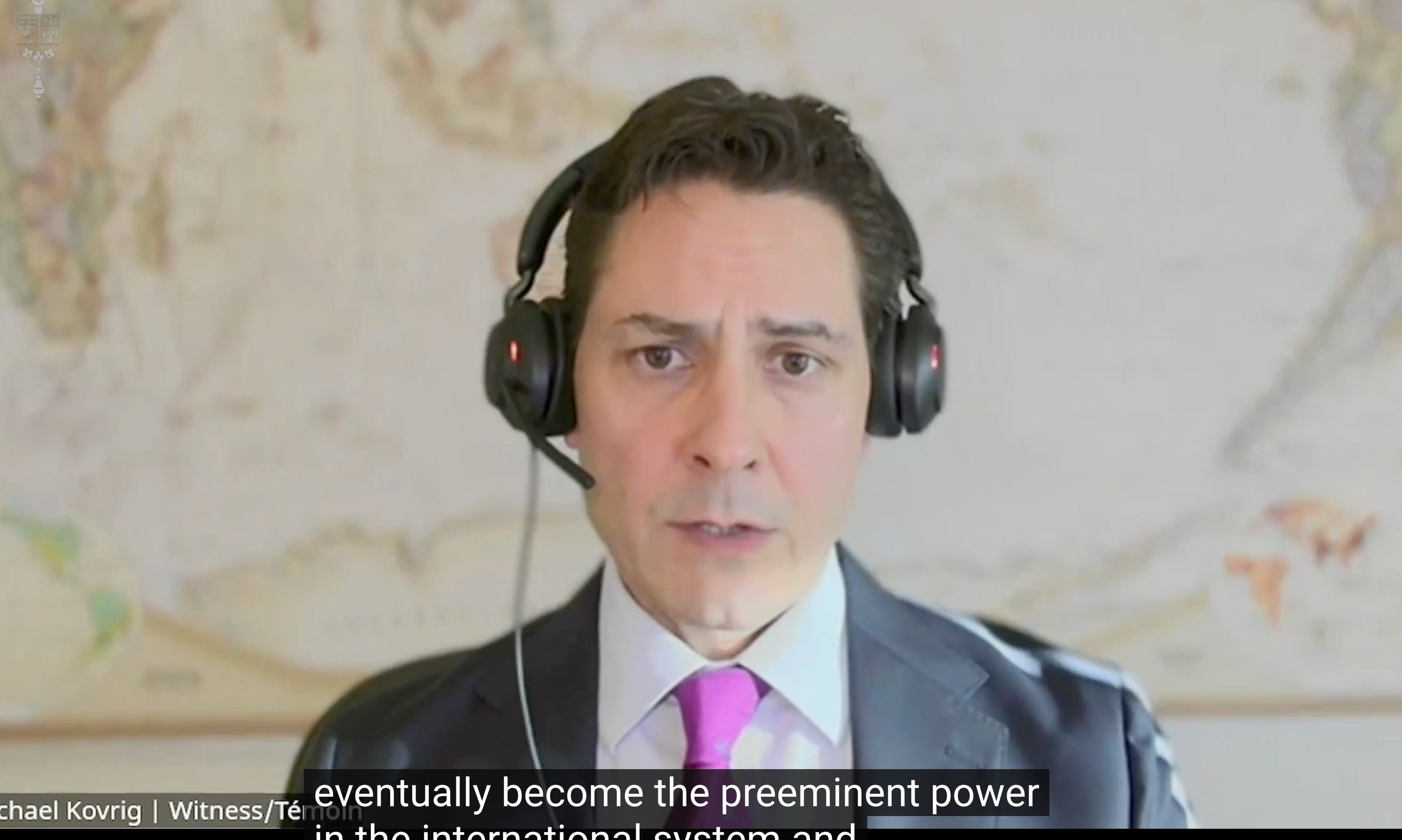
Detained in December 2018 in retaliation for Canada’s arrest of Huawei executive Meng Wanzhou, he spent 1,028 days in a Chinese prison before his release in 2021. On Monday, testifying before the House of Commons Standing Committee on Industry and Technology, he told Parliament what that experience taught him about power — and why “importing Chinese EVs means importing predatory monopolistic behaviour our companies can’t survive.”
Kovrig based that prediction on China’s use of “labour conditions our workers won’t tolerate and infringements of sovereignty our nation shouldn’t accept.”
Monday’s testimony was the third time in ten weeks that Kovrig, now executive director of the Global Network for Strategic Effects, had appeared before a parliamentary committee to deliver versions of the same warning. Together, the three testimonies — before the International Trade, Science and Research, and Industry and Technology committees — form a sustained analytical indictment of Carney’s China engagement strategy, delivered with the authority of someone who has studied the CCP from both a diplomatic career and a detention cell.
His February appearance before the International Trade committee set the strategic framework. Carney’s January trip to Beijing, he acknowledged, was defensible as a restoration of diplomatic dialogue. But what troubled him was Carney’s revival of “strategic partnership” language favoured by Beijing, and agreements to reduce trade barriers and explore further trade and investment. Normalizing relations without accountability, Kovrig told the committee, risks confirming to the CCP that democracies will yield to pressure. “Ephemeral stability purchased through accommodation today,” he said, “invites more coercion tomorrow.”
His April testimony before the Science and Research committee illuminated narrowing optionality for Canada’s economic foundations.
Behind every China-built electric vehicle, he argued, is a state-directed financing model that has poured more than 300 billion Canadian dollars into subsidies, tax breaks, cheap land, and suppressed wages.
The pattern that model produces, he said, follows three stages: flood, consolidate, weaponize.
In stage one, Chinese firms saturate foreign markets and undercut rivals on price. In stage two, competitors exit and Chinese companies consolidate. In stage three, the Party-state converts control of supply chains, exports, and pricing power into geopolitical leverage. Canada, he warned, was at the threshold of stage one. He cited Mexico as a cautionary precedent.
“Batteries and EVs are the thin end of the wedge,” Kovrig testified. “The 49,000 vehicles allowed in are less than three percent of the Canadian light-vehicle market — but 40 percent of 2025 battery EV sales.”
“In Mexico, Chinese BEVs went from a quarter of the BEV market to nearly 90 percent in two years,” he continued. “Mexico ran the experiment, then reversed in January with a 50 percent tariff. Canada should not repeat that mistake.”
Monday’s testimony before the Industry and Technology committee added the sovereignty dimension. Kovrig offered a live illustration after China’s ambassador had pressed Canada last week to weaken its longstanding policy on Taiwan, just as the first Chinese EVs were crossing Canada’s borders.
“The PRC weaponizes technology, supply chains and market access to coerce acquiescence to its geopolitical agenda,” Kovrig said. “China’s Ambassador just demonstrated that when he pressed Canada to weaken longstanding policy on Taiwan.”
This is a matter that impacted Kovrig’s own case, as The Bureau has reported.
A high-level Canadian Security Intelligence Service assessment in June 2019 concluded that Beijing, jolted by Canada’s detention of Huawei executive Meng Wanzhou, launched a “calibrated and multi-faceted pressure campaign” that blended trade coercion — including curtailing canola imports — with the detention of Canadians and clandestine interference surrounding the 2019 federal election, aiming to exert “personalized political pressure on Canada’s leadership,” with the Ministry of State Security driving the response and CSIS collection further establishing that President Xi Jinping received reports “directly from the MSS.”
The assessment — marked “SECRET” and titled PRC Strategy and Tactics to Influence the Meng Wanzhou Proceedings — warned that Beijing was “actively leveraging its leading intelligence service, the Ministry of State Security, to both apply pressure and encourage dialogue with Canada on Beijing’s terms.”
It further assessed that MSS units were tasked from “high levels” to “actively respond,” spurring competition inside the service to make the “largest possible impact,” while PRC missions in Canada moved to shape the political environment ahead of the 2019 vote.
As The Bureau reported in January, that CSIS report said the PRC “very likely imposed restrictions on imported goods from Canada as a means to coerce the Government of Canada to concede to China’s demands with respect to Ms. Meng’s extradition,” adding that “economic pressure is aimed at the business community, particularly those individuals with personal access to senior government officials.”
In concrete terms, CSIS assessed that the PRC curtailed canola imports “as a means to coerce Ottawa to concede to China’s demands with respect to the Meng extradition.”
The Bureau further reported that in mid-January, Prime Minister Mark Carney, on a trade mission to Beijing, reached an initial agreement that would allow China to export up to 49,000 electric vehicles into the Canadian market at a sharply reduced tariff, while China would lower tariffs on Canadian canola seed by March 1 to a combined rate of about 15 percent.
On Monday, Kovrig argued Canada should treat the EV quota as a temporary ceiling, not an import target; screen Chinese electric vehicles for ownership, subsidies, forced labour, supply-chain traceability and connected-vehicle security; reward only verified Canadian industrial capability; allocate imports in controlled quarterly tranches; align with Washington on security rules; and build in an automatic snapback if Beijing renews coercive pressure.
The backdrop against which all of this is unfolding is Canada’s failure to advance a renegotiated trade agreement with the United States.
The July 1 deadline to decide on renewal of the Canada-United States-Mexico Agreement is fast approaching amid stalled negotiations and Trump’s pre-emptive dismissal of the deal’s value to the United States. US Trade Representative Jamieson Greer told Fox Business in mid-March that Canada was behind Mexico on trade discussions, and later accused Ottawa of “doubling down on globalization” by diversifying its trading relationships — precisely the China pivot Carney has championed — calling it at odds with Washington’s trade priorities. Carney himself acknowledged in late April that talks could take longer than anticipated.
The contrast with other American allies and partners is glaring.
Japan concluded a strategic trade and investment agreement with Washington in July 2025, reducing its tariff rate to 15 percent after facing a 24 percent “Liberation Day” tariff rate, with a second tranche of Japanese investments worth tens of billions of dollars announced in March 2026.
The United States and India reached an interim trade framework in February 2026, reaffirming a broader bilateral trade negotiation launched by Trump and Prime Minister Narendra Modi in February 2025.
The European Union and United States also just signed a memorandum of understanding on critical mineral supply chains, a factor that directly implicates Beijing’s efforts to dominate raw materials essential to advanced technology and defense manufacturing.
Canada, by contrast, has yet to move formal negotiations forward and has received no relief from the Section 232 tariffs that continue to hammer its steel, aluminum, auto, and lumber sectors.


I think we all know who controls the Canadian government the problem is the liberal voter that continues to support them.
The last guy at the table is the one who usually gets the short end of the stick. Canada and the U.S. talks are going exactly the way Carney wants them to go as he most likely uses being spurned by Trump into even more of a reason to align with China. The guy is so transparent he could be glass.