

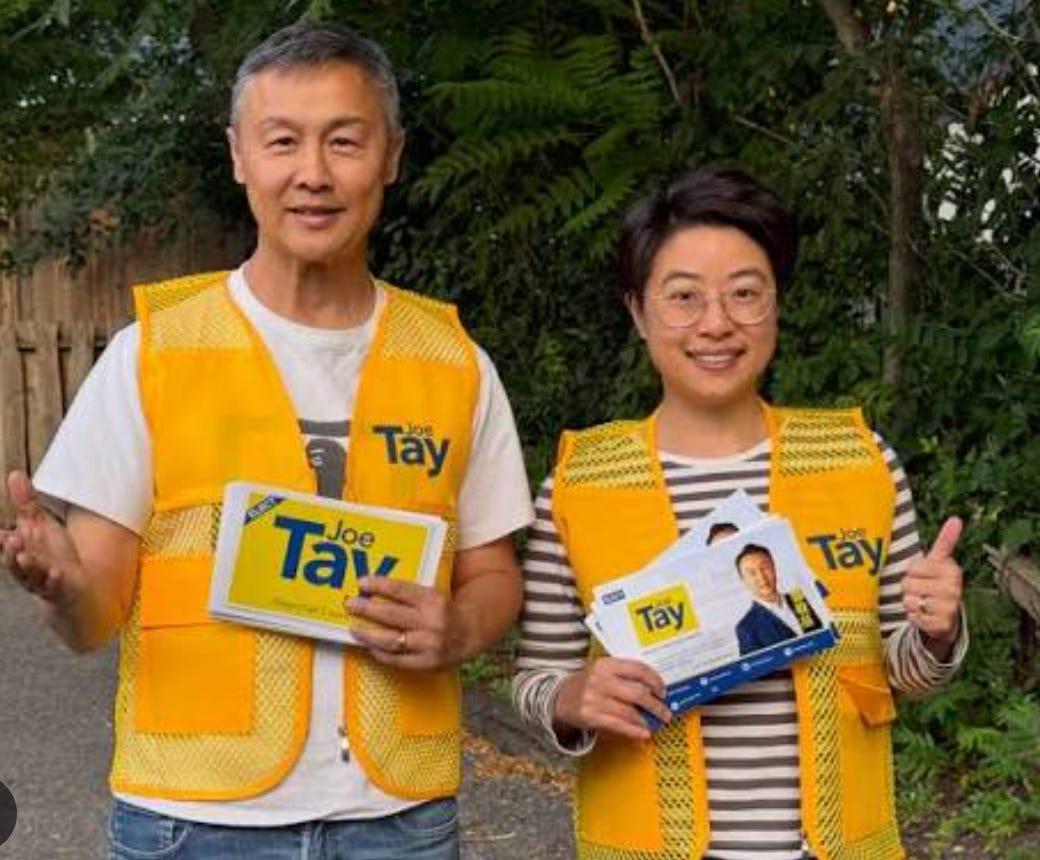
OTTAWA — The Bureau has never endorsed a political candidate. We do so now because Markham’s regional council race poses a question few Canadian voters have been equipped by their institutions to answer, and one we have spent years investigating. What does a democracy owe an earnest citizen whom a foreign state has decided to silence, repress and potentially harm with violence?
Joseph Tay is that citizen.
In December 2024, Hong Kong’s national security police placed a bounty of HK$1 million, about $180,000 Canadian, on the former Hong Kong entertainer, a Canadian citizen who runs a pro-democracy channel from the Toronto area. When he became the Conservative candidate for Don Valley North on March 23, 2025, Canada’s own election-security task force found that posts attacking him appeared en masse on Chinese-language platforms within a day, and tied the campaign to the People’s Republic of China, which it said was working to suppress his visibility to Canadian voters.
On March 24, two Mounties walked into Tay’s backyard unannounced, he disclosed in a recent interview with The Bureau, to warn him that a credible source said someone intended to harm him. On April 21, the task force publicly identified him as the target of a coordinated transnational repression operation. That same day, on the advice of federal police, he stopped campaigning in person.
The pressure followed him past election day. In May 2025, Hong Kong police questioned his cousin and his cousin’s wife in the case against him. His mother-in-law fled Hong Kong and now seeks asylum in Canada.
The federal police file opened during that campaign remains, by Tay’s account, unresolved. “There is never an update since last federal election till now,” he told us. Canada’s response, he said, was “far from adequate.”
Our prior reporting puts the government’s silence in a darker context.
In June 2024, The Bureau reported on a case study in that year’s review by the National Security and Intelligence Committee of Parliamentarians, 12 paragraphs censored in full, concerning a People’s Republic of China proxy that the security and intelligence community considered “the most egregious case of foreign interference.”
Redaction notes indicated that the proxy threatened Canada in every way defined by the law, including through threats of bodily harm, and that Canadian Security Intelligence Service had shared with the RCMP what it called a “high-risk, high-harm threat to some Canadians and permanent residents.” The Bureau does not know the proxy’s identity, and cannot say whether it has any connection to the threat against Tay. It is a fair question, and Ottawa has not answered it.
The pattern of violent threats has precedent.
In New York, United States prosecutors allege that a Ministry of State Security officer, Qiming Lin, directed proxies including an American private investigator to destroy the 2022 congressional candidacy of Yan Xiong, a former Tiananmen Square student leader, first through smears and entrapment and then, if needed, by force. “Beat him, beat him until he cannot run for election,” Lin allegedly said in a recorded voice message.
No one running for office in Canada should face what Tay faced, and Canada’s response was and continues to be deeply inadequate.
Ottawa warned him of threats and then left him largely to absorb them. By any reasonable accounting, China’s interference arms accomplished what they intended to do in Canada’s 2025 federal election: reduce the visibility of Tay’s campaign to the electors of Don Valley North, a riding in Greater Toronto with a high proportion of ethnic Chinese voters.
When a sitting Liberal member of Parliament, Paul Chiang, suggested to Chinese-language journalists in his constituency office that Tay be delivered to China’s Toronto consulate to collect the bounty, the prime minister first called it a teachable moment and kept him on the ballot.
Chiang later apologized and withdrew. He is now running against Tay in the same Markham council race, and he did not respond to our questions about the remarks, the bounty or China’s transnational repression of people in Canada.
China has worked inside Canada’s democracy for decades, largely without consequence. No news organization has investigated Tay’s case as deeply as The Bureau, and none has spent as long documenting the methods behind it: the pressure on diaspora communities, the capture of Chinese-language media, the targeting of dissidents and their families abroad.
The political field Tay has chosen to walk back onto is not level.
He was not invited to last week’s candidates’ meeting with Chinese-language media, held at the Markham studio of a Mandarin-language broadcaster, while his opponent attended.
The Chinese-language broadcaster where he once worked has not invited him on air once since he entered politics. He says some rivals’ mailings run three or four times the volume of his own, and that fear keeps some supporters from donating openly or appearing beside him in a photograph. We make no claim about who funds any campaign in this race. Candidates’ financial statements are not due until next year.
Voters should understand that a candidate whom a foreign state has marked carries costs others do not.
That imbalance should never be ignored, let alone accepted or minimized.
Our reporting raises concerns that Prime Minister Mark Carney’s government has continually minimized Chinese interference, and perhaps even accepted it. Testifying before a House of Commons committee in December 2025, Tay said the prime minister’s defense of Paul Chiang frightened him most of all. “When Mark Carney was protecting the candidate, that really scared me,” he said.
The challenges Tay seeks to overcome should jolt the conscience of every Canadian.
We are endorsing him just as much for how he has met them, and we assert his qualities represent the best of this nation’s strong traditions: resilience, courage, selflessness, integrity and a commitment to democratic principles.
After his defeat he withdrew from public life to heal alongside his wife, Angie. He came back. “We want to take back the control instead of being fearful,” he said.
In more than an hour of conversation with The Bureau, Tay showed a willingness to outwork the people he is running against. He has campaigned every day for two months and promises to treat the regional council seat “as if you have a full-time job.”
He pledged to answer residents within 24 hours, with a timeline for follow-up. His platform is specific: more police officers for a region he says runs well below the provincial average, faster youth mental-health care in a region where he says young people can wait 900 days for counseling, smart traffic signals and better coordination between GO trains and buses.
Canadian voters have good reason to treat campaign promises with skepticism, and to ask not only whether a candidate is personally believable but whose interests stand behind them. On our reporting, Tay can be trusted.
Tay knows what it is to have the political system fail to stand with him. “All this previous experience has led me to this position that I can identify and relate to different individuals when they are feeling so helpless,” he told us.
His election would do more than support good governance in Markham. It would help rehabilitate democracy across Canada.
For voters who value integrity, hard work and a representative on their side, The Bureau recommends Joseph Tay for Markham regional councillor.
Now this is what I call a true moral and ethical endorsement. We all know there is foreign interference. Let’s hope Canadians stand up against this corruption and send China a message! Joe Tay for the win!
Good on The Bureau for supporting such a courageous, individual with a hell of a lot of integrity.
I’m sure we ALL wish him the very best. A hell of a difference that some of these “jumping gymnasts”…… that run for a party “ with” intentions jump to a different party once elected.