Taiwan's Highest Court Is Jailing Beijing's Election Proxies. Canada Is Still Asking Who Cleared the Alleged Spy Inside NATO's Military Command: Analysis
Op-Ed: Taiwan's Supreme Court ended judicial leniency toward Chinese political subversion while a Canadian intern stood in a closed Brussels courtroom.
OTTAWA – Within the span of a few days last week, on opposite sides of the world, two democracies revealed how differently they answer the same threat.
In Taipei, the Supreme Court handed down back-to-back rulings upholding prison sentences for two political candidates convicted of taking Beijing’s money to subvert Taiwan’s elections. In Brussels, a Canadian woman of Chinese origin — an intern inside the Supreme Headquarters Allied Powers Europe, the North Atlantic Treaty Organization’s military command — stood behind closed doors as a pre-trial chamber weighed espionage allegations.
And it became clear where the final say on her clearance had rested: with Global Affairs Canada — a ministry that, a secret report by Parliament’s own intelligence review body concluded, operated where trade considerations with China took precedence over security.
The Taiwan story is laid out with precision by Guermantes Lailari, a retired US Air Force Foreign Area officer specializing in the Middle East, counterterrorism, and irregular warfare, who holds advanced degrees in international relations and strategic intelligence and now researches in Taipei. Writing in Taiwan News, Lailari details how the convictions of Ma Chih-wei and Lin Hsueh-feng mark, in his words, “a definitive end to judicial leniency toward foreign election meddling.”
The methods revealed in the judgments deserve attention in every Western capital. Ma accepted roughly US$32,500 from Chinese handlers, split between cash and Tether cryptocurrency — the stablecoin chosen, Lailari writes, “to bypass traditional banking watchlists and anti–money laundering filters.”
In return she leaked business cards of national security personnel and internal government directories, while running for office in Taoyuan, home to Taiwan’s main international airport and key army defense infrastructure. Lin, funded by a section chief in a provincial branch of China’s Taiwan Affairs Office, organized subsidized “cultural tours” to China for grassroots village wardens, where Chinese officials solicited votes for a preferred presidential candidate over banquet tables.
Lailari then makes a comparison that flatters the West, with a telling exception.
Had Ma and Lin operated in Washington, their conduct would likely draw five to ten years under foreign-agent statutes; in the United Kingdom, five to fourteen under the modernized National Security Act; in France, three to seven. The Western democracies, he shows, maintain even tougher laws than Taipei.
He is right — and Canada appears nowhere on his list of hardened Western regimes.
Consider the timing.
Canada’s Foreign Influence Transparency Registry — the centerpiece of the Countering Foreign Interference Act — came into force only today, August 4, 2026, more than two years after Parliament granted royal assent in June 2024, with British Columbia’s former chief electoral officer Anton Boegman appointed its first commissioner.
This only occurred after significant reporting, including from these pages and this writer, on China’s vast foreign interference apparatus.
In Canada, those acting under pre-existing arrangements with foreign principals have until October 3 to declare themselves. In the same two years Taiwan prosecuted, convicted and imprisoned Beijing’s proxies through two levels of appeal, Ottawa built an office.
And in that same window, by all appearances, a suspected penetration of the Atlantic alliance ran through Canadian screening.
Belgium’s Federal Prosecutor’s Office says the intern arrested at allied military command in Mons is suspected of spying for a third country prosecutors will not name — China, according to Reuters reporting — and, notably, of belonging to a criminal organization they will not describe.
Public broadcaster CBC has named the suspect, an IT systems engineer who previously worked at the Canadian Space Agency and Statistics Canada. The Bureau, which held the same profile, has not yet named her, as we follow the judicial process.
Canadians hired into NATO positions receive their clearance from the Government of Canada, which makes the final decision to grant, deny or revoke, following a security assessment by the Canadian Security Intelligence Service (CSIS). The Globe and Mail has reported that Ottawa vetted the intern, and that Global Affairs Canada asked the Royal Canadian Mounted Police (RCMP) to run the formal law enforcement record check.
Global Affairs Canada had final say, whatever the security vetters beneath it said about the NATO intern — and what they said, we do not know.
That department was led, from October 2022 until March 4 of this year, by Deputy Minister David Morrison — who was then elevated by Prime Minister Mark Carney to Senior Diplomatic and International Affairs Advisor and personal representative to the G7 and G20. Given that alliance clearances routinely take from eight weeks to eighteen months, Ottawa owes Canadians an answer to a precise question: did this file cross desks at Global Affairs Canada while Morrison held the last call?
The careers of Morrison and his former boss are instructive on Canada’s pro-Beijing trade lobby, and the posture it produced.
For most of Morrison’s tenure as deputy minister, his boss was Mélanie Joly — the foreign minister who made a surprise visit to Beijing in July 2024 and explained that Ottawa’s problem was not Chinese conduct but that “it’s more Canadian perceptions toward China, which are negative right now. And it’s important for China to understand that.”
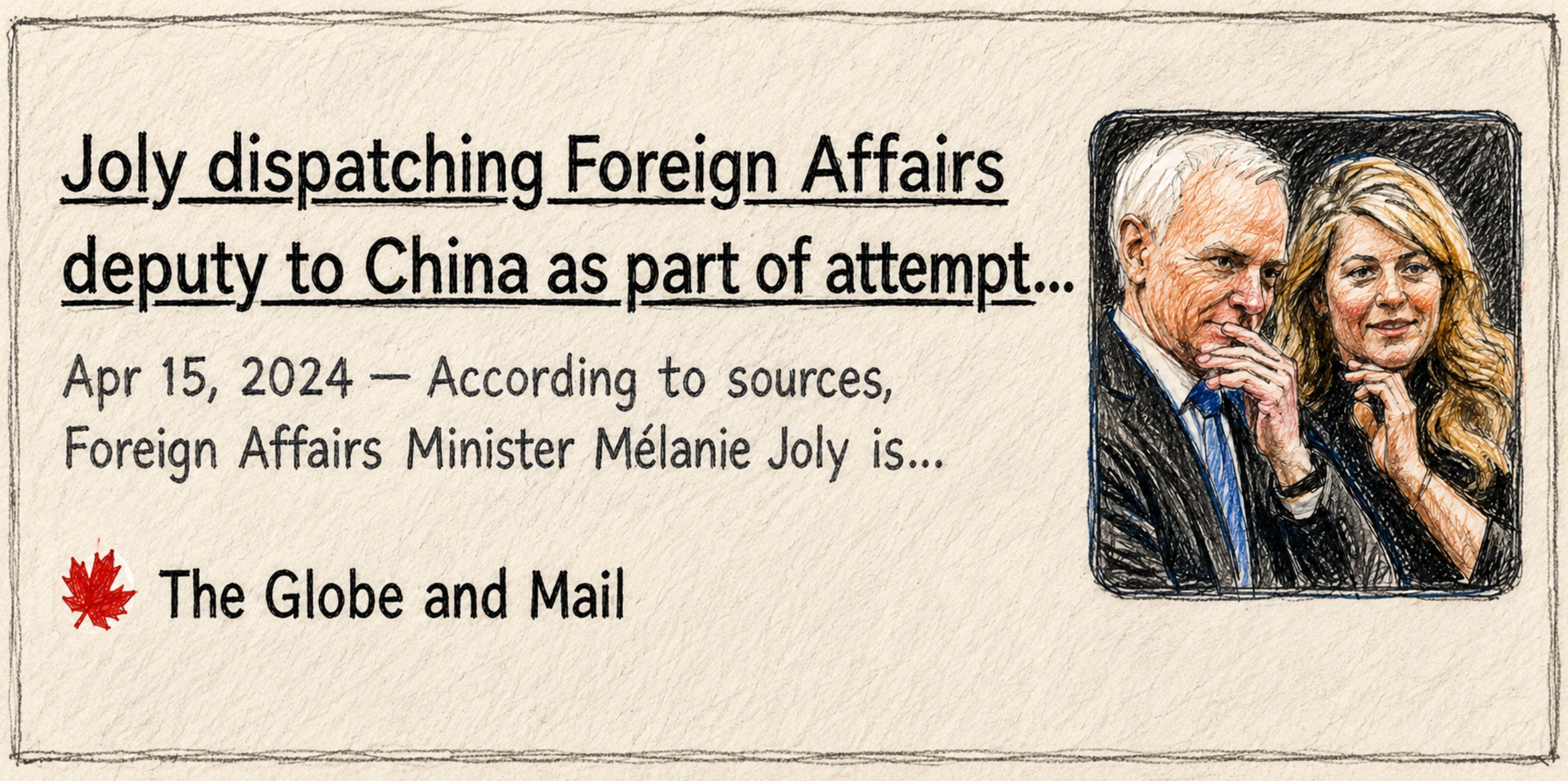
Prior to that, in April 2024, Joly dispatched Morrison himself to Beijing, where the deputy minister met China's Executive Vice Foreign Minister Ma Zhaoxu — a visit that, according to the two governments' own accounts, renewed the Canada-China Scholars' Exchange Program and advanced what Ottawa called "constructive dialogue" with Beijing.
The Bureau has previously reported that in April 2018, Joly led a trade delegation of more than 30 companies to China arranged by tycoon Zhang Bin and the China Cultural Industry Association — an entity tied to the People’s Liberation Army, and central to the scandal of a massive donation to the Trudeau family foundation that a United States congressional report, citing reported Canadian intelligence intercepts, described as directed and reimbursed by a Chinese consular official.
Well before Carney’s government began its 2026 re-engagement with Beijing, in other words, the two officials atop Canada’s foreign ministry were building bilateral ties.
In June 2023, The Bureau published an investigation based on exclusive access to a secret June 2019 “Draft Final Report” by the National Security and Intelligence Committee of Parliamentarians, the intelligence oversight body of Canada’s Parliament, drawing on more than 4,300 pages of intelligence records and secret testimony from the director of CSIS.
That review concluded Ottawa’s decision-makers valued trade and political objectives over security concerns, and put the calculation in plain language: “Foreign policy considerations, which are often clear and immediate (e.g. India will not import pulses [seeds] from Canada), will take precedence over considerations of domestic harms, which are often vague and long-term (e.g. China’s activities undermine free speech).”
The same document recorded the intelligence service’s repeated warnings that Beijing “views Canada as a permissive environment within which to pursue its interference activities.”
It documented that the Trudeau government went further than inaction — advising the service to scale down sensitive threat-reduction interventions, in that case targeting Indian diplomats’ covert networks in Vancouver, rather than upset a trade partner ahead of a prime ministerial visit.
And it recorded the evidence supporting a recommendation for new Canadian laws, including a foreign agent registry. The registry that opened its doors this morning, in other words, was on Parliament’s own intelligence review desk seven years ago, while the government that received it kept choosing trade.
And on the very day the registry opened, its first commissioner told CBC News these words, which might surprise Canadians.
“It’s not going to solve foreign interference in Canada,” Boegman said, explaining that the transparency model and the new laws are “not designed necessarily to identify covert foreign influence ... or acts of transnational repression and things like that.” Actual interference, he said, is a job for the RCMP and Canada’s national security agencies: “If it’s something that’s outside of our mandate, we’ll be passing that off to one of the national security partners.”
Consider where any referrals from Boegman will land.
Canada’s foreign interference inquiry heard RCMP Deputy Commissioner Mark Flynn describe a “clear nexus” between organized crime and hostile state activity in Canada — and heard that a proposed investigation into a money-laundering network connected to organized crime and Chinese foreign-interference activity was declined by the RCMP because it would have “no significant impact” on the larger problem.
So let’s look slowly at the problem, as it stands this morning: the new registry passes Chinese interference concerns to the police; the police have deprioritized the very Chinese networks where crime and state activity meet; and Global Affairs Canada, the ministry that ran Ottawa’s trade-first engagement with Beijing even before Mark Carney took over from Justin Trudeau as Canada’s leader, held the say on clearing a Canadian into the Atlantic alliance’s military command — with the RCMP addressing the case only at Global Affairs Canada’s request.
Recall what CSIS — the agency mandated to vet the NATO intern, but whose reporting was subordinate to Global Affairs Canada’s judgments — warned Canada’s government secretly, eight years ago.
“CSIS assesses that, absent any public or private admonitions from [Government of Canada] decision makers, these threat activities are unlikely to diminish.” Absent other evidence, it appears Mark Carney’s Canada is as permissive as the one that memo described — and perhaps more so.


