Surrey Mayor Presses Carney to Appoint an “Extortion Czar” as Canada’s Mafia Shooting Wave Spreads
Call follows The Bureau’s reporting that transnational networks are exploiting international students and immigration loopholes.
OTTAWA — Following The Bureau’s investigation into Canada’s Indian mafia-linked extortion crisis, Surrey Mayor Brenda Locke is urging Mark Carney’s government to appoint an “Extortion Czar” to coordinate a national response to what she calls a rapidly escalating wave of violence that has spread beyond British Columbia and is now “approaching 1,500” cases across Canada since 2023.
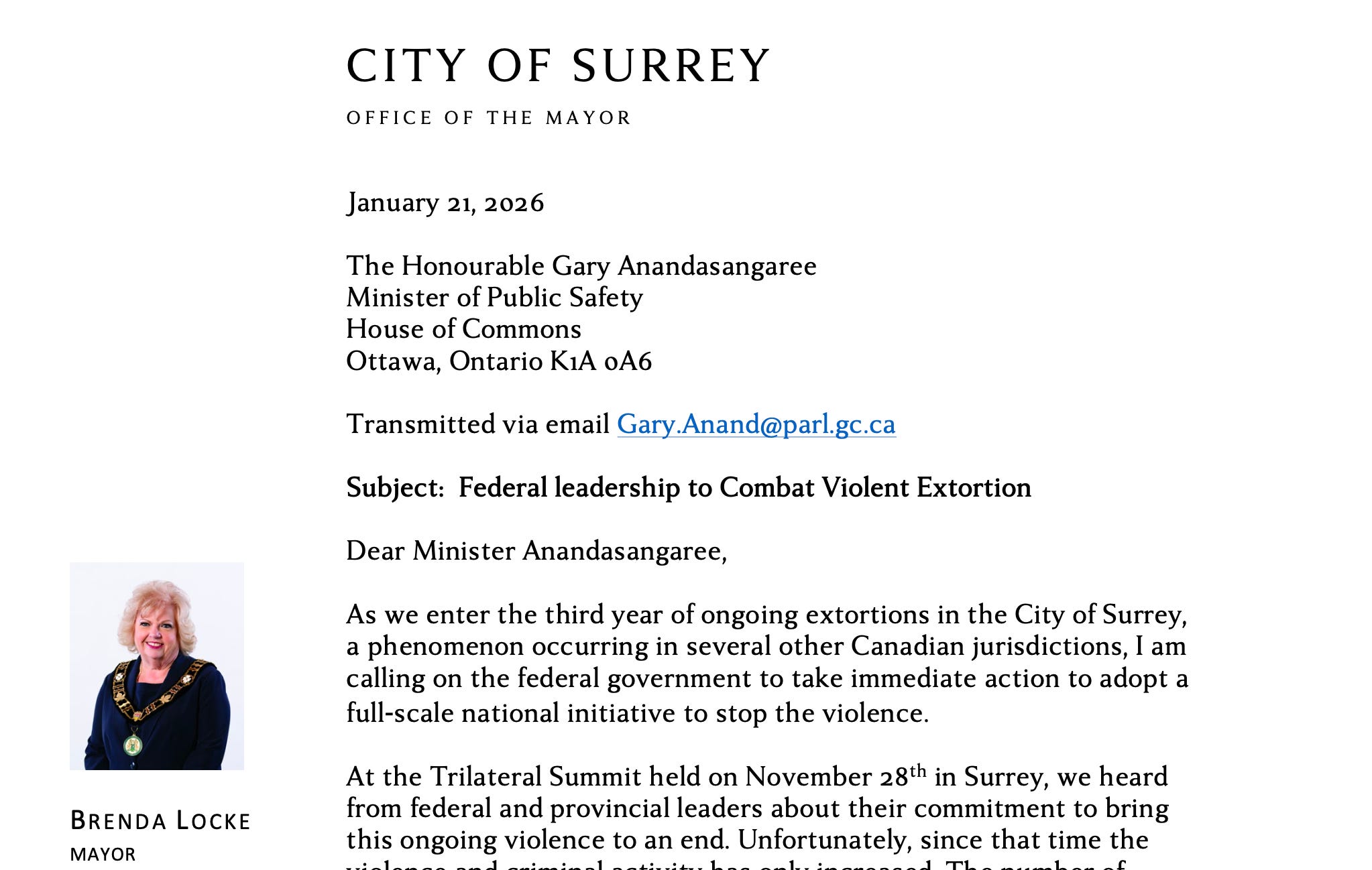
“As we enter the third year of ongoing extortions in the City of Surrey, a phenomenon occurring in several other Canadian jurisdictions, I am calling on the federal government to take immediate action to adopt a full-scale national initiative to stop the violence,” Locke wrote in the letter to Public Safety Minister Gary Anandasangaree, obtained by The Bureau.
Locke’s January 21 letter follows explosive comments yesterday from British Columbia Premier David Eby, who said the senior RCMP officer leading B.C.’s anti-extortion task force should step aside if he cannot demonstrate urgency in the fight.
Locke, mayor of the west coast city of 700,000, a densely South Asian-populated diaspora and Canada’s most visible epicenter of the extortion shootings now spilling into other cities including Toronto, Edmonton, and Winnipeg, argued the crime spree is exposing “legislative gaps, barriers to the gathering of evidence, siloed government entities, and very real challenges stemming from our immigration and citizenship processes.”
Locke’s appeal to Ottawa follows The Bureau’s reporting — based on accounts from inside British Columbia’s multi-agency anti-extortion task force — that warned federal agencies lack the capacity to contain an ecosystem of intimidation and violence as it metastasizes through shady immigration consultants and language and vocational schools that harvest fees from international students seeking citizenship.
In that reporting, a government investigator tied to the B.C. task force described a system overwhelmed by sophisticated organized crime that is exploiting immigration volumes that spiraled out of control.
“We just have no capacity to police this, and now we’re just living it out on the streets every day in Surrey and in Brampton,” the investigator said.
The Indian mafia networks that allegedly task young men on student visas to join extortion shootings, a national security threat the RCMP has broadly linked to Indian hostile state activity targeting the Sikh community in Canada, are operating with impunity partly due to Canada’s weak laws and judicial rules, the source added.
“We got 47,175 undocumented students that came in here under the student visa program, and they’re missing in Canada,” the source said. “And in that pool of missing students, we know that we’ve had people that have been coerced into—or have been brought into Canada—to do some of this national security stuff that Canadians are reading about.”
In her letter, Locke also warned that despite repeated political commitments from Ottawa, “the violence and criminal activity has only increased,” and argued that police agencies “are doing their best but they can’t solve this problem alone.”
Locke’s core pitch to Anandasangaree is that Ottawa needs a single national lead with the authority to force coordination across jurisdictions — and to map, in plain terms, how extortion networks are exploiting weak seams in Canada’s systems.
She argues the proposed “Commissioner for Extortion Violence Against Canadians” should “immediately bring together police, experts, governments and community leaders” to address the causes of the violence and drive solutions.
The commissioner, Locke says, should “be empowered to work with all relevant parties across federal, provincial and municipal governments” to “examine, identify, analyze and report on the pathways offenders are using to victimize Canadians.”
Crucially, Locke frames the problem as broader than policing. The mandate, she writes, should “deconstruct any weak links in our criminal, immigration, and citizenship systems,” extending into provincial processes she suggests are being exploited — “driver’s licensing, post-secondary enrollment and attendance, institution accreditation and work programs.”
That argument aligns with The Bureau’s recent reporting from sources in government, and privy to findings from B.C.’s multi-agency anti-extortion task force, which described the crisis as being driven by transnational organized crime exploiting Canada’s immigration and international-student ecosystem at industrial scale — through designated learning institutes, immigration consultant storefronts, document fraud, and the coercion of vulnerable newcomers into intimidation and shooting squads — while enforcement bodies struggle with sheer volume.
For example, documents that are critical for immigration and vocational approvals are being forged and sold by Indian mafia networks for up to $45,000, a key source asserted.
The Bureau’s reporting also highlighted the scale of the capacity challenge described by government sources and public data: tens of thousands of “missing” international students (47,175) feeding an underground workforce vulnerable to coercion; an immigration system strained by record inflows (471,808 permanent residents admitted in 2023, following Ottawa’s prior plan to reach 500,000 in 2025 and 2026); and a refugee-claims backlog (295,819 pending as of Sept. 30, 2025) creating years-long delays and a potential parallel channel for fraud — alongside claims from task-force sources that some extortion suspects facing removal have filed refugee claims that can stall deportations.
That “capacity” theme surfaced on the record at the House of Commons Public Safety committee on Nov. 20, 2025, when Conservative MP Frank Caputo pressed witnesses on the federal government’s pledge to hire 1,000 new Canada Border Services Agency officers — arguing that if the agency is losing roughly 500 to 600 officers annually to attrition, headline hiring announcements risk producing only marginal net growth. Mark Weber, national president of the Customs and Immigration Union, agreed with the basic math and underscored the training bottleneck.
Locke’s letter argues that Ottawa must now match that crisis framing with a single, empowered national strategy.


Canada does not need czars, we need accountability , responsibility and follow through that leads to permanent elimination of this kind of crime.
Because a Drug/Border Czar for Canada worked so well. 🤨
They will do anything but address what needs to be addressed.