

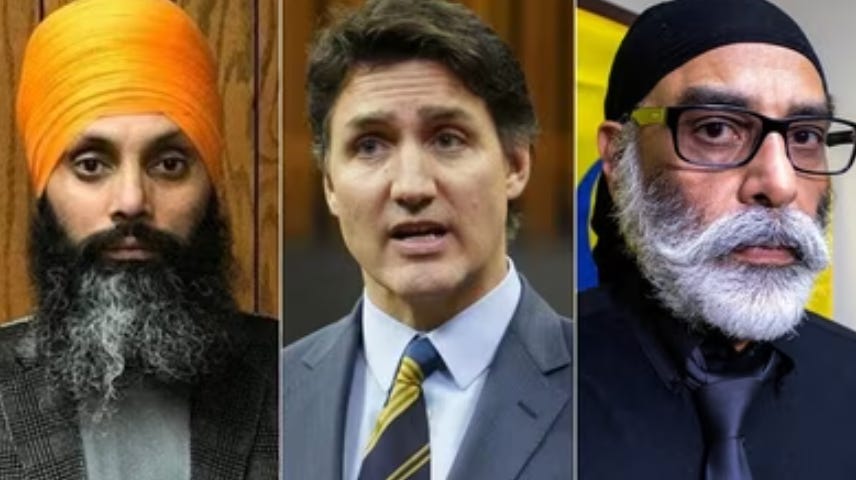
OTTAWA — Less than three weeks after the FBI added a fugitive accused of ordering the assassination of Hardeep Singh Nijjar in Surrey, British Columbia, to its Ten Most Wanted Fugitives list, another Sikh separatist leader tied to the Nijjar case and identified as the target of a U.S. murder-for-hire plot says agents have warned him of a threat to his life ahead of a Khalistan Referendum vote in Edmonton on Sunday.
Gurpatwant Singh Pannun, general counsel for Sikhs For Justice, said in a statement to The Bureau that the agents came to see him in person.
“On October 15, FBI agents personally visited me and warned me of what they described as an imminent threat to my life, particularly concerning my planned travel to Edmonton, Canada, for the October 18 Khalistan Referendum,” Pannun said. “The agents confirmed that the FBI was actively investigating leads but did not disclose the identities of those behind the threat.”
It is the second such warning Pannun has disclosed in two months.
In August he told the Associated Press that FBI agents had visited him, advised him not to travel until the threat was resolved, and asked him to notify the agency in advance of any trips. Pannun, a dual U.S.-Canadian citizen, said at the time that Canadian police had issued similar warnings to Nijjar in the weeks before Nijjar was shot dead outside a Surrey Sikh temple on June 18, 2023.
The two men were associates, and a federal case in Manhattan links their cases.
Prosecutors allege that an Indian government employee, later identified in a superseding indictment as Vikash Yadav, recruited Nikhil Gupta, an Indian narco-trafficker, in May 2023 to arrange Pannun’s murder in New York. The hitman Gupta hired was an undercover agent of the Drug Enforcement Administration.
Hours after Nijjar was killed, according to the indictment, Gupta’s handler sent him a video clip of Nijjar’s body slumped in his vehicle. About an hour later, the handler sent the street address of Pannun’s residence in New York. Gupta then urged that the New York killing be carried out at once. “He [Pannun] will be more cautious, because in Canada, his colleague is down,” Gupta allegedly said.
Gupta pleaded guilty in February to murder-for-hire, conspiracy to commit murder-for-hire and conspiracy to commit money laundering. His sentencing was moved to November 20 after Pannun, identified by his counsel as the intended victim, asked to take part. The Indian government has rejected the accusation that one of its officials directed the plot, and it considers Pannun a terrorist.
“The subsequent indictment identified Vikash Yadav, an Indian government employee associated with RAW (Indian security agency), as the alleged director of the assassination conspiracy,” Pannun said. “Yadav remains wanted by the FBI.”
On September 28, the FBI added Satinderjeet Singh, known as Goldy Brar, to its Ten Most Wanted Fugitives list and offered a $1 million reward for his capture. Patrick Grandy, assistant director in charge of the FBI’s Los Angeles field office, said Brar and imprisoned gang leader Lawrence Bishnoi are charged with ordering Nijjar’s assassination. The indictment, unsealed July 7 as part of a years-long investigation known as Operation Hardball, makes no reference to former prime minister Justin Trudeau’s September 2023 allegation that Indian government agents were behind the killing.
Operation Hardball also exposed the alleged reach of Indian transnational crime networks operating across Canada and the United States. Investigators described gangs trafficking cartel-sourced narcotics across the northern border, while the Bishnoi–Brar network allegedly terrorized members of the Indian diaspora through extortion, threats and targeted killings. The investigation also uncovered allegations of cocaine thefts from Mexican cartels in California, corruption involving Canada Border Services Agency personnel, and Vancouver-based gangsters who told an undercover agent they aspired to become a new “cartel.”
Pannun argues that the alleged political assassination plots and broader transnational organized crime cases cannot be separated.
“The Bishnoi–Brar criminal network must be examined in the context of Indian intelligence operations,” he said. “In my assessment, criminal networks can serve as the visible operational face of assassination plots while the intelligence officials who direct and facilitate them remain concealed.”
He said his belief that the Indian government is behind the latest threat rests on “the previous DOJ indictments, the continuing threats, and repeated FBI and RCMP warnings.” He acknowledged that the FBI has not told him who is responsible.
“The October 18 Khalistan Referendum in Edmonton will proceed as scheduled,” Pannun said. “Threats to my life will not silence the peaceful and democratic campaign for Sikh self-determination.”
The latest warning comes amid a longstanding intelligence and diplomatic dilemma that Canadian authorities have struggled to resolve.
As The Bureau exclusively reported in June 2023, a secret 2019 draft report from Parliament’s National Security and Intelligence Committee of Parliamentarians (NSICOP) revealed that CSIS had repeatedly warned Ottawa about Indian intelligence operations targeting Sikh diaspora communities, while Canadian officials weighed security concerns against trade and diplomatic priorities.
The report identified India, China and Russia as Canada’s most prolific foreign interference threats, documenting allegations that Indian diplomats cultivated politicians, recruited community informants and pressured dissidents through visa restrictions. It also identified New Delhi’s competing security narrative: India believes Canada has failed to adequately confront Sikh extremism, a grievance rooted partly in the 1985 Air India bombing, planned and executed in Canada. The committee warned that immediate foreign policy considerations could outweigh less visible domestic security harms. The Bureau also reported that Ottawa had advised CSIS to scale back sensitive threat-reduction activities involving Indian diplomats and Canadian politicians.
Those tensions erupted publicly after Nijjar’s June 2023 assassination, when Trudeau accused Indian government agents of involvement—an allegation New Delhi denied. The subsequent U.S. indictment of Bishnoi and Brar identifies alleged criminal organizers of the killing without alleging Indian government involvement.
The unresolved question is whether Prime Minister Mark Carney’s government can confront credible threats to Sikh activists while addressing legitimate security concerns about violent extremism, without allowing diplomatic and economic considerations to compromise either obligation.
Questions also loom over the RCMP’s capacity to investigate these threats—and the reliability of its cooperation with American law enforcement.
In September, The Bureau exclusively reported that FBI personnel stationed at U.S. diplomatic posts in Canada had been ordered home amid a controversy over CBC News guidance instructing journalists not to describe the September 11, 2001, attacks as terrorism without attribution to experts.
Days later, The New York Times confirmed that FBI Director Kash Patel had temporarily suspended some cooperation with the RCMP, reporting new details about canceled meetings and disrupted communications between the agencies. The interruption was brief, but the episode underscored the vulnerability of a cross-border law enforcement partnership central to investigating terrorism, organized crime and foreign interference.
Hey, Justin..Thanks ALOT for dropping this crap on our doorstep..(be sure you pass that along to your dad when you join him)