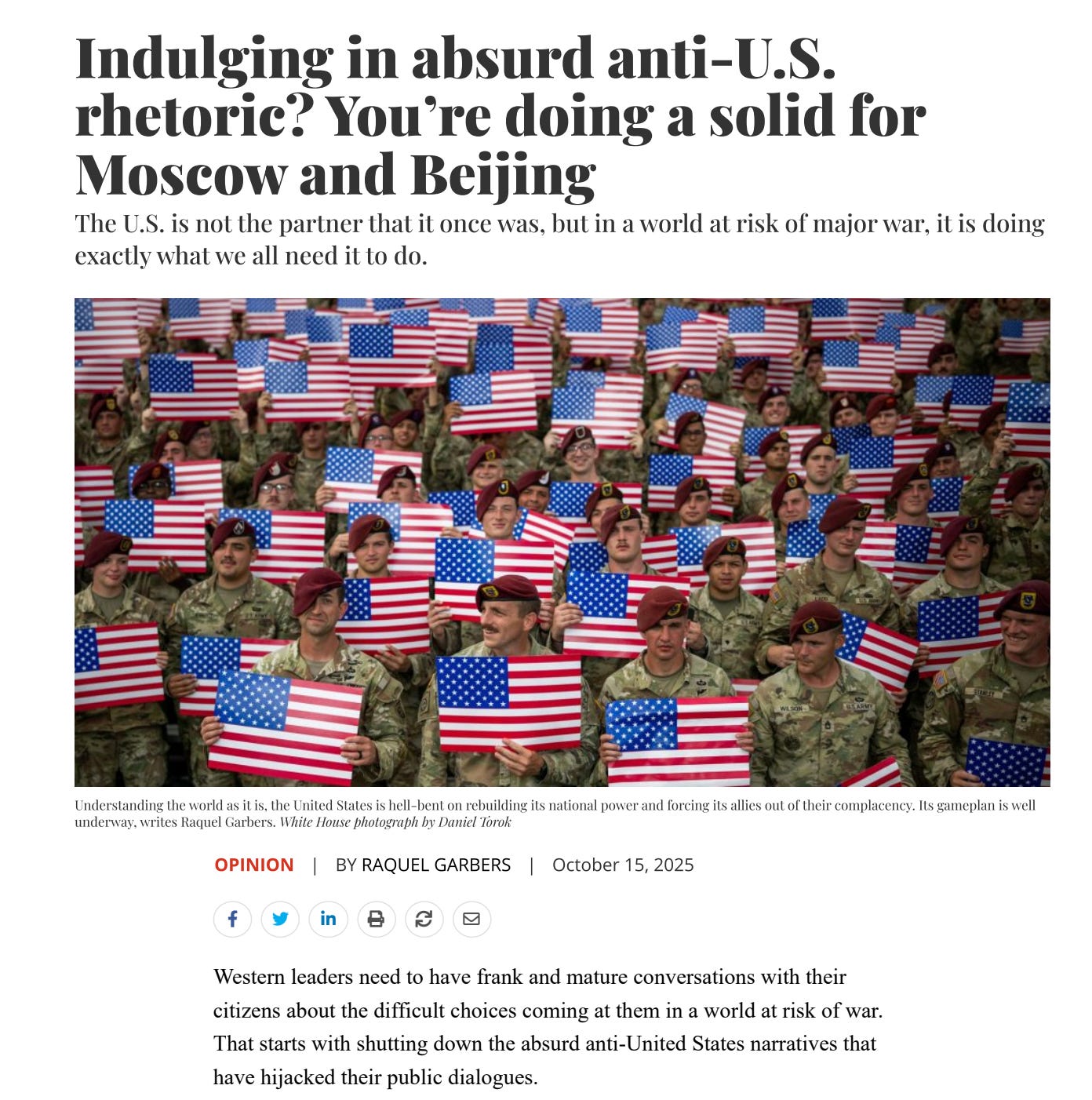
Senior Defence Official's Firing Claim Casts a Newspaper Report on Her Op-Ed as a Flashpoint in Her Ouster
OTTAWA — An explosive wrongful-dismissal lawsuit that claims a senior defence official was fired after warning that Ottawa’s anti-American rhetoric was handing a gift to Canada’s real adversaries, China and Russia, casts an article by a veteran Ottawa newspaper reporter as a turning point in the government’s posture toward her — a characterization the reporter firmly rejects.
Raquel Garbers, the 57-year-old principal architect of Canada’s 2024 defence policy, alleges in a statement of claim that the Department of National Defence began to distance itself from her in the days after she published a provocative opinion piece, and that an October 20 article in the Ottawa Citizen, written by the paper’s longtime defence reporter David Pugliese, mischaracterized and distorted her position as “pro-US and pro-Trump” and helped expose her to a public backlash that preceded her firing.
Pugliese rejects that account.
“My article is factually correct and contains quotes from Garbers herself, both from her Hill Times piece as well as her appearance on a TV show,” he responded to The Bureau. He said he sought her comment before publishing — “I provided her with a detailed set of questions about her op-ed — and she declined to comment” — and that no objection reached him until the lawsuit. “Neither Garbers nor her legal representatives have ever reached out to say that the article mischaracterized or distorted her views, nor have they pointed out any factual inaccuracy in my reporting,” he said.
In her Hill Times op-ed, Garbers argued that the Trump administration’s controversial new tariff regime was driven by geopolitical risk.
The Western world, she wrote, was at last confronting hard truths: that the United States was no longer the unrivalled superpower it had been, and that China had risen to near-peer status in both military and economic terms. Were war to break out in the Indo-Pacific, she argued, there was no guarantee the United States would prevail; were conflict to erupt there and in the Euro-Atlantic at once, she warned, nuclear weapons might be all that stood between the allies and their aggressors.
The United States, in her account, was now “hell-bent on rebuilding its national power and forcing its allies out of their complacency.”
She framed the previous spring’s tariff offensive as the opening move in a deliberate strategic reset meant to rebuild American industrial and trade power, and read Washington’s pressure on allies to spend more on defence as a response to hostile states preparing for war against democracies.
The narratives then dominating Western debate — that America was just like China, or that it was abandoning its allies — she dismissed as absurd, arguing it was Beijing, not Washington, waging cyberattacks, espionage and sabotage against the West. The real danger, she concluded, was that anti-American rhetoric had become “the own-goal that Moscow and Beijing are hoping we’ll score.”
Garbers’s case has unsettled Ottawa’s senior ranks, according to her legal team. She spent 28 years in the public service before her dismissal, and her lawyer, Kathryn Marshall, has framed the suit around a single question: who, inside a government turning toward Beijing and away from Washington, ordered her removed.
On October 15, Garbers published an opinion piece in the Hill Times warning that anti-American rhetoric was splitting the Western alliance and doing the work of Moscow and Beijing. Two days later, Foreign Affairs Minister Anita Anand, in Beijing, signaled that Canada now viewed China as a strategic partner. On November 13, the claim says, a senior assistant deputy minister told Garbers her position was being eliminated. She is seeking about $2 million, the bulk of it in moral and punitive damages tied to what the claim calls the bad-faith manner of her firing. The government has not filed a defence.
The portion of the claim concerning Pugliese states that on October 16, the day after the op-ed, he sought an interview with Garbers through the think tank where she was on secondment, and that in doing so he raised questions about her employment status — noting, the claim says, that the department appeared reluctant to confirm whether she remained employed. Four days later, it says, her photograph appeared on the front page of the Ottawa Citizen beneath Pugliese’s article.
The claim alleges that the article “mischaracterized and distorted” the substance of her op-ed, “falsely portrayed” her as advancing a pro-American and pro-Trump position, and cast her as a voice of institutional dissent — suggesting, it says, that senior leadership inside the department and the Canadian Armed Forces opposed and were actively undermining the prime minister’s strategic decisions on the United States and China. The article, the claim continues, emphasized her standing as a senior defence official and reported that the government’s pivot away from Washington was “facing pushback in the Canadian Forces and DND.” The department’s distancing, the pleading argues, created a false impression. None of these allegations has been tested in court.
The claim also states, in Garbers’s own telling, that Pugliese has a long and at times adversarial history with National Defence, stating that he has publicly asserted the department took steps to interfere with or curtail his reporting.
Pugliese is among Canada’s most experienced defence journalists, with a record of accountability reporting on the military and the department. His October 20 article, which remains publicly available, quoted Garbers’s op-ed and a televised interview, reported that she had declined to comment, and carried a departmental spokesperson’s statement noting that she wrote in her capacity as a visiting executive at a think tank, not in her former role.
In an interview, Garbers’s legal team argued that the case could be larger than the firing of one senior defence-policy architect who had countered the messaging emanating from Prime Minister Mark Carney’s new position on Beijing.
Carney is not named in the statement of claim.
But Garbers’s Hill Times argument cuts directly against the rhetoric the prime minister has embraced — through his election campaign and since taking office, in his declaration that Canada’s old relationship with Washington “is over.”
Her op-ed placed the real threat in Beijing.
For decades, she wrote, authoritarian states “chiefly China” had worked to shift the balance of power away from the United States, with an endgame of imposing their will “without the risk of being checked by the Americans.” Security and defence professionals, she argued, had warned for more than a decade that the West would end up scrambling to defend itself, “hobbled by the effects of China’s quiet war against them.” The remedy, she wrote, was for Western leaders to hold “honest conversations with their citizens” — exchanges she said had instead been “overtaken by the narrative that the U.S. is ‘just like China,’ and that it is abandoning its allies.”
For Marshall, that question now hangs over Ottawa’s public service.
“The question is, is the Carney government trying to create a public service where everyone has to just agree with him, and what he’s doing?”


Very interesting, lots of questions to be answered can’t wait to see what the conclusion will be as I personally believe that the Carney government has left us totally vulnerable
A sad statement of Canada’s current state of affairs. A faint shadow of its past.